Ventricular fibrillation (v-fib) quiz review for nursing students!
This quiz will test your knowledge on how to identify ventricular fibrillation (v-fib), the causes of this heart rhythm, and the treatment.
Don’t forget to check out the lecture on v-fib and the access the v-fib notes.
Ventricular Fibrillation (V-fib) ECG Heart Rhythm Quiz Questions
ECG/EKG Study Guide and Workbook for Nursing Students
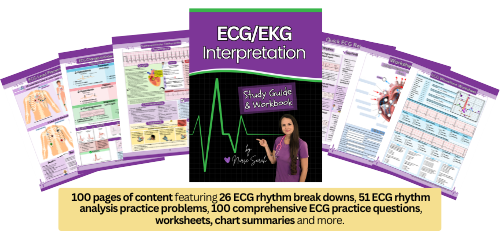
“ECG/EKG Interpretation Study Guide and Workbook by Nurse Sarah”. This book contain 100 pages of content featuring 26 ECG rhythm break downs, 51 ECG rhythm analysis practice problems, 100 comprehensive ECG practice questions, worksheets, chart summaries, and more.
You can get an eBook version here: “Nurse Sarah ECG Book” or a physical copy here: “ECG/EKG Interpretation Study Guide by Nurse Sarah“.
Also, check out the other ECG quizzes:
Second-Degree Type I (Mobitz I or Wenckebach)
Second-Degree Type II (Mobitz II)
Third-Degree (Complete) Heart Block
Pulseless Electrical Activity (PEA)
ECG Interpretation Comprehensive
Ventricular Fibrillation (V-fib) ECG/EKG Quiz Questions
1. Select the options below that describe the rhythm above:
A. Irregular atrial rate
B. Regular ventricular rate
C. Fine fibrillatory waves
D. Coarse fibrillatory waves
E. Torsades de Pointes
G. Asystole
H. Ventricular tachycardia
I. Ventricular fibrillation
The answers are D and I. The rhythm above is coarse ventricular fibrillation (V-fib). Due to the nature of the rhythm, you can NOT assess atrial/ventricular rate or rhythm, p waves, QRS complex, or t wave. It is coarse ventricular fibrillation because note the presentation of the waveform …the amplitude is high. Fine v-fib the amplitude is low and almost looks flat like asystole.
2. TRUE or FALSE: Ventricular fibrillation (V-fib) is a lethal rhythm that results in the quivering of the ventricles which leads to a rapid fall in cardiac output.
The answer is TRUE.
3. TRUE or FALSE: A patient experiencing fine ventricular fibrillation has a better chance of being revived than a patient in coarse ventricular fibrillation.
The answer is FALSE: Fine ventricular fibrillation has a lower chance of successful resuscitation than coarse ventricular fibrillation. This is because the electrical activity in the heart is almost similar to asystole, which is hard to revive. Remember asystole is a flat-line on the ECG.
4. The nurse sees the rhythm above on the ECG. The patient is unresponsive and has no pulse. The nurse calls a code blue and takes what step next?
A. Prepare for defibrillation
B. Administer Epinephrine
C. Start high-quality CPR
D. Notify the physician
The answer is C. The nurse would want to immediately start high-quality CPR and continue this until help arrives.
5. What medications can be administered to a patient experiencing Ventricular fibrillation (V-fib) during a code resuscitation attempt? Select all that apply:
A. Atropine
B. Epinephrine
C. Amiodarone
D. Lidocaine
The answers are B, C, D. Epinephrine, Amiodarone, and Lidocaine can be administered during a code for the treatment of v-fib…with Epinephrine being the first choice.
6. Your patient is in ventricular fibrillation (v-fib). You’ve started CPR and the airway is supported. A rhythm checked in performed and shows the patient is still in ventricular fibrillation. The next action the code team will take in addition to performing high-quality CPR is to?
A. Administer Atropine
B. Defibrillate
C. Administer Epinephrine
D. Synchronized cardiovert
The answer is B. Ventricular fibrillation is a shockable rhythm. The team will continue CPR until the machine is ready to deliver a shock (hence defibrillate). Once the machine is ready for defibrillation, the team will shout clear (all members will remove themselves from the patient) and a shock will be delivered. Then CPR will be resumed.
Don’t forget to tell your friends about this quiz by sharing it your Facebook, Twitter, and other social media. You can also take more fun nursing quizzes.
*Disclaimer: While we do our best to provide students with accurate and in-depth study quizzes, this quiz/test is for educational and entertainment purposes only. Please refer to the latest NCLEX review books for the latest updates in nursing. This quiz is copyright RegisteredNurseRn.com. Please do not copy this quiz directly; however, please feel free to share a link to this page with students, friends, and others.