Second-Degree type I (Mobitz I or Wenckebach) AV heart block quiz review for nursing students!
This quiz will test your knowledge on how to identify a Second-Degree type I heart block, the causes of this heart rhythm, and the treatment.
There are four types of heart blocks a nurse should be familiar with. This includes a First-Degree, Second-Degree Type I (Mobitz type I or Wenckebach), Second-Degree Type II (Mobitz type II), and Third-Degree (Complete Heart Block).
Also check out the other heart block quizzes:
Second-Degree Type II (Mobitz II)
Third-Degree (Complete Heart Block)
Ventricular Tachycardia (V-tach)
Don’t forget to watch the lecture on Second-Degree type I heart blocks and review the notes before taking this quiz.
Second-Degree Type I (Mobitz I Wenckebach) Heart Block Quiz
ECG/EKG Study Guide and Workbook for Nursing Students
“ECG/EKG Interpretation Study Guide and Workbook by Nurse Sarah”. This book contain 100 pages of content featuring 26 ECG rhythm break downs, 51 ECG rhythm analysis practice problems, 100 comprehensive ECG practice questions, worksheets, chart summaries, and more.
You can get an eBook version here: “Nurse Sarah ECG Book” or a physical copy here: “ECG/EKG Interpretation Study Guide by Nurse Sarah“.
Second-Degree type I Heart Block Quiz
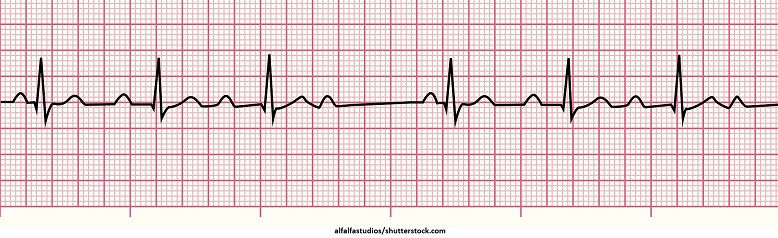
1. Select all the options below that describe the heart rhythm above:
A. PR Interval <0.20 seconds throughout the rhythm
B. Atrial and ventricular rhythm regular
C. Atrial rate is faster than the ventricular rate
D. Normal p waves
E. Gradually lengthening PR Intervals
F. Dropped QRS complexes
G. QRS <0.12 seconds
H. Second-Degree type II (Mobitz II)
I. Second Degree type I (Mobitz I or Wenckebach)
The answers are: C, D, E, F, G, and I. This rhythm is a Second Degree type I (Mobitz I or Wenckebach). It features: an atrial rhythm that is regular BUT an IRREGULAR ventricular rhythm, the atrial rate is faster than the ventricular rate (this is because a QRS complex is missing), the p waves are normal, there is gradually lengthening PR intervals with dropped QRS complexes, and the QRS complexes measure less than 0.12 seconds.
2. True or False: A hallmark finding in a Second-Degree type I (Mobitz I or Wenckebach) heart block is that the PR interval will remain constant throughout the rhythm but there will be a dropped QRS complex after a p wave.
True
False
The answer is FALSE. This describes a Second-Degree type II heart block. A Second-Degree type I (Mobitz I or Wenckebach) occurs when the PR interval follows a pattern where they gradually lengthen (so the p wave is getting further and further away from the QRS complex), and then all of the sudden there is a p wave without the QRS complex. Then this cycle will repeat itself again.
3. In Second-Degree type I (Mobitz I or Wenckebach) heart block why is the ventricular rate slower than the atrial rate?
A. The atrial rate is faster than the ventricular rate because of the shorten PR intervals.
B. The constant PR intervals decrease the rate of conduction to the AV node which slows down the ventricular rate.
C. The ventricular rate is slower than the atrial rate because at times the electrical signal isn’t able to travel down from the atria to the ventricles, which leads to a dropped QRS complex.
D. The SA node is firing too slowly and this affects how the AV node stimulates the ventricles to contract.
The answer is C. The ventricular rate is slower than the atrial rate because at times the electrical signal isn’t able to travel down from the atria to the ventricles, which leads to a dropped QRS complex.
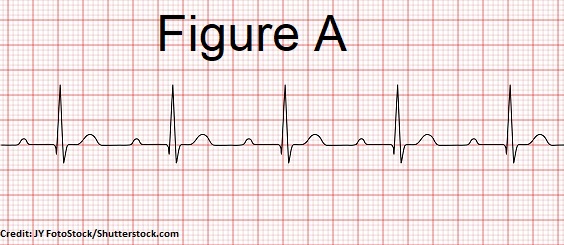
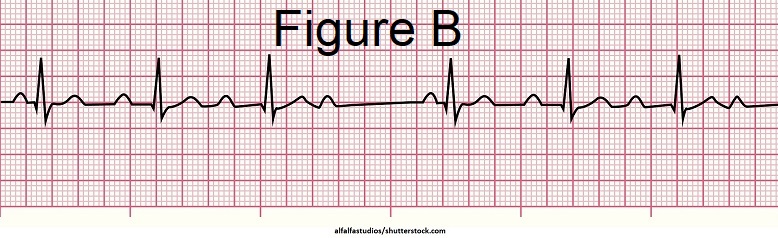
4. Which rhythm above illustrates a Second-Degree type I (Mobitz I or Wenckebach) heart block?
A. Figure A
B. Figure B
The answer is B: Figure B
5. Your patient reports they do not feel well and feels very weak. You assess the patient’s vital signs. The patient’s blood pressure is 78/52 and heart rate is irregular and weak. The patient appears clammy and pale. You note a Second-Degree type I heart block on the ECG. What steps should the nurse take? Select all that apply:
A. Activate the emergency response system
B. Prepare Atropine
C. Prepare for Synchronized Conversion
D. Prepare temporary pacing pads and monitor
E. Assess patient’s current medications
F. Start chest compressions
The answers are A, B, D, and E. This patient is showing signs and symptoms of decreased cardiac output due to this heart block. Therefore, the patient’s heart is not perfusing the body and steps need to be taken to help this patient. Treatment for symptomatic Second-Degree type I includes activating the emergency response system, atropine, and temporary pacing. In addition, the nurse should assess the patient’s medications for any meds that can cause a heart block like calcium channel blockers, Digoxin, or beta blockers.
6. What are potential causes of a Second-Degree Type I (Mobitz I or Wenckebach) Heart Block? Select all that apply:
A. An anterior wall myocardial infarction
B. Calcium channel blockers
C. Rheumatic fever
D. Beta Blockers
The answers are B, C, D. An active inferior (not anterior) wall MI can cause this type of heart block.
Don’t forget to tell your friends about this quiz by sharing it your Facebook, Twitter, and other social media. You can also take more fun nursing quizzes.
*Disclaimer: While we do our best to provide students with accurate and in-depth study quizzes, this quiz/test is for educational and entertainment purposes only. Please refer to the latest NCLEX review books for the latest updates in nursing. This quiz is copyright RegisteredNurseRn.com. Please do not copy this quiz directly; however, please feel free to share a link to this page with students, friends, and others.