When drawing blood from a patient, the blood is collected into specific tubes. These tubes contain different additives and are identified by different colors.
The tube used depends on the provider’s orders. Some patients may only need a couple of tubes, while others may require many different tubes.
It is important to follow the correct order of draw instead of placing tubes on randomly. This helps prevent cross-contamination of additives between tubes, which can affect test results.
Note: The order of draw may vary between labs and facilities. Always follow facility protocol.
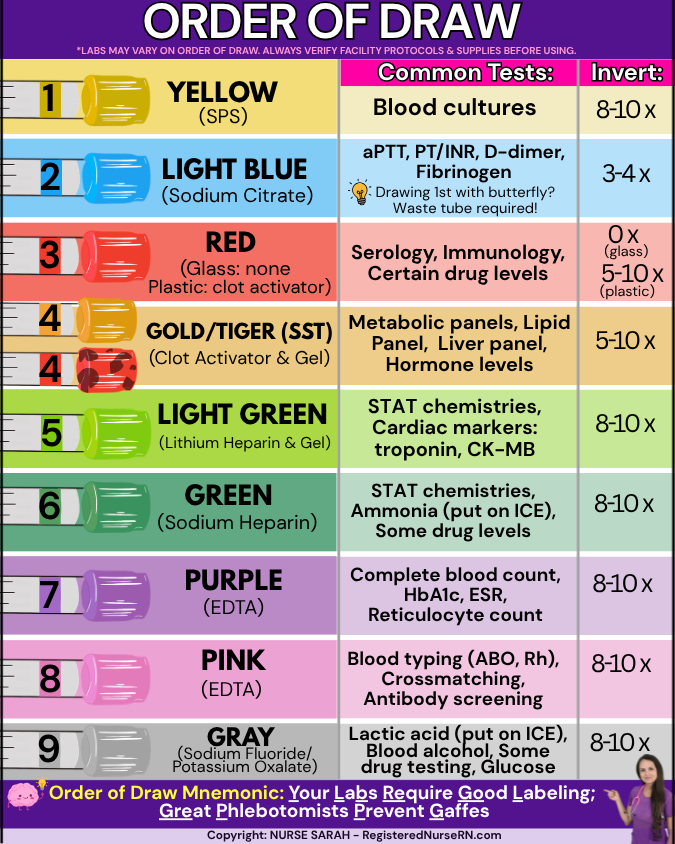
Order of Draw
Yellow Tube
- Additive: SPS (Sodium Polyanethol Sulfonate)
- Tests: Blood cultures
- Inversion Time: 8–10 inversions
- Notes: May also be collected in blood culture bottles
Light Blue Tube
- Additive: Sodium citrate
- Tests: aPTT, PT/INR, D-dimer, Fibrinogen
- Inversion Time: 3–4 inversions
- Important Note: If the light blue tube is the first tube drawn OR the only tube ordered, and a butterfly (winged blood collection set) is being used, a waste tube may be needed first. This is because air in the butterfly tubing can affect the precise blood-to-additive ratio required for the light blue tube. Facility protocols for waste tubes may vary. Always follow facility policy.
Red Tube
- Additive:
- Glass tube: no additive
- Plastic tube: clot activator
- Tests: Serology, Immunology, Certain drug levels
- Inversion Time:
- Glass tube: none
- Plastic tube: 5–10 inversions
Gold/Tiger Top Tube (SST)
- Additives: Clot activator, Gel
- Tests: Metabolic panels, Lipid panels, Liver panels, Hormone levels
- Inversion Time: 5–10 inversions
Light Green Tube
- Additives: Lithium heparin, Gel
- Tests: STAT chemistries, Cardiac markers, Troponin, CK-MB
- Inversion Time: 8–10 inversions
Green Tube
- Additive: Sodium heparin
- Tests: STAT chemistries, Ammonia, Drug levels
- Inversion Time: 8–10 inversions
- Important Note: Ammonia levels should be placed on ice after collection.
Lavender/Purple Tube
- Additive: EDTA
- Tests: CBC, Hemoglobin A1C, ESR (Erythrocyte Sedimentation Rate), Reticulocyte count
- Inversion Time: 8–10 inversions
Pink Tube
- Additive: EDTA
- Tests: Blood typing, Rh factor, Crossmatching, Antibody screening
- Inversion Time: 8–10 inversions
- Notes: Commonly referred to as the blood bank tube
Gray Tube
- Additives: Sodium fluoride, Potassium oxalate
- Tests: Lactic acid, Blood alcohol levels, Drug testing, Glucose
- Inversion Time: 8–10 inversions
- Important Note: Lactic acid levels should be placed on ice after collection.
Mnemonic for Lab Order of Draw
Your Labs Require Good Labeling. Great Phlebotomists Prevent Gaffs.
Pop Quiz
- Ordered Lab tubes: green (sodium heparin), light blue (sodium citrate), lavender/purple (EDTA)
- Using: butterfly collection set
What is the order of draw?
Answer: Waste tube, light blue (sodium citrate), green (sodium heparin), lavender/purple (EDTA)
Order of Draw Reference

Never forget the order of draw with this bright, easy-to-read “Order of Draw” mouse pad or poster, designed for phlebotomists, nurses, and students who want accurate lab information at a glance.
This functional reference displays each lab tube color in the correct order, including additives, common tests, required inversion times, and a memory mnemonic, keeping essential details right at your fingertips while you study, chart, or work.
Perfect for study desks, nursing stations, labs, classrooms, and offices, this reference reinforces accuracy, confidence, and best practice without interrupting your workflow.
Whether you’re learning, teaching, or practicing, this mouse pad turns essential lab knowledge into a clean, colorful, and functional reference that supports safe, accurate blood collection.
Available at: NurseSarah.com
You may be interested in: Order of Draw Phlebotomy Quiz