As a nurse you want to be familiar with different types of heart rhythms, especially life-threatening rhythms like ventricular fibrillation (v-fib).
Before reviewing these notes, don’t forget to check out the lecture on ventricular fibrillation (v-fib).
Ventricular fibrillation (v-fib) is a deadly rhythm that leads to death if not reversed and treated within minutes. This rhythm is causing the heart to not pump efficiently. Due to this, cardiac output drops significantly to a point where the patient can NOT survive. Instead of the ventricles thoroughly pumping blood out through the body, they are just quivering.
Characteristics and Criteria of Ventricular Fibrillation (V-fib)
This rhythm is fairly easy to identify. It is a chaotic, rapid rhythm that has no organization to it.

Instead, what you see are fibrillatory waves that can vary in size. These fibrillatory waves can be coarse or fine. In cases of fine ventricular fibrillation, the chances of a successful resuscitation are slim when compared to coarse fibrillation.
Coarse ventricular fibrillation has waves that are high in amplitude and really look similar to big squiggly lines on the ECG. While fine ventricular fibrillation has waves that are lower in amplitude to the point where they look almost flat (similar to asystole).

In addition, with this rhythm you can’t see p waves, QRS complexes, t-waves, PR intervals etc.
ECG/EKG Study Guide and Workbook for Nursing Students
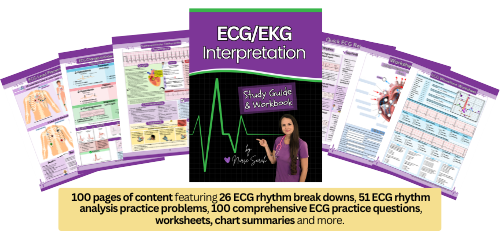
“ECG/EKG Interpretation Study Guide and Workbook by Nurse Sarah”. This book contain 100 pages of content featuring 26 ECG rhythm break downs, 51 ECG rhythm analysis practice problems, 100 comprehensive ECG practice questions, worksheets, chart summaries, and more.
You can get an eBook version here: “Nurse Sarah ECG Book” or a physical copy here: “ECG/EKG Interpretation Study Guide by Nurse Sarah“.
Causes of Ventricular Fibrillation (V-fib)
Heart attack, heart disease, electrolyte imbalance especially potassium levels either high or low, hypoxia, drug overdose etc.
Treatment of Ventricular Fibrillation (V-fib)
When this rhythm presents the patient will be unresponsive and have no pulse. The nurse wants to immediately activate the emergency response system (ex: call a code blue) and start CPR. When the code team arrives, ACLS protocol will be followed.
This includes rhythm checks. If ventricular fibrillation is present during the rhythm check, defibrillation will be administered. In addition, medications can be given like Epinephrine (first-choice) and other meds can like Amiodarone or Lidocaine. Other treatments include securing the airway.
If the patient is successfully resuscitated it may be necessary for the patient to receive an implanted ICD (cardioverter-defibrillator) to prevent further episodes (depending on the cause of the rhythm).
Now test your knowledge with this ventricular fibrillation (V-fib) Quiz.
References:
American Heart Association | Algorithms. (n.d.). Retrieved September 2, 2022, from https://cpr.heart.org/en/resuscitation-science/cpr-and-ecc-guidelines/algorithms#adult
Ludhwani D, Goyal A, Jagtap M. Ventricular Fibrillation. [Updated 2022 Aug 8]. In: StatPearls [Internet]. Treasure Island (FL): StatPearls Publishing; 2022 Jan-. Available from: https://www.ncbi.nlm.nih.gov/books/NBK537120/