Ventricular tachycardia (v-tach) quiz review for nursing students!
This quiz will test your knowledge on how to identify ventricular tachycardia (v-tach), the causes of this heart rhythm, and the treatment.
Ventricular Tachycardia (V-tach) ECG Heart Rhythm Quiz Questions
ECG/EKG Study Guide and Workbook for Nursing Students

“ECG/EKG Interpretation Study Guide and Workbook by Nurse Sarah”. This book contain 100 pages of content featuring 26 ECG rhythm break downs, 51 ECG rhythm analysis practice problems, 100 comprehensive ECG practice questions, worksheets, chart summaries, and more.
You can get an eBook version here: “Nurse Sarah ECG Book” or a physical copy here: “ECG/EKG Interpretation Study Guide by Nurse Sarah“.
Also, check out the other ECG quizzes and lecture notes:
Second-Degree Type I (Mobitz I or Wenckebach)
Second-Degree Type II (Mobitz II)
Third-Degree (Complete) Heart Block
Pulseless Electrical Activity (PEA)
ECG Interpretation Comprehensive
Ventricular Tachycardia (V-tach) Quiz
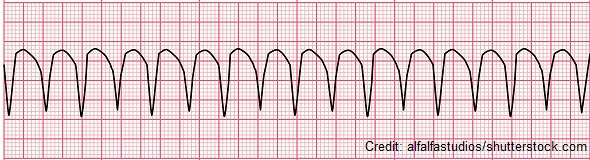
1. Select the options below that describe the rhythm above:
A. Monomorphic
B. Regular atrial rhythm
C. QRS complex >0.12 seconds
D. Irregular ventricular rhythm
E. Regular ventricular rhythm
F. Ventricular rate >100 bpm
G. Atrial rate >80 bpm
H. Polymorphic
I. Ventricular tachycardia
J. Ventricular fibrillation
The answers are A, C, E, F, and I. This rhythm is ventricular tachycardia and is monomorphic. The P waves can’t be assessed (therefore, you can’t asses the atrial rate or rhythm or the PR interval). The QRS complex is >0.12 seconds and bizarre. The ventricular rate is fast >100 bpm and regular.
2. TRUE or FALSE: Torsades de pointes is known as a type of monomorphic ventricular tachycardia.
The answer is FALSE: Torsades de pointes is known as a type of polymorphic (NOT monomorphic) ventricular tachycardia.
3. Your patient is unresponsive and the cardiac monitor shows Torsades de Pointes as the patient’s rhythm. As the code team is attempting to resuscitate the patient, you look through the patient’s electronic health record to try to determine a potential cause for this rhythm. What, if found in the patient’s record, could be a cause of this rhythm?
A. Magnesium level 2 mg/dL
B. Amiodarone
C. Potassium 5 mEq/L
D. Glyburide
The answer is B: Amiodarone… This medication can cause a prolonged QT interval, which is a common cause of Torsades de Pointes.
4. The patient is experiencing the rhythm above. You assess the patient and find the patient is having no symptoms and a pulse is present. What type of treatment do you anticipate will be ordered for this patient?
A. CPR
B. Defibrillation
C. Amiodarone IV
D. Digoxin IV
The answer is C. The patient is experiencing ventricular tachycardia. Currently, the patient has no symptoms and a pulse is present. Therefore, the patient is stable. When stable with no symptoms and has a pulse an anti-arrhythmic med like amiodarone IV can be ordered. If the patient doesn’t convert to sinus rhythm synchronized cardioversion may be used.
5. The patient is experiencing the rhythm above. The patient is presenting with a blood pressure of 70/42, mental status changes, and is clammy and pale. A pulse is present. The nurse preps the patient for?
A. CPR
B. Synchronized cardioversion
C. Defibrillation
D. Atropine IV
The answer is B. The rhythm above is ventricular tachycardia. The patient is unstable and demonstrating signs and symptoms related to decreased cardiac output. A pulse is present. The patient is currently unstable; therefore, synchronized cardioversion needs to be performed to convert the patient to a normal rhythm. An antiarrhythmic like Amiodarone may be started to maintain the normal rhythm.

6. The following rhythm is noted in your patient. The patient is unresponsive and has no pulse. What order below would the nurse ask for clarification if received?
A. IV Amiodarone
B. IV Magnesium Sulfate
C. Defibrillation
D. IV epinephrine
The answer is A. The rhythm above is Torsades de Pointes. A common cause of this rhythm is due to a medication causing a prolonged QT interval. Amiodarone can prolong the QT interval and should not be used in this rhythm.
7. A patient is experiencing ventricular tachycardia and is unresponsive with no pulse. After activating the emergency response system, the nurse would immediately?
A. Prep the patient for defibrillation
B. Administer IV epinephrine
C. Secure the airway
D. Start chest compressions
The answer is D: start chest compressions
Don’t forget to tell your friends about this quiz by sharing it your Facebook, Twitter, and other social media. You can also take more fun nursing quizzes.
*Disclaimer: While we do our best to provide students with accurate and in-depth study quizzes, this quiz/test is for educational and entertainment purposes only. Please refer to the latest NCLEX review books for the latest updates in nursing. This quiz is copyright RegisteredNurseRn.com. Please do not copy this quiz directly; however, please feel free to share a link to this page with students, friends, and others.