First-Degree AV heart block quiz review for nursing students!
This quiz will test your knowledge on how to identify a First-Degree heart block, the causes of this heart rhythm and the treatment.
There are four types of heart blocks a nurse should be familiar with. This includes a First-Degree, Second-Degree Type I (Mobitz type I or Wenckebach), Second-Degree Type II (Mobitz type II), and Third-Degree (Complete Heart Block).
Also check out the other heart block quizzes:
Second-Degree Type I (Mobitz I Wenckebach)
Second-Degree Type II (Mobitz II)
Third-Degree (Complete Heart Block)
Ventricular Tachycardia (V-tach)
Don’t forget to watch the lecture on First-Degree heart block and review the notes before taking this quiz.
First-Degree AV Heart Block Quiz Questions
ECG/EKG Study Guide and Workbook for Nursing Students
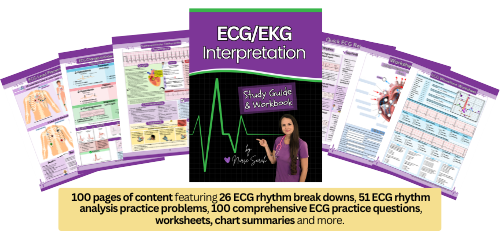
“ECG/EKG Interpretation Study Guide and Workbook by Nurse Sarah”. This book contain 100 pages of content featuring 26 ECG rhythm break downs, 51 ECG rhythm analysis practice problems, 100 comprehensive ECG practice questions, worksheets, chart summaries, and more.
You can get an eBook version here: “Nurse Sarah ECG Book” or a physical copy here: “ECG/EKG Interpretation Study Guide by Nurse Sarah“.
First-Degree Heart Block Quiz

- Select all the correct options below that describe the rhythm above: A. Regular P Waves
B. PR Interval <0.20 seconds C. Regular Ventricular Rhythm D. First-Degree Heart Block E. Second-Degree Type I Heart Block (Mobitz type I) F. PR Interval >0.20 seconds
The answers are: A, C, D, and F. It contains regular p waves, regular ventricular rhythm, is a first-degree heart block, and has a PR interval that is >0.20 seconds.
- True or False: In a First-Degree Heart Block, the atrial rhythm is regular and the QRS complex will measure less than 0.12 seconds. True
False
The answer is True.
- Your patient is found to have a First-Degree Heart Block after obtaining an ECG. The patient is asymptomatic. The nurse prepares to? Select all that apply: A. Activate the emergency response team
B. Obtain atropine and temporary pacing pads
C. Continue to monitor
D. Start CPR
E. Assess the patient’s current medications
The answer is C and E. Patients with first-degree heart blocks rarely have symptoms. It is the least severe of all the heart blocks. This patient is having no symptoms and should continue to be monitored. In addition, the nurse should review the patient’s current medication to make sure no medication the patient is taking could slow down AV conduction leading to this heart block (such as Calcium channel blockers, Digoxin, or Beta blockers).
- What medication below could cause a First-Degree Heart Block? A. Lisinopril
B. Dilitiazem
C. Furosemide
D. Clopidogrel
The answer is B: Dilitiazem is a calcium channel blocker which slows down conduction through the AV node. This could lead to a heart block.
- A hallmark finding in a First-Degree Heart Block is? A. a gradually lengthening PR interval with a random dropped QRS complex
B. a PR interval >0.20 seconds
C. a constant PR interval with random dropped QRS complexes
D. independent p waves and QRS complexes
The answer is B: a PR interval >0.20 seconds.
- Which statement below best describes why a First-Degree Heart Block occurs? A. The SA node is firing too rapidly to the AV node.
B. The signal traveling from the AV node to the Purkinje fibers is blocked in the right and left bundle branches.
C. The electrical signal is moving slowly through the AV node.
D. The AV node is completely unable to fire during the electrical conduction cycle which create a delay in ventricular contraction.
The answer is C: The electrical signal is moving slowly through the AV node.
Don’t forget to tell your friends about this quiz by sharing it your Facebook, Twitter, and other social media. You can also take more fun nursing quizzes.
*Disclaimer: While we do our best to provide students with accurate and in-depth study quizzes, this quiz/test is for educational and entertainment purposes only. Please refer to the latest NCLEX review books for the latest updates in nursing. This quiz is copyright RegisteredNurseRn.com. Please do not copy this quiz directly; however, please feel free to share a link to this page with students, friends, and others.