Third-Degree (complete) heart block quiz review for nursing students!
This quiz will test your knowledge on how to identify a Third-Degree heart block, the causes of this heart rhythm, and the treatment.
There are four types of heart blocks a nurse should be familiar with. This includes a First-Degree, Second-Degree Type I (Mobitz type I or Wenckebach), Second-Degree Type II (Mobitz type II), and Third-Degree (Complete Heart Block).
Also check out the other quizzes and lecture notes:
Second-Degree Type I (Mobitz I or Wenckebach)
Second-Degree Type II (Mobitz II)
Ventricular Tachycardia (V-tach)
Third-Degree Heart Block (Complete) ECG Quiz Questions
ECG/EKG Study Guide and Workbook for Nursing Students
“ECG/EKG Interpretation Study Guide and Workbook by Nurse Sarah”. This book contain 100 pages of content featuring 26 ECG rhythm break downs, 51 ECG rhythm analysis practice problems, 100 comprehensive ECG practice questions, worksheets, chart summaries, and more.
You can get an eBook version here: “Nurse Sarah ECG Book” or a physical copy here: “ECG/EKG Interpretation Study Guide by Nurse Sarah“.
Third-Degree (Complete) Heart Block Quiz

1. Select all the options below that describe the heart rhythm above:
A. PR Interval progressively prolonged
B. Ventricular rhythm regular
C. Independent P waves and QRS complexes
D. Regular atrial rhythm
E. Slower ventricular rate than atrial rate
F. Atrial rate slower than ventricular rate
G. Equal atrial and ventricular rate
H. Second-Degree type II (Mobitz II)
I. Third-Degree Heart Block (complete)
J. Second Degree type I (Mobitz I or Wenckebach)
The answers are: B, C, D, E, and I. This rhythm is a Third-Degree Heart Block (complete heart block). This rhythm features independent p waves and QRS complexes, regular ventricular and atrial rhythm, but the ventricular rate is slower than the atrial rate.
2. TRUE or FALSE: A Third-Degree Heart Block is unlikely to cause symptoms in a patient and usually requires no treatment.
The answer is FALSE: A Third-Degree Heart block is the most serious type of heart block. The patient will usually have symptoms because there is impaired cardiac output. Therefore, the patient will need treatment like temporary pacemaker, and then a permanent pacemaker.
3. Which option below best describes the findings a nurse would find in a Third-Degree Heart Block (complete heart block)?
A. Normal p waves with progressively prolonged PR interval and missing QRS complexes
B. Normal p waves with constant PR intervals and intermittent missing QRS complexes
C. Normal p waves each with a QRS complex but prolonged PR intervals regularly throughout the rhythm
D. Normal p waves and QRS complexes that are independent of each other but has regular atrial and ventricular rhythm
The answer is D: “Normal p waves and QRS complexes that are independent of each other but has regular atrial and ventricular rhythm” Option A describes a Second-Degree Type I (Mobitz I/Wenckebach), Option B describes a Second-Degree Type II (Mobitz II), and Option C describes a First-Degree Heart Block.
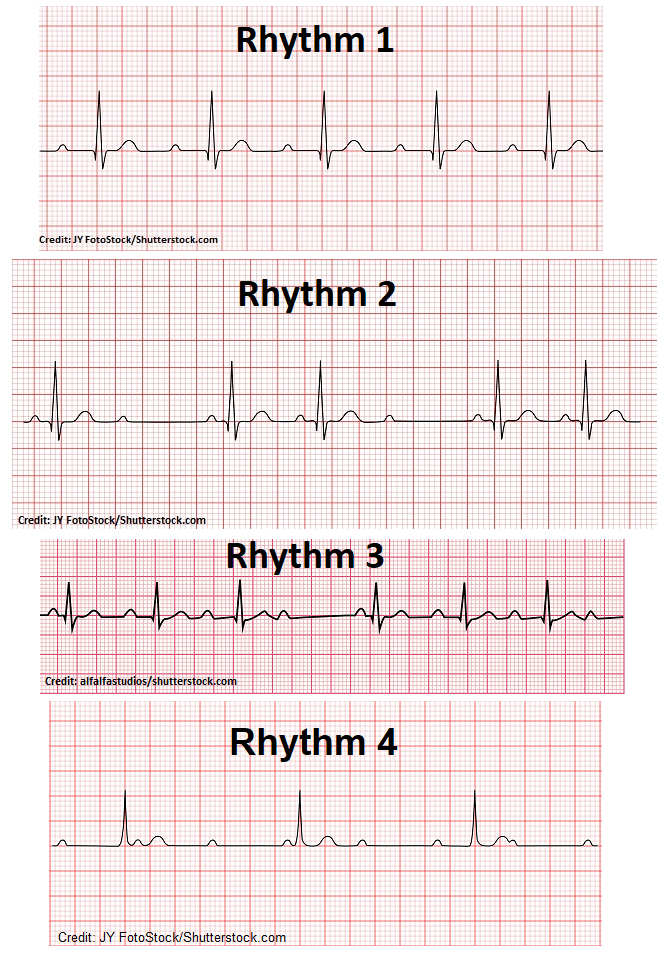
4. Which rhythm above is a Third-Degree Heart Block?
A. Rhythm 1
B. Rhythm 2
C. Rhythm 3
D. Rhythm 4
The answer is D: Rhythm 4
5. Your patient is experiencing a blood pressure of 70/42, weak pulse, chest pain, and is pale. The patient is confused and anxious. An ECG is obtained and a Third-Degree Heart Block is noted. What treatment should the nurse be prepping for? Select all that apply:
A. Amiodarone IV
B. Defibrillation
C. Temporary pacing
D. Synchronized Defibrillation
The answer is C. The patient is exhibiting signs of low cardiac output associated with a Third-Degree heart block. Treatment the nurse should prep for is the administration of temporary pacing.
6. Select below all the causes of a Third-Degree Heart block:
A. Congenital heart disease
B. Digoxin Toxicity
C. Blood Glucose 50 mg/dL
D. Potassium 4.2 mEq/L
E. Heart valve damage
The answers are A, B, and E.
Don’t forget to tell your friends about this quiz by sharing it your Facebook, Twitter, and other social media. You can also take more fun nursing quizzes.
*Disclaimer: While we do our best to provide students with accurate and in-depth study quizzes, this quiz/test is for educational and entertainment purposes only. Please refer to the latest NCLEX review books for the latest updates in nursing. This quiz is copyright RegisteredNurseRn.com. Please do not copy this quiz directly; however, please feel free to share a link to this page with students, friends, and others.