As a nurse you want to be familiar with all the types of heart blocks. The types include:
Before you review this material be sure to check out the other videos in this series along with the comprehensive ECG lecture that details how to analyze heart rhythms.
First-Degree AV Heart Block
Characteristics and Criteria of First-Degree Heart Block
This rhythm looks a lot like normal sinus rhythm, but it has a subtle secret. The PR intervals will be prolonged ( >0.20 seconds) regularly throughout the rhythm.

What you will see?
- Normal p-waves
- Normal atrial and ventricular rate (60-100 bpm) but can be slower
- Atrial and ventricular rhythm is regular
- Normal QRS <0.12 seconds
- Normal QT interval 0.36-0.44 seconds
- PR Interval >0.20 seconds regularly throughout the rhythm
ECG/EKG Study Guide and Workbook for Nursing Students
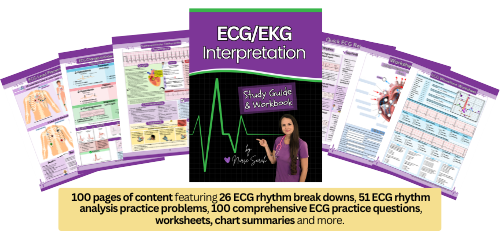
“ECG/EKG Interpretation Study Guide and Workbook by Nurse Sarah”. This book contain 100 pages of content featuring 26 ECG rhythm break downs, 51 ECG rhythm analysis practice problems, 100 comprehensive ECG practice questions, worksheets, chart summaries, and more.
You can get an eBook version here: “Nurse Sarah ECG Book” or a physical copy here: “ECG/EKG Interpretation Study Guide by Nurse Sarah“.
Causes of First-Degree Heart Block
It can be normal for some patients. However, it can be present with a myocardial infarction (MI) or due to medications like calcium channel blockers, Digoxin, or beta blockers, which slow down AV node conduction.
Treatment for First-Degree Heart Block
Most patients are asymptomatic because this is usually detected randomly during a routine ECG reading.
If the patient has no symptoms, they will be monitored to make sure that it doesn’t progress to a more serious type of heart block or another abnormal rhythm. This is usually the least severe of all types of heart blocks.
The patient’s medications may have to be evaluated and adjusted, especially if they are taking a medication that can slow down AV node conduction like calcium channel blockers, beta blockers, or Digoxin.
In addition, if the patient has an extensive heart history a consult with cardiologists may be need for further evaluation.
Now test your knowledge on this material with this free First-Degree Heart Block Quiz.
References:
American Heart Association | Algorithms. (n.d.). Retrieved September 2, 2022, from https://cpr.heart.org/en/resuscitation-science/cpr-and-ecc-guidelines/algorithms#adult
Oldroyd SH, Quintanilla Rodriguez BS, Makaryus AN. First Degree Heart Block. [Updated 2022 May 1]. In: StatPearls [Internet]. Treasure Island (FL): StatPearls Publishing; 2022 Jan-. Available from: https://www.ncbi.nlm.nih.gov/books/NBK448164/