As a nurse you want to be familiar with different types of heart rhythms, especially life-threatening rhythms like ventricular tachycardia (v-tach).
Before reviewing these notes, don’t forget to check out the lecture on ventricular tachycardia (V-tach).
Characteristics and Criteria of Ventricular Tachycardia (V-tach)
This rhythm is occurring because there is an abnormal electrical signal in the ventricles causing the ventricles to beat at a very fast rate.
Ventricular tachycardia, also called V-tach, is a rhythm that can occur for a short duration and quit or be sustained.
If there is a “run of v-tach”, hence it happens for a short duration, you may see a bunch of premature ventricular contractions (PVCs) happen together, and then the rhythm returns to normal. For example, there may be 3 or more PVCs in a row on the patient’s ECG strip and we refer to this as a “run of v-tach”, hence non-sustained V-tach.

What you will see on the ECG?
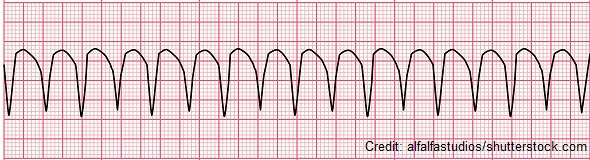
- Can’t find the p waves usually
- can’t assess atrial rate or rhythm or the PR interval
- QRS complex is the star of this rhythm because its wide >0.12 seconds and bizarre
- Ventricular rate is fast (100-250 bpm)
- Ventricular rhythm regular
- Can’t assess t-waves
V-tach can appear monomorphic (as noted in the image above) where the presentation is the same throughout, or it can appear polymorphic where the rhythm is not the same throughout but different. As seen below:

One type of polymorphic v-tach is called Torsades de pointes. You want to be aware of the different presentations because treatment is slightly different. Here is an example of Torsades de pointes:

ECG/EKG Study Guide and Workbook for Nursing Students
“ECG/EKG Interpretation Study Guide and Workbook by Nurse Sarah”. This book contain 100 pages of content featuring 26 ECG rhythm break downs, 51 ECG rhythm analysis practice problems, 100 comprehensive ECG practice questions, worksheets, chart summaries, and more.
You can get an eBook version here: “Nurse Sarah ECG Book” or a physical copy here: “ECG/EKG Interpretation Study Guide by Nurse Sarah“.
Causes of Ventricular Tachycardia (V-tach)
Abnormal electrolyte like low potassium, myocardial infarction, medications toxicity especially like Digoxin toxicity, heart disease like heart failure, coronary artery disease, or valve disease
*Torsades de pointes: common cause tends to be medications that increase the QT interval like Amiodarone, Sotalol, Procainamide etc. However, this rhythm can happen due to low calcium, potassium or magnesium levels too.
Treatment for Ventricular Tachycardia (V-tach)
This rhythm requires immediate attention because it can progress to v-fib, which leads to death. Therefore, depending on where you’re at and how the patient is you want to get help: activate the emergency response system (get the crash cart, defibrillator etc.)
Patient Stable: no symptoms, has a pulse…anti-arrhythmic medication like Amiodarone IV. If doesn’t convert to sinus rhythm, synchronized cardioversion may be used.
Patient Unstable: having symptoms associated with cardiac output decreasing but still has pulse… synchronized cardioversion and then antiarrhythmic like Amiodarone IV.
Patient has no pulse: start CPR…chest compressions, defibrillation, Epinephrine IV and other meds can be give like Amiodarone or Lidocaine along with securing the airway.
***Polymorphic like Torsades de pointes: stop QT interval prolonging medication, Magnesium Sulfate IV (no Amiodarone or Procainamide these increase QT interval)…if unstable treat like v-fib with CPR and defibrillation
May need an implanted ICD (cardioverter-defibrillator)
Now test your knowledge on this material by taking the free ventricular tachycardia (V-tach) quiz.
References:
American Heart Association | Algorithms. (n.d.). Retrieved September 2, 2022, from https://cpr.heart.org/en/resuscitation-science/cpr-and-ecc-guidelines/algorithms#adult
Foth C, Gangwani MK, Alvey H. Ventricular Tachycardia. [Updated 2021 Aug 11]. In: StatPearls [Internet]. Treasure Island (FL): StatPearls Publishing; 2022 Jan-. Available from: https://www.ncbi.nlm.nih.gov/books/NBK532954/