For nursing exams, you want to understand which medications require specific laboratory monitoring before administration. Many medications can cause dangerous changes in electrolytes, kidney function, liver function, blood counts, or drug levels.
This review will cover common medications nurses encounter and the important labs to monitor, including potassium levels, creatinine, therapeutic drug levels, coagulation studies, liver enzymes, and more.
To access more free nursing pharmacology reviews, check out our nursing pharmacology videos.
Medications That Require Lab Monitoring in Nursing
Loop Diuretics: Furosemide (Lasix)
Furosemide is a loop diuretic commonly used to treat conditions such as heart failure and fluid overload.
Key Nursing Lab to Monitor:
- Potassium level (K⁺)
Furosemide can cause the body to lose potassium, leading to hypokalemia.
Before administering this medication, nurses should check the patient’s potassium level and monitor for signs of low potassium, such as:
- Muscle weakness
- Cardiac dysrhythmias
- Fatigue
Potassium-Sparing Diuretics: Spironolactone
Spironolactone works differently from loop diuretics because it helps the body retain potassium.
Key Nursing Lab to Monitor:
- Potassium level (K⁺)
Because spironolactone can increase potassium levels, nurses should monitor for hyperkalemia.
NCLEX Lab Value Study Sticker
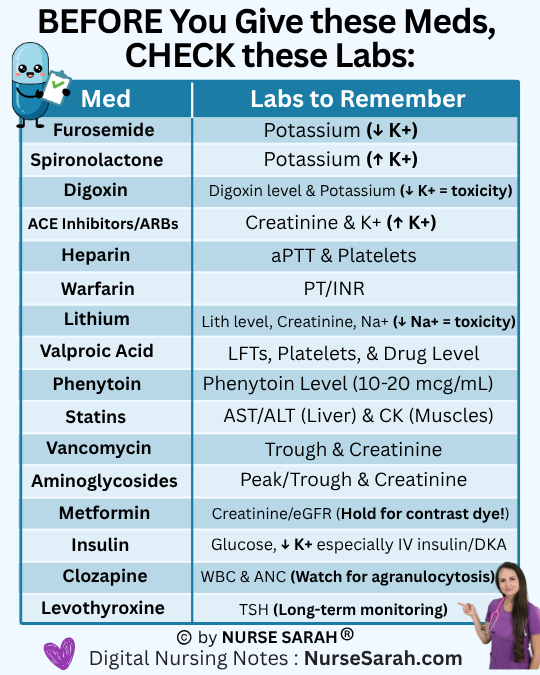
Stay one step ahead of medication errors with this NCLEX Nursing Lab Values Check Sticker designed to make clinical connections instant and unforgettable. Available at NurseSarah.com
This study sticker organizes commonly tested medications and their critical lab monitoring requirements into a simple, easy-to-read two-column format—perfect for quick review during clinicals, lab prep, or NCLEX studying.
- Clear 2-column layout: Medication → Key Labs to Monitor
- Nursing tips including whether values may increase or decrease
- Fast-reference clinical reminders to reinforce safe medication administration
- Designed for rapid recall—not overwhelming textbook detail
Cardiac Glycosides: Digoxin
Digoxin is used for conditions such as heart failure and certain heart rhythm disorders.
Key Nursing Labs to Monitor:
- Digoxin drug level
- Potassium level
- Renal function
The goal is to maintain a therapeutic digoxin level. Too much digoxin can lead to toxicity.
Low potassium levels increase the risk of digoxin toxicity, making potassium monitoring especially important.
ACE Inhibitors and ARBs
ACE inhibitors and angiotensin II receptor blockers (ARBs) are commonly used to:
- Lower blood pressure
- Treat heart failure
- Protect kidney function in certain patients
Examples:
- ACE inhibitor: Captopril
- ARB: Losartan
Key Nursing Labs to Monitor:
- Creatinine
- Potassium level
These medications can affect kidney function and may increase potassium levels, causing hyperkalemia.
Nursing NCLEX Review
Anticoagulants: Heparin and Warfarin
Heparin
Heparin requires monitoring to ensure the patient is receiving a safe therapeutic dose.
Key Nursing Labs to Monitor:
- aPTT
- Platelet count
Heparin can cause heparin-induced thrombocytopenia (HIT), a dangerous decrease in platelets that increases clotting risk.
Warfarin
Warfarin requires regular monitoring.
Key Nursing Lab to Monitor:
- PT/INR
The INR helps determine whether the patient’s blood is clotting too quickly or too slowly.
Lithium
Lithium is used as a mood stabilizer, especially for bipolar disorder.
Key Nursing Labs to Monitor:
- Lithium level
- Creatinine
- Sodium level
Lithium has a narrow therapeutic range, meaning small changes can lead to toxicity.
Low sodium levels increase the risk of lithium toxicity because the kidneys try to retain sodium. Since lithium is handled similarly to sodium, the kidneys may also retain more lithium, increasing blood levels.
Valproic Acid
Valproic acid is used for seizures and mood disorders.
Key Nursing Labs to Monitor:
- Liver function tests (AST/ALT)
- Platelet count
- Valproic acid level
This medication can affect the liver and decrease platelet production.
Phenytoin
Phenytoin is an anticonvulsant used to prevent seizures.
Key Nursing Lab to Monitor:
- Phenytoin level
The therapeutic range is typically:
10–20 mcg/mL
Levels outside this range can increase the risk of toxicity or inadequate seizure control.
Statins
Atorvastatin and other statins help lower cholesterol levels.
Key Nursing Labs to Monitor:
- ALT and AST
- Creatine kinase (CK)
Statins can affect:
- The liver
- Skeletal muscles
A serious complication is rhabdomyolysis, which involves muscle breakdown and can lead to kidney injury.
Antibiotics
Vancomycin
Vancomycin is an antibiotic that requires careful monitoring.
Key Nursing Labs to Monitor:
- Vancomycin trough level
- Creatinine
The trough level is often measured before a scheduled dose (commonly before the fourth dose, depending on protocol).
Kidney function must be monitored because vancomycin can cause nephrotoxicity.
Aminoglycosides
Aminoglycoside antibiotics require monitoring because of their potential kidney and ear toxicity.
Key Nursing Labs to Monitor:
- Peak and trough levels
- Creatinine
Examples include medications such as gentamicin and tobramycin.
Metformin
Metformin is a first-line medication for type 2 diabetes.
Key Nursing Labs to Monitor:
- Creatinine
- Estimated GFR (eGFR)
Metformin is cleared through the kidneys, so kidney function must be monitored.
Some protocols may require holding metformin before certain contrast dye procedures.
Insulin
Insulin lowers blood glucose by allowing glucose to enter cells.
Key Nursing Labs to Monitor:
- Blood glucose
- Potassium level (especially in DKA)
In conditions such as diabetic ketoacidosis (DKA), insulin can cause potassium to move into cells, lowering blood potassium levels.
Nurses should monitor for hypokalemia.
Clozapine
Clozapine is an atypical antipsychotic medication.
Key Nursing Labs to Monitor:
- White blood cell count (WBC)
- Absolute neutrophil count (ANC)
Clozapine can cause agranulocytosis, a dangerous reduction in neutrophils that increases infection risk.
Levothyroxine
Levothyroxine is used to treat hypothyroidism.
Key Nursing Lab to Monitor:
- TSH
TSH is monitored long term to evaluate whether the medication dose is appropriately treating hypothyroidism.
Quick NCLEX Memory Tips
When reviewing medications and labs, remember:
- Diuretics = Think potassium
- ACE inhibitors/ARBs =Think creatinine + potassium
- Digoxin = Think dig level + potassium
- Heparin = Think aPTT + platelets
- Warfarin = Think PT/INR
- Lithium =Think lithium level + sodium + kidneys
- Vancomycin = Think trough + kidneys
- Metformin = Think kidney function
- Clozapine = Think ANC
More NCLEX Reviews