This review will cover how to identify Normal Sinus Rhythm on the ECG/EKG.
As a nurse you want to be able to identify different types of heart rhythms in a patient. These types include:
Second-Degree Type I (Mobitz type I or Wenckebach)
Second-Degree Type II (Mobitz type II)
Third-Degree (Complete) Heart Block
Before you review this material be sure to check out the lecture on Normal Sinus Rhythm and the comprehensive ECG lecture that details how to analyze heart rhythms.
Normal Sinus Rhythm

Before you can analyze an ECG rhythm you must know what is normal. Therefore, let’s first talk about Normal Sinus Rhythm.
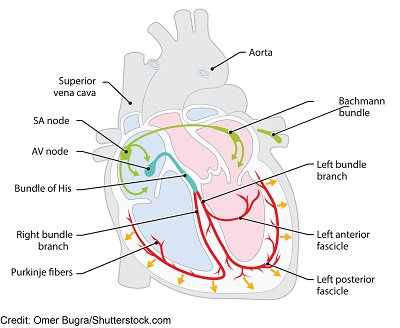
This rhythm originates for the SA node (sinoatrial node), which is the beginning point for the electrical conduction system. If this rhythm isn’t present in your patient, they may have some type of arrhythmia:
Characteristics and Criteria for Normal Sinus Rhythm
- Overall rhythm is regular and the rate is always between 60-100 bpm
- A p-wave will be present in front of every QRS complex and should be upright and measures less than 0.12 seconds
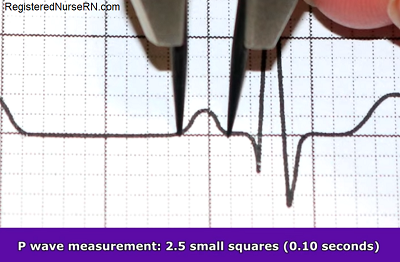
- The p wave represents the atrial rhythm and rate. Therefore, the atrial rhythm should be regular and rate 60-100 bpm.
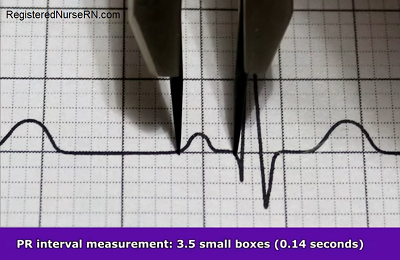
- PR interval should measure 0.12-0.20 seconds….anything greater than 0.20 seconds, think HEART BLOCK.
- A QRS complex should be present after every p-wave and should measure no more than 0.12 seconds.
- The QRS complex represents the ventricular rhythm and rate. Therefore, the ventricular rhythm should be regular and the rate 60-100 bpm.
- NOTE: The ventricular and atrial rate should be the SAME.

- Normal QT interval: 0.36-0.44 seconds (varies depending on gender and if the heart rate is slow vs. fast)

- Normal t wave after each QRS complex, round, and upright
- ST segment: flat, isoelectric
ECG/EKG Study Guide and Workbook for Nursing Students
“ECG/EKG Interpretation Study Guide and Workbook by Nurse Sarah”. This book contain 100 pages of content featuring 26 ECG rhythm break downs, 51 ECG rhythm analysis practice problems, 100 comprehensive ECG practice questions, worksheets, chart summaries, and more.
You can get an eBook version here: “Nurse Sarah ECG Book” or a physical copy here: “ECG/EKG Interpretation Study Guide by Nurse Sarah“.
Causes and Treatment of Normal Sinus Rhythm
Normal sinus rhythm is a normal finding and requires no treatment. The nurse should continue to monitor the patient’s telemetry strips or cardiac monitor to ensure that the patient’s heart rhythm doesn’t deviate from this rhythm.
It’s not uncommon for a hospitalized patient to be in sinus rhythm one minute, and then in an abnormal rhythm like atrial fibrillation, atrial flutter, sinus bradycardia, etc. Therefore, it is essential to always assess those tele strips/cardiac monitor.
Now test your knowledge on this material with this quiz: Normal Sinus Rhythm Quiz
References:
How the Heart Works | NHLBI, NIH. Retrieved 2 September 2022, from https://www.nhlbi.nih.gov/health-topics/how-heart-works
Sattar Y, Chhabra L. Electrocardiogram. [Updated 2021 Jul 31]. In: StatPearls [Internet]. Treasure Island (FL): StatPearls Publishing; 2022 Jan-. Available from: https://www.ncbi.nlm.nih.gov/books/NBK549803/