As a nurse you want to be familiar with all the types of heart blocks. The types include:
Second-Degree Type I (Mobitz type I or Wenckebach)
Second-Degree Type II (Mobitz type II)
Before you review this material be sure to check out the lecture on Third-Degree (Complete) Heart Block and the comprehensive ECG lecture that details how to analyze heart rhythms.
Third-Degree (Complete) Heart Block ECG Review

Characteristics and Criteria of Third-Degree Heart Block
This is the worst type of heart block. The reason for this is because the electrical signal is not going from the atria to the ventricles. And this creates a major problem because the atria and ventricles are no longer working together.
Remember normally the signal goes from the atria to ventricles, creating a p wave (when the atria contract) and then a QRS complex (when the ventricles contract), and this happens continuously….a p wave is always with a QRS complex.
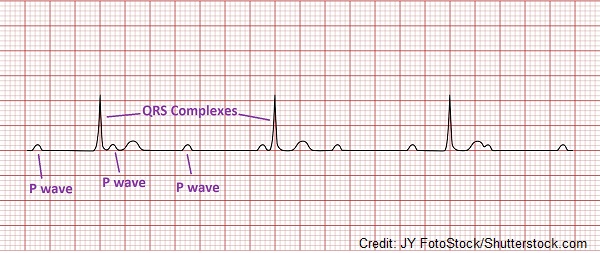
However, this is not the case with a Third-Degree Heart Block. The p-waves are doing their own thing, and the QRS complexes are doing their own thing. Due to this cardiac output will become compromised.
What you will see?
- Normal p-waves but not found with every QRS complex (independent from QRS complexes)
- Regular atrial rhythm and rate
- Regular and slow ventricular rhythm
- Slower ventricular rate than the atrial rate (less QRS complexes than p waves)
- Ventricular rate can be 40 bpm or less, depending on what is firing for the ventricles
- QRS complex width varies depending on what structure is firing…it can >0.12 or <0.12 seconds
- QRS complexes not always found after every p wave (independent from p waves)
- Variable PR intervals because the p waves and QRS complexes are independent
ECG/EKG Study Guide and Workbook for Nursing Students
“ECG/EKG Interpretation Study Guide and Workbook by Nurse Sarah”. This book contain 100 pages of content featuring 26 ECG rhythm break downs, 51 ECG rhythm analysis practice problems, 100 comprehensive ECG practice questions, worksheets, chart summaries, and more.
You can get an eBook version here: “Nurse Sarah ECG Book” or a physical copy here: “ECG/EKG Interpretation Study Guide by Nurse Sarah“.
Causes of Third-Degree Heart Block
Congenital, heart disease, medications (Digoxin toxicity), structural damage to the heart, myocardial infarction, heart valve problem
Treatment of Third-Degree Heart Block
The patient is usually going to have symptoms that reflect impaired cardiac output. This symptoms can include hypotension, weak pulse, chest pain, pale, clammy etc.
Therefore, as the nurse you want to get help for your patient by activating the emergency response team. Atropine can be used with in some cases but with extreme caution, however, it can make the heart block worse. First choice is a temporary pacemaker, and then a permanent pacemaker can be implanted to prevent further problems.
Now test your knowledge on this material with the free Third-Degree (Complete) Heart Block Quiz.
References:
American Heart Association | Algorithms. (n.d.). Retrieved September 2, 2022, from https://cpr.heart.org/en/resuscitation-science/cpr-and-ecc-guidelines/algorithms#adult
Knabben V, Chhabra L, Slane M. Third-Degree Atrioventricular Block. [Updated 2022 May 22]. In: StatPearls [Internet]. Treasure Island (FL): StatPearls Publishing; 2022 Jan-. Available from: https://www.ncbi.nlm.nih.gov/books/NBK545199/