Hormones play a major role in fluid regulation. This is because water in the body must be balanced. There cannot be too much or too little of it. If an imbalance occurs major problems will develop such as fluid volume overload and deficit.
Hormones and certain body systems work to prevent fluid imbalance. In this review, I will discuss the following hormones and body systems that regulate the fluid in the body:
- Aldosterone
- Antidiuretic hormone (ADH)
- Natriuretic peptide hormones (ANP and BNP)
- Renin-angiotensin-aldosterone system (RAAS)
- Thirst mechanism
Nurse Sarah’s Notes and Merch

Just released is “Fluid and Electrolytes Notes, Mnemonics, and Quizzes by Nurse Sarah“. These notes contain 84 pages of Nurse Sarah’s illustrated, fun notes with mnemonics, worksheets, and 130 test questions with rationales.
You can get an eBook version here or a physical copy of the book here.
First, let’s review RAAS: Renin-angiotensin-aldosterone system (RAAS):
When fluid volume deficit occurs (too little fluid in the body) a low blood pressure will develop. The body doesn’t like low blood pressure and has built-in monitoring systems to surveillance the body and increase the blood pressure as needed. One of those systems is called the RAAS.
RAAS stands for renin-angiotensin-aldosterone system (RAAS). The goal of this system is to increase the blood pressure by increasing blood volume through the activation of certain hormones like aldosterone and antidiuretic hormone (ADH). It is only able to achieve this goal once Angiotensin II is created. Therefore, RAAS leads to the creation of Angiotensin II.
Angiotensin II is responsible for activating aldosterone and ADH. In addition, it causes vasoconstriction and stimulates the thirst mechanism (so you will drink more water, which it will use to increase blood volume).
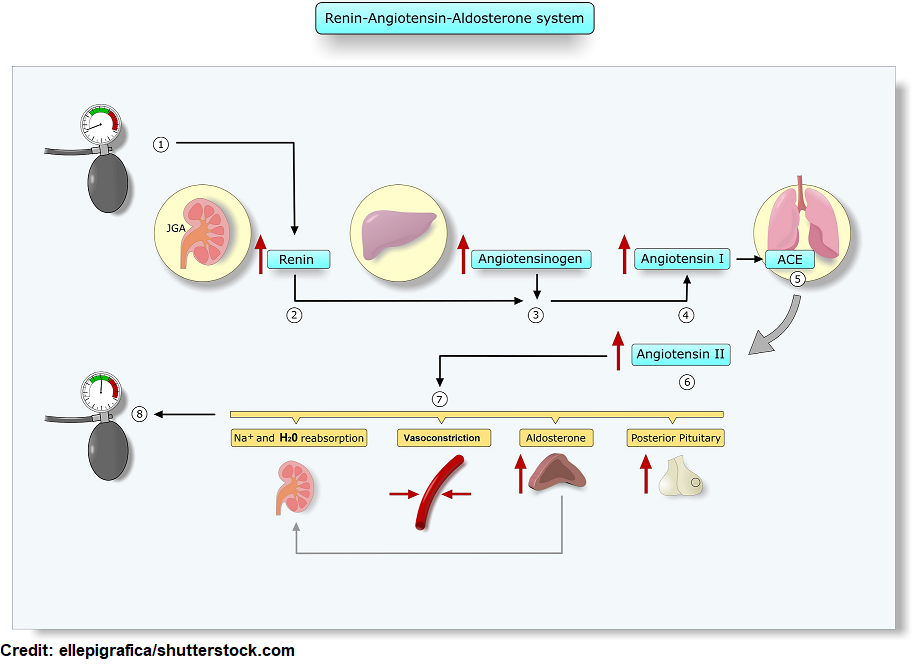
It’s important to be familiar with the sequence of the renin-angiotensin-aldosterone system. Therefore, let’s review it:
- Drop in blood pressure (which can indicate a loss of too much fluid)
- Kidneys respond
- Juxtaglomerular cells release renin and this causes….
- The liver to responds
- Activates angiotensinogen
- Angiotensinogen turns into Angiotensin I
- Activates angiotensinogen
- Angiotensin-converting-enzyme (ACE) turns Angiotensin I into….
- Angiotensin II (goal achieved…now to increase blood pressure):
- Leads to major vasoconstriction
- Constricting blood flow to the kidneys limits its ability to excrete water and more water is kept in the blood to increase fluid volume and blood pressure
- Leads adrenal cortex to release aldosterone
- Causes kidneys to keep sodium and water in blood and urination will decrease
- Leads the posterior pituitary gland to release antidiuretic hormone (ADH)
- Causes kidneys to keep water and increase blood volume
- Stimulates thirst mechanism
- Leads to major vasoconstriction
Now this leads us to the thirst mechanism:
The goal of the thirst mechanism is to add water back to the body.
When there is low fluid in the body, plasma osmolality is high. This is because the blood plasma has very little water in it but a lot of solutes (so it’s concentrated). And again, the body is equipped with a monitoring system that will respond to a high plasma osmolality, which are the osmoreceptors in hypothalamus.
It is important to be familiar with the sequence of the thirst mechanism and how it works. So, let’s look at the sequence:
- Low fluid in the blood causes a high plasma osmolality (low fluid, high solutes)
- Hypothalamus responds, specifically osmoreceptors
- Causes antidiuretic hormone (ADH) to be released
- Hypothalamus makes ADH
- Posterior pituitary gland stores and secretes ADH
- Thirst sensation is experienced
- Causes antidiuretic hormone (ADH) to be released
- Kidneys respond to the presence of ADH, particular parts of the nephron
- ADH causes the distal convoluted tubule (DCT) and collecting duct to reabsorb water
- Water is put back into the blood stream and not excreted via urine
- ADH causes the distal convoluted tubule (DCT) and collecting duct to reabsorb water
- Water is retained (goal achieved)
- This adds water to the plasma, correcting the fluid volume deficit and lowering the plasma osmolality to normal.
Natriuretic Peptide Hormones:
These hormones work against Angiotensin II. They stop the effects of aldosterone, ADH, and renin. Remember these hormones worked to increase fluid volume. However, there comes a point when fluid volume doesn’t need to increase anymore, and these hormones work to help prevent overloading the system with fluid by “turning off” the hormones’ effects.
These hormones include:
- Atrial natriuretic peptide (ANP): hormone released by the heart cells due to atrial wall stretching
- Brain natriuretic peptide (BNP): hormone released by the heart cells due to ventricle wall stretching
Now test your knowledge on this material with this hormone fluid regulation quiz.
References:
Fountain JH, Lappin SL. Physiology, Renin Angiotensin System. [Updated 2019 May 5]. In: StatPearls [Internet]. Treasure Island (FL): StatPearls Publishing; 2019 Jan-. Available from: https://www.ncbi.nlm.nih.gov/books/NBK470410/
Leib DE, Zimmerman CA, Knight ZA. Thirst. Curr Biol. 2016 Dec 19;26(24):R1260-R1265. doi: 10.1016/j.cub.2016.11.019. PMID: 27997832; PMCID: PMC5957508.
NCI Dictionary: Aldosterone. National Cancer Institute. (n.d.). https://www.cancer.gov/publications/dictionaries/cancer-terms/def/aldosterone