This quiz will test your knowledge on the hormones in fluid regulation balance.
Hormones play a very vital role in balancing fluid levels in the body. The thirst mechanism and renin-angiotensin-aldosterone system (RAAS) work to try to correct fluid volume deficits.
Hormones you want to be familiar with in fluid regulation include: aldosterone, antidiuretic hormone, atrial natriuretic peptide (ANP), and brain natriuretic peptide.
Nurse Sarah’s Notes and Merch
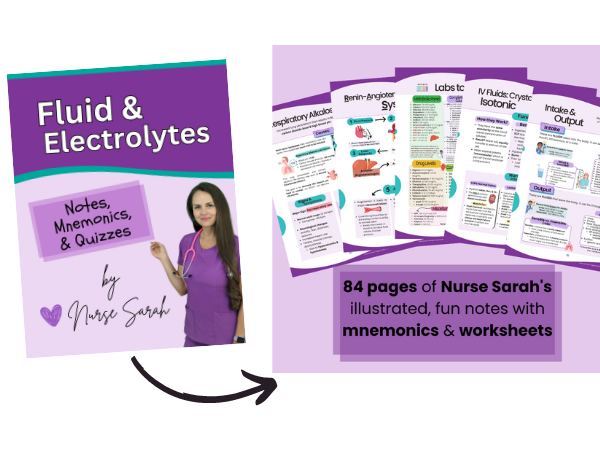
Just released is “Fluid and Electrolytes Notes, Mnemonics, and Quizzes by Nurse Sarah“. These notes contain 84 pages of Nurse Sarah’s illustrated, fun notes with mnemonics, worksheets, and 130 test questions with rationales.
You can get an eBook version here or a physical copy of the book here.
Don’t forget to check out the comprehensive fluid and electrolytes review. In addition, to the lecture on hormones in fluid regulation and notes.

Hormones in Fluid Regulation Balance Quiz
Hormones in Fluid Regulation Balance Nursing Quiz
1. What does the juxtaglomerular cells release as part of the Renin-Angiotensin-Aldosterone System?
A. aldosterone
B. antidiuretic hormone
C. renin
D. Angiotensin II
The answer is C: renin. Juxtaglomerular cells respond to a low blood pressure and released renin.
2. What organ(s) in the body activates angiotensinogen when it senses the presence of renin in the circulation?
A. Kidney
B. Heart
C. Lungs
D. Liver
The answer is D: Liver. The liver activates angiotensinogen when it senses the presence of renin in the circulation.
3. What substance does angiotensinogen turn into in RAAS?
A. Angiotensin II
B. Renin
C. Aldosterone
D. Angiotensin I
The answer is D: Angiotensin I. Angiotensinogen turns into Angiotensin I.
4. What is the role of ACE (Angiotensin-Converting Enzyme)?
A. Turns renin into angiotensin II
B. Turns angiotensin I into angiotensin II
C. Turns angiotensin I into aldosterone
D. Turns angiotensin I into renin
The answer is B: turns angiotensin I into angiotensin II. ACE, Angiotensin-Converting Enzyme, has an important role for converting Angiotensin I into Angiotensin II.
5. Select all the roles of Angiotensin II:
A. vasoconstriction
B. vasodilation
C. release renin
D. lead to the release of aldosterone
E. lead to the release of ADH
F. stimulate thirst mechanism
G. decrease blood volume
The answers are A, D, E, and F. Angiotensin II will cause: vasoconstriction, lead to the release of aldosterone and ADH, and stimulate the thirst mechanism. It will INCREASE blood volume (not decrease) because it has a goal of increasing blood pressure.
6. What structure in the body makes antidiuretic hormone (ADH)?
A. kidneys
B. posterior pituitary gland
C. hypothalamus
D. adrenal cortex
The answer is C: hypothalamus. This structure makes ADH, but it is stored and secreted by the posterior pituitary gland.
7. When a patient is low on fluid or has a high plasma osmolality, what structure in the body responds to this issue first in the thirst mechanism?
A. hypothalamus
B. thalamus
C. adrenal glands
D. kidneys
The answer is A: hypothalamus
8. True or False: Osmoreceptors in the hypothalamus cause antidiuretic hormone to be released.
The answer is TRUE.
9. What structure stores and secretes ADH?
A. kidneys
B. posterior pituitary gland
C. hypothalamus
D. adrenal cortex
The answer is B: posterior pituitary gland. This structure stores and secretes ADH. ADH is made in the hypothalamus.
10. What parts of the nephron in the kidney respond to antidiuretic hormone (ADH)? Select all that apply:
A. Loop of Henle
B. Bowman’s capsule
C. Distal convoluted tubule
D. Proximal convoluted tubule
E. Collecting duct
The answers are C and E. These structures of the nephron are affected by ADH and reabsorb water back into the blood stream. Therefore, water goes back into the plasma and helps increase blood volume.
11. What is the purpose of antidiuretic hormone (ADH)?
A. reabsorb sodium and water to increase fluid volume in the blood
B. reabsorb water to increase blood volume
C. cause vasoconstriction to increase blood volume
D. waste sodium and water to increase blood volume
The answer is B: reabsorb water to increase blood volume. This is the purpose of antidiuretic hormone.
12. What hormone is released by the heart cells due to atrial wall stretching?
A. ANP
B. BNP
C. aldosterone
D. antidiuretic hormone
The answer is A: ANP. This stands for atrial natriuretic peptide.
13. What hormone is released by the heart cells due to ventricle wall stretching?
A. ANP
B. BNP
C. aldosterone
D. antidiuretic hormone
The answer is B: BNP. This stands for brain natriuretic peptide and is released by heart cells due to ventricle wall stretching.
14. What hormones work against the effects of Angiotensin II? Select all that apply:
A. aldosterone
B. atrial natriuretic peptide
C. brain natriuretic peptide
D. renin
The answers are B and C. These are natriuretic peptides that work against Angiotensin II and stop the effects of aldosterone, ADH, and renin.
Don’t forget to tell your friends about this quiz by sharing it your Facebook, Twitter, and other social media. You can also take more fun nursing quizzes.
*Disclaimer: While we do our best to provide students with accurate and in-depth study quizzes, this quiz/test is for educational and entertainment purposes only. Please refer to the latest NCLEX review books for the latest updates in nursing. This quiz is copyright RegisteredNurseRn.com. Please do not copy this quiz directly; however, please feel free to share a link to this page with students, friends, and others.