Fluid volume excess or overload occurs when there is too much fluid in the body.
The body needs just the right amount of fluid to function and if there is too much or too little it starts to fail.
In this review, you will learn about the types of fluid volume overload, signs and symptoms, treatments, and nursing interventions.
Don’t forget to take the fluid volume overload quiz and to watch the lecture on hypervolemia.
Nurse Sarah’s Notes and Merch

Just released is “Fluid and Electrolytes Notes, Mnemonics, and Quizzes by Nurse Sarah“. These notes contain 84 pages of Nurse Sarah’s illustrated, fun notes with mnemonics, worksheets, and 130 test questions with rationales.
You can get an eBook version here or a physical copy of the book here.
Fluid volume overload affects the fluid compartments of the body by overloading them with fluid.
Let’s quickly review these compartments:
Remember there is the intracellular compartment which is the fluid found inside the cell, and it accounts for 2/3 of our body water.
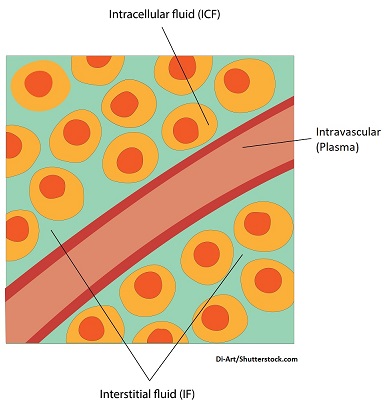
The extracellular compartment is the fluid outside the cell and accounts for 1/3 of our body water.
This compartment can be further divided into:
Intersitital space: the fluid surrounding the outside or in between cells
Intravascular space (this the blood plasma): the fluid found within our blood vessels
Transcellular space: this is the fluid found around joints and certain organs (it is the smallest extracellular compartment of the three).
These compartments can become overloaded with fluid and depending on the cause or type of overload the patient has, will determine which compartment is the most affected.
Types of Fluid Overload
There are several causes and types of fluid volume overload which can be organized into hypertonic, hypotonic, or isotonic.
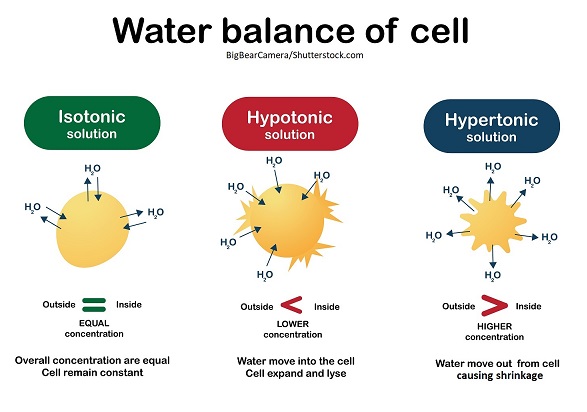
Hypertonic fluid volume overload: this occurs due to the movement of water from intracellular to extracellular compartment from an increase in osmolarity (hence solute concentration) in the extracellular compartment. Due to this, it pulls fluid from the intracellular compartment to the extracellular compartment and overloads the extracellular compartment. In addition, the cell shrinks.
Causes of Hypertonic Fluid Volume Overload:
- Excessive intake of sodium: remember water LOVES sodium and flows to it increasing the fluid volume
- Excessive administration of hypertonic IV solutions: these fluids pull water from the intracellular space to the extracellular space into the plasma.
Hypotonic fluid volume overload (also called water intoxication): this occurs due to the movement of water from extracellular to intracellular compartment. It’s happening because there is an increase in free water to the extracellular compartment but not osmolarity (hence solute concentration) that results in water moving from extracellular compartment to intracellular.
Another way to look at it, is that in hypotonic overload the extracellular compartment becomes overloaded with water “watered down” and this lowers the amount of solutes which will pull too much water into the intracellular compartment from the extracellular compartment and overload both compartments. In addition, the cell can swell and rupture.
Causes of Hypotonic Fluid Overload:
- Excessive intake of free water orally: primary polydipsia…patient has compulsion to drink water and can become water intoxicated
- SIADH (Syndrome of Inappropriate Antidiuretic Hormone secretion): this is where too much ADH is being released. When this happens water is retained which dilutes sodium levels and causes fluid overload.
Isotonic fluid volume overload (also referred to as hypervolemia): no drastic movement of water from compartments because osmolarity is equal, however, the extracellular compartment becomes overloaded.
Occurs when major organs in our body that normally help balance fluid volume FAIL (like the heart and kidneys).
Causes of Isotonic Fluid Overload:
- Too much isotonic IV solutions
- Corticosteroids over usage: leads to the retention of sodium and water
Signs and Symptoms of Fluid Volume Overload
Think about what is going on with the patient. They have way too much fluid in their fluid compartments. Everything from head to toe is just oversaturated with water.
Therefore, signs and symptoms are going to be based on how that body system is affected and the type of fluid volume overload.
So, let’s start with the head:
- Neuro: brain swelling (cells are literally swollen with fluid) this leads to confusion which is an EARLY sign that brain swelling is occurring so watch for decline in mental status. In addition, the patient may report pressure or pain in the head.
- Cardiovascular (intravascular system is carrying a lot of fluid): think of a water hose with a high amount of water in it….pulse will be bounding, sinus tachycardia, hypertension, jugular venous distention (JVD).
- Respiratory (depends on severity and if fluid is in the lungs): shortness of breath, crackles, increased respiratory rate, dry, hacking cough (can progress to frothy blood-tinged…bad sign get help immediately….flash pulmonary edema).
- Peripherally: edema (especially lower extremities that can pit), skin will be cool to the touch because it is very edematous and blood flow is diminished, swollen abdomen (ascites), nausea: liver congestion and enlargement, weight gain: 1 kg (2.2 lbs.)= 1 liter
Labs & Diagnostics:
Too much fluid is going to DILUTE everything: blood and urine diluted….many things are going to be “watered down” which decreases it concentration (remember D for dilute and decreased)
- Decreased hemoglobin and hematocrit
- Decreased sodium level (hyponatremia) less than 135 mEq/L
- Decreased BUN
- Decreased serum osmolality: concentration of substances in the blood
- Decreased urine specific gravity and osmolality: these tests assess and measure solutes (electrolytes) concentration in urine
- Urine specific gravity: assesses the number and size of them
- Urine osmolality: assesses number of electrolytes
- Chest x-ray: pulmonary edema
Nursing Interventions for Fluid Volume Excess
Treatment goals are to remove just the right amount of fluid without removing electrolytes or sending the patient into fluid volume deficit.
Therefore, as the nurse, we play a vital role in monitoring the patient’s fluid status to make sure we are removing enough but not too much and that organs systems and electrolytes aren’t being affected.
Remember: DRAIN the water….
Diuretics to remove extra fluid through the kidneys…loop, osmotic, thiazides (depends on type of overload, renal function, and severity)…if the patient has renal insufficiency they may need dialysis
Restrict sodium and fluid: 1-2 L fluid restriction and low sodium foods
Assess daily weights: this is a good indicator of fluid status….1 kg (2.2 lbs.) = 1 liter of fluid, weigh at the same time each day with the same scale. Don’t want gaining more than 2-3 lbs. in 24 hours or 5 lbs. in a week
Also, routinely provide edema checks: make sure not getting worst…check for pitting edema and grade it (helpful to use the lower leg and press over the fibula/tibia region).

- 1+: 2 mm of pitting
- 2+: 4 mm of pitting
- 3+: 6 mm of pitting
- 4+: 8 mm of pitting
If very edematous, elevate extremities and prevent skin from breaking down by repositioning and keeping skin dry and clean.
Intake and output strict measurement
Na+ level monitored along with other electrolytes (potassium…loops can waste too much)
Test your knowledge on this content with this fluid volume overload quiz.
References:
Center for Food Safety and Applied Nutrition. (2022, February 25). Sodium in your diet. U.S. Food and Drug Administration. https://www.fda.gov/food/nutrition-education-resources-materials/sodium-your-diet
Lopez MJ, Hall CA. Physiology, Osmosis. [Updated 2023 Mar 13]. In: StatPearls [Internet]. Treasure Island (FL): StatPearls Publishing; 2023 Jan-. Available from: https://www.ncbi.nlm.nih.gov/books/NBK557609/
U.S. National Library of Medicine. (2021, November 6). Fluid imbalance: Medlineplus medical encyclopedia. MedlinePlus. https://medlineplus.gov/ency/article/001187.htm
III, J. L. L. (2023, April 18). Volume overload – endocrine and metabolic disorders. Merck Manuals Professional Edition. https://www.merckmanuals.com/professional/endocrine-and-metabolic-disorders/fluid-metabolism/volume-overload