Atrial fibrillation (a-fib) quiz review for nursing students!
This quiz will test your knowledge on how to identify atrial fibrillation (a-fib), the causes of this heart rhythm, and the treatment.
Don’t forget to check out the lecture on a-fib and the access the a-fib notes .
Atrial Fibrillation (A-Fib) ECG Heart Rhythm Quiz Questions
ECG/EKG Study Guide and Workbook for Nursing Students
“ECG/EKG Interpretation Study Guide and Workbook by Nurse Sarah”. This book contain 100 pages of content featuring 26 ECG rhythm break downs, 51 ECG rhythm analysis practice problems, 100 comprehensive ECG practice questions, worksheets, chart summaries, and more.
You can get an eBook version here: “Nurse Sarah ECG Book” or a physical copy here: “ECG/EKG Interpretation Study Guide by Nurse Sarah“.
Atrial Fibrillation (A-Fib) ECG Quiz

1. Select the options below that describe the rhythm above:
A. Atrial rate <60 bpm
B. Regular atrial rate
C. Irregular ventricular rate
D. Ventricular rate >100 bpm
E. QRS complex absent
F. Fibrillary waves present
G. Atrial Flutter
H. Atrial Fibrillation
I. Sinus Tachycardia
The answers are C D, F, and H. This rhythm is atrial fibrillation (a-fib) and features no p-waves (but rather fibrillary waves). This makes counting the atrial rate impossible, but if we could count it, it would be >400 bpm and irregular. The ventricular rate (represented by the QRS complex) is irregular and >100 bpm.
2. The nurse is assessing an ECG strip. Which finding on the ECG strip is NOT a characteristic present in atrial fibrillation (a-fib)?
A. fibrillary waves
B. unmeasureable atrial rate
C. saw-tooth appearance of f-waves
D. irregular ventricular rate
The answer is C. Saw-tooth waves are found in atrial flutter. The other options are found in atrial fibrillation.
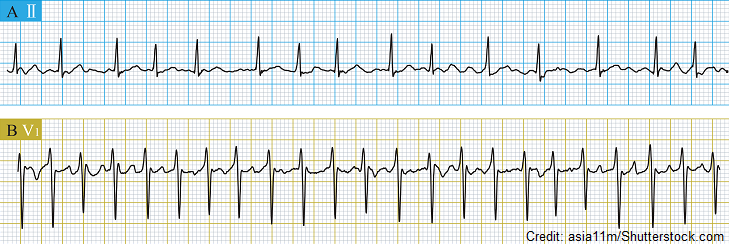
3. The patient’s ECG shows the rhythm above. The patient is symptomatic and experiencing shortness of breath and chest pain. The patient’s blood pressure in 80/44 with the heart rate fluctuating between 130-150s. The nurse calls a rapid response and prepares the patient for?
A. Ablation
B. Synchronized cardioversion
C. Defibrillation
D. Pacemaker implantation
The answer is B. The rhythm above is uncontrolled atrial fibrillation with a ventricular rate >100. The patient is experiencing signs and symptoms of decreased cardiac output, which can occur when atrial fibrillation when this rhythm is fast (hence out of control). The patient needs to be cardioverted so the rhythm can return back to normal sinus rhythm.
4. Which statements below best described a transesophageal echocardiogram (TEE) used in the treatment of atrial fibrillation? Select all that apply:
A. It can be performed before a cardioversion to assess for blood clots in the heart.
B. This procedure destroys electrical pathways in the heart to help return a patient’s heart rhythm to normal.
C. During this procedure, an ultrasound probe is inserted in the patient’s mouth down through the esophagus where it takes ultrasound pictures of the heart.
D. During the procedure, a transducer is placed on the chest that sends ultrasound waves through the skin so pictures can be obtained of the heart’s blood flow.
The answers are A and C. A TEE can be performed before a cardioversion to assess for blood clots in the heart (for example before a cardioversion for the treatment of atrial fibrillation). In addition, during this procedure, an ultrasound probe is inserted in the patient’s mouth down through the esophagus where it takes ultrasound pictures of the heart.
5. What complications can develop from uncontrolled atrial fibrillation that the nurse should monitor for? Select all that apply:
A. Hypertension
B. Stroke
C. Heart failure
D. Hyperglycemia
The answers are B and C. Remember from the lecture I discussed how atrial fibrillation leads to incomplete atrial contraction that causes the atria to quiver. This can lead to blood pooling in the atria. When blood pools it coagulates (hence forms clots). The clots can break off and travel through the body leading to a stroke. In addition, if the rate if too fast (not controlled) the heart’s ability to pump blood throughout the body fails because it becomes overworked and tired. This leads to heart failure.
6. True or False: If a patient has been in atrial fibrillation for more than 48 hours, anticoagulation is needed prior to a cardioversion due to blood clot risks.
True
False
The answer is TRUE.
Ventricular Tachycardia (Vtach) Quiz ECG
6. True or False: If a patient has been in atrial fibrillation for more than 48 hours, anticoagulation is needed prior to a cardioversion due to blood clot risks.
True
False
The answer is TRUE.
Atrial Fibrillation (A-Fib) Quiz ECG

7. Which rhythm above is atrial fibrillation?
A. Rhythm 1
B. Rhythm 2
C. Rhythm 3
D. Rhythm 4
The answer is D: Rhythm 4
Don’t forget to tell your friends about this quiz by sharing it your Facebook, Twitter, and other social media. You can also take more fun nursing quizzes.
*Disclaimer: While we do our best to provide students with accurate and in-depth study quizzes, this quiz/test is for educational and entertainment purposes only. Please refer to the latest NCLEX review books for the latest updates in nursing. This quiz is copyright RegisteredNurseRn.com. Please do not copy this quiz directly; however, please feel free to share a link to this page with students, friends, and others.