In this review, we will walk through how to solve injectable medication dosage calculation problems using the ratio and proportion method.
With ratio and proportion, the key idea is that we set up two ratios:
- A known ratio (what we are supplied with)
- An unknown ratio (what we are trying to find)
At the end, these two ratios should be equivalent, and we solve by cross multiplying.
Practice Problem 1
The provider orders 0.5 mg IM every month. You’re supplied with a 1000 mcg/mL vial. How many mL/dose will you administer?
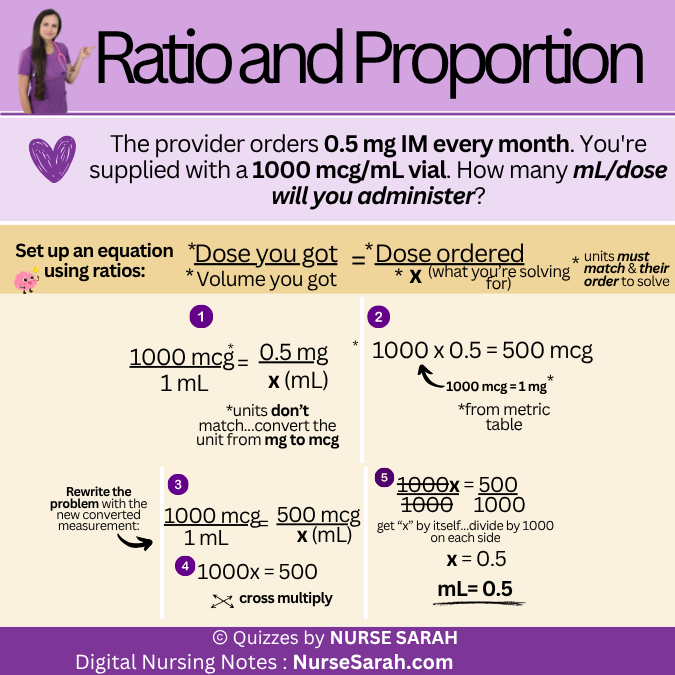
The healthcare provider has ordered 0.5 mg IM monthly. You are supplied with a vial that contains 1,000 micrograms per milliliter. We need to determine how many milliliters per dose to give.
Step 1: Set up the known ratio
The known ratio comes from what we are supplied with:
1,000 micrograms / 1 milliliter
This represents what is in the vial.
Step 2: Set up the unknown ratio
The unknown ratio comes from what is ordered:
0.5 mg / x milliliters
We are solving for milliliters per dose.
Step 3: Check units and convert
Before we can solve, we need to make sure the units match.
At the top, we have micrograms and milligrams. These do not match, so we need to convert.
From the metric table:
1,000 micrograms = 1 milligram
Since we are converting from milligrams to micrograms, we multiply:
0.5 mg × 1,000 = 500 micrograms
Now both ratios are in micrograms.
So the equation becomes:
1,000 micrograms / 1 milliliter = 500 micrograms / x
Step 4: Cross multiply
Now we cross multiply:
1,000 × x = 500 × 1
This simplifies to:
1,000x = 500
Step 5: Solve for x
Divide both sides by 1,000:
x = 500 / 1,000
x = 0.5 milliliters
Final Answer: 0.5 mL per dose
Video Tutorial
Practice Problem 2
A patient is prescribed 1 g IM of a medication to be taken every 8 hours. You’re supplied with 250 mg/mL. How many mL/day will be administered?
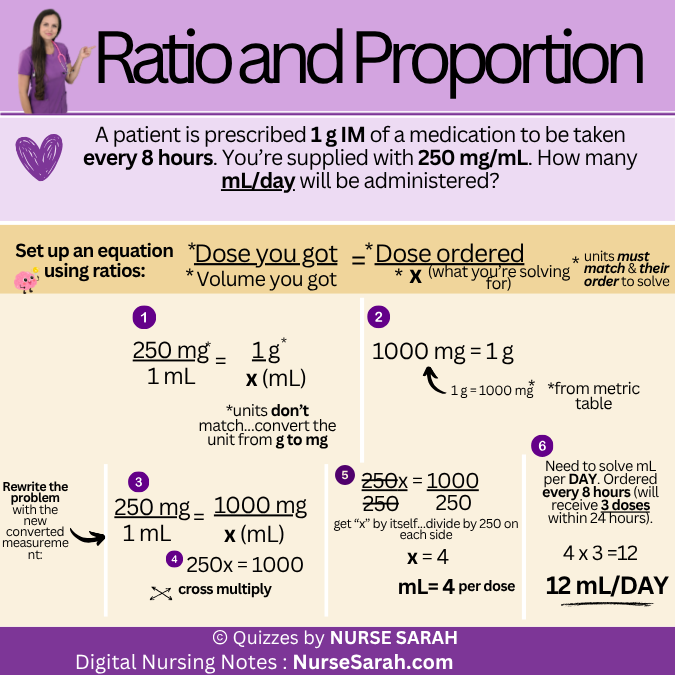
The healthcare provider has ordered 1 gram IM every 8 hours. You are supplied with a vial that contains 250 mg per milliliter. We need to determine milliliters per day.
Step 1: Set up known ratio
From what we are supplied with:
250 mg / 1 milliliter
Step 2: Set up unknown ratio
From the order:
1 gram / x milliliters
Step 3: Convert units
We need consistent units. Convert grams to milligrams:
1 gram = 1,000 milligrams
So the order becomes:
1,000 mg / x milliliters
Now we can solve.
Step 4: Cross multiply
250 × x = 1,000 × 1
250x = 1,000
Step 5: Solve for x (per dose)
x = 1,000 / 250
x = 4 milliliters per dose
Step 6: Convert to per day
The medication is given every 8 hours.
There are 24 hours in a day:
24 ÷ 8 = 3 doses per day
Now multiply:
4 mL × 3 = 12 mL per day
Final Answer: 12 mL per day
Practice Problem 3 (Weight-Based Dosage)
The provider orders 2 mg/kg subcutaneous every 12 hours. You’re supplied with 40 mg/0.4 mL. The patient weighs 90 lbs. How many mL/dose will you administer?
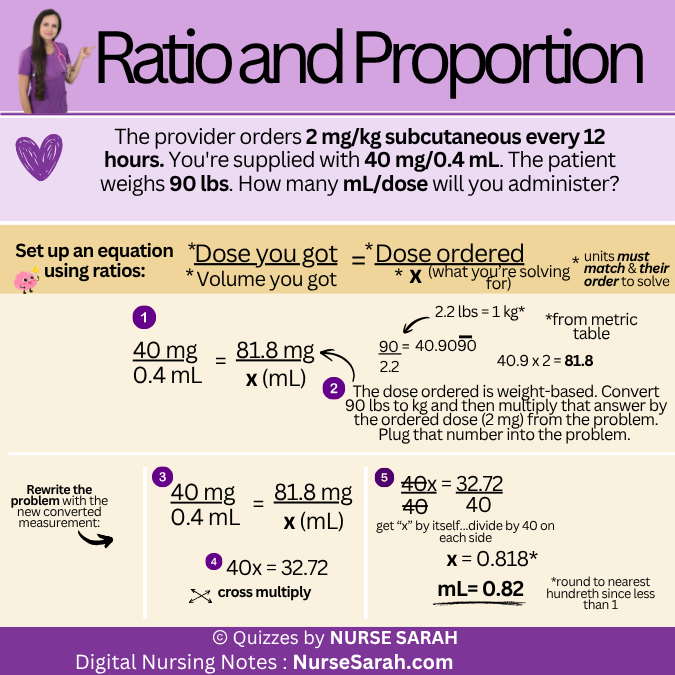
The healthcare provider has ordered 2 mg per kg subcutaneous every 12 hours. The patient weighs 90 pounds. You are supplied with 40 mg per 4 mL. We need to determine milliliters per dose.
Step 1: Convert weight to kilograms
We know:
2.2 pounds = 1 kilogram
So:
90 ÷ 2.2 = 40.9 kg (rounded to the nearest tenth)
Step 2: Calculate ordered dose
The order is:
2 mg per kg
So:
40.9 × 2 = 81.8 mg
This is the total ordered dose per administration.
Step 3: Set up known ratio
From what we are supplied:
40 mg / 0.4 mL
Step 4: Set up unknown ratio
From the calculated order:
81.8 mg / x mL
Step 5: Cross multiply
40 × x = 81.8 × 0.4
40x = 32.72
Step 6: Solve for x
x = 32.72 / 40
x = 0.818 mL
Since this is less than 1 mL, we round to the nearest hundreth:
Final Answer: 0.82 mL per dose
Key Points to Remember
When using ratio and proportion for injectable dosage calculations:
- Always set up a known ratio and an unknown ratio
- Make sure units match before solving
- Convert between metric units when necessary
- Cross multiply once ratios are equivalent
- Adjust final rounding based on the size of the dose
- Always double-check whether the question asks per dose or per day
Test your knowledge: Injectable Dosage Calculation Practice Quiz