As a nurse you want to be familiar with different types of heart rhythms, especially ones that most commonly affect patients like atrial fibrillation.
Before reviewing this lecture notes, don’t forget to watch the lecture on atrial fibrillation.
Atrial fibrillation, also known as a-fib, is one of the most common rhythms seen in a hospitalized patient. In this rhythm, the atria are contracting rapidly at an irregular, fast rate. This really causes the atria to quiver instead of fully contract.
This quivering leads blood to pool in the atria, and when blood is stagnate (hence pooling) for a period of time it starts to clot. Therefore, there is a risk of blood clots developing in patients with atrial fibrillation. This development of blood clots can lead to a stroke.
ECG/EKG Study Guide and Workbook for Nursing Students
“ECG/EKG Interpretation Study Guide and Workbook by Nurse Sarah”. This book contain 100 pages of content featuring 26 ECG rhythm break downs, 51 ECG rhythm analysis practice problems, 100 comprehensive ECG practice questions, worksheets, chart summaries, and more.
You can get an eBook version here: “Nurse Sarah ECG Book” or a physical copy here: “ECG/EKG Interpretation Study Guide by Nurse Sarah“.
Characteristics and Criteria of Atrial Fibrillation:
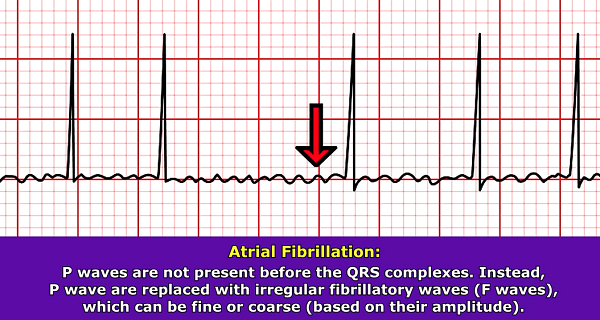
- P-waves are not present before each QRS complex
- Instead the p-waves are replaced with irregular fibrillary waves (also called f-waves), which can be described as fine or coarse depending on their amplitude. Due to this, the atrial rate or PR interval can’t be assessed, but if we could count the atrial rate, it would be really fast and irregular ( >400 bpm).
- QRS complexes present and measure less than 0.12 seconds. The QRS complex tells us about the ventricular rate and rhythm.
- The ventricular rhythm will be irregular.
- The ventricular rate can be anywhere from normal to fast >100 bpm.
- If the rate is greater than 100 it is termed uncontrolled a-fib, and significant complications can happen from this like heart failure, especially if the rhythm doesn’t become under control.
- If the rate is <100 bpm it is considered controlled a-fib.

Causes of Atrial Fibrillation
This rhythm can develop after heart surgery or be related to a structural problem in the heart like mitral valve disease. Furthermore, it can happen in cases of heart disease like coronary artery disease, myocardial infarction, or pericarditis. And lung conditions like COPD.
Interestingly, patients with sleep apnea are at greater risk for developing atrial fibrillation as well. Therefore, as a nurse be sure to screen patients for sleep apnea.
Treatment for Atrial Fibrillation
Treatment for a-fib depends on how stable the patient is and if they’re having symptoms.
Stable (no symptoms) and Controlled: Monitor to make sure rate stays controlled <100 and notify MD for further orders.
Unstable and uncontrolled:
Synchronized electrical cardioversion can be administered. During this procedure, an electrical shock is synchronized with the patient’s R-wave to help convert the patient back into normal sinus rhythm.
Another type of treatment is a cardioversion using medications, known as a pharmacological cardioversion. Medications like Cardizem (Diltiazem), Adenosine, Amiodarone etc. can be used for this type of cardioversion.
As a side note, it is important to know how long the patient has been in atrial fibrillation. If the patient has been in a-fib >48 hours, they may need anticoagulation therapy (Warfarin, Heparin etc.) before the procedure to prevent a problem with blood clots. In addition, the patient may need anticoagulation for several weeks after the procedure.

A TEE (transesophageal echocardiogram) can be performed before the cardioversion to assess for a blood clot in the heart before cardioverting. This procedure uses an ultrasound probe that is inserted through the patient’s mouth and into the esophagus to assess the back of the patient’s heart for possible blood clots.
If conversion from atrial fibrillation is unsuccessful the patient may be a candidate for an ablation. This is a procedure that ablates (hence destroys or erodes) some of the tissue in the heart to prevent it from irregularly firing.
Now, test your knowledge with this free Atrial Fibrillation Quiz.
References:
American Heart Association | Algorithms. (n.d.). Retrieved September 2, 2022, from https://cpr.heart.org/en/resuscitation-science/cpr-and-ecc-guidelines/algorithms#adult
Atrial fibrillation. (2022, October 14). Retrieved September 5, 2022, from https://www.cdc.gov/heartdisease/atrial_fibrillation.htm
What is atrial fibrillation? [Updated 22 March 2022] Retrieved September 5, 2022, from https://www.nhlbi.nih.gov/health/atrial-fibrillation