In this review, we will walk through how to solve injectable medication dosage calculation problems using dimensional analysis.
With dimensional analysis, the goal is to arrange conversion factors so that unwanted units cancel out, leaving only the unit you are trying to solve for.
When setting up dimensional analysis problems:
- Always include the ordered dose first.
- Bring units over carefully.
- Use conversion factors when units do not match.
- Cancel units as you go.
- Multiply across the top.
- Multiply across the bottom.
- Divide to obtain the final answer.
Practice Problem 1
The provider orders 0.5 mg IM every month. You’re supplied with a 1,000 mcg/mL vial. How many mL/dose will you administer?
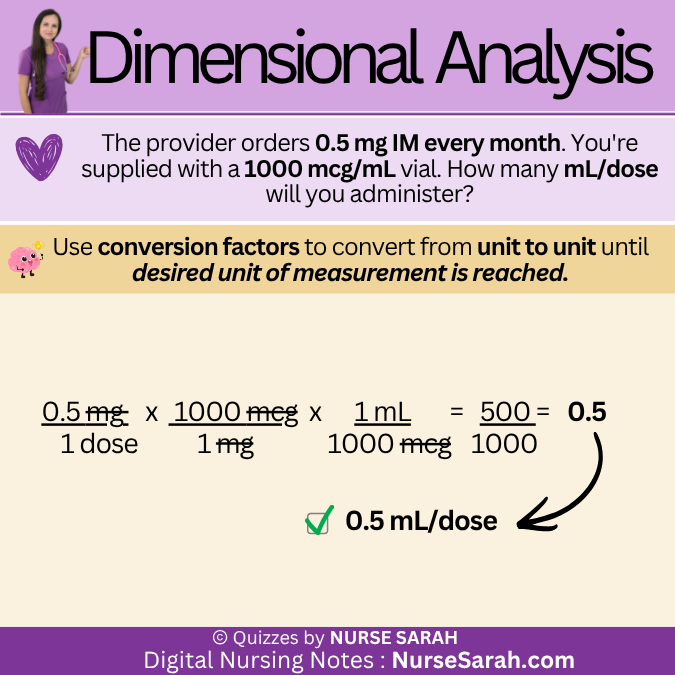
The healthcare provider has ordered 0.5 mg IM every month. You are supplied with a vial that contains 1,000 micrograms per milliliter. We need to determine how many milliliters per dose to administer.
Step 1: Start with the ordered dose
0.5 mg / 1 dose
Step 2: Convert milligrams to micrograms
The supplied medication is measured in micrograms, so we need matching units.
From the metric table:
1 mg = 1,000 mcg
Set up the conversion factor:
1,000 mcg / 1 mg
The milligrams cancel out.
Step 3: Use the supplied concentration
The vial contains:
1,000 mcg / 1 mL
Set up the conversion factor so micrograms cancel:
1 mL / 1,000 mcg
The micrograms cancel out.
Step 4: Verify the remaining units
After canceling units, we are left with:
mL / dose
This is exactly what the problem is asking for.
Step 5: Solve
Multiply across the top:
0.5 × 1,000 × 1 = 500
Multiply across the bottom:
1 × 1 × 1,000 = 1,000
Divide:
500 ÷ 1,000 = 0.5
Final Answer: 0.5 mL per dose
Video Tutorial
Practice Problem 2
The provider orders 1 g IM every 8 hours. You’re supplied with 250 mg/mL. How many mL/day will be administered?
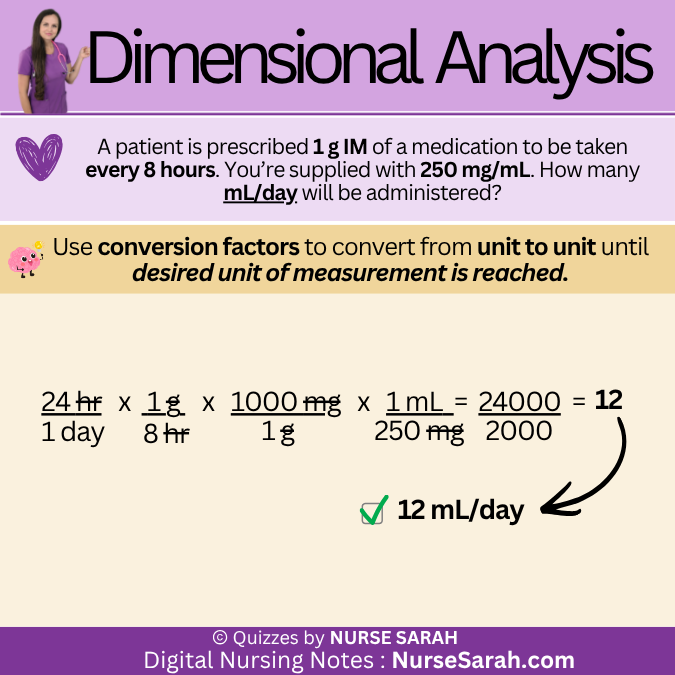
The healthcare provider has ordered 1 gram IM every 8 hours. You are supplied with a vial containing 250 mg per milliliter. We need to determine the total milliliters administered per day.
Step 1: Incorporate the time component
Because the question asks for mL per day, begin with:
24 hours / 1 day
Step 2: Use the ordered dose
The patient receives:
1 gram / 8 hours
Set up the conversion factor so hours cancel.
Step 3: Convert grams to milligrams
The supplied medication uses milligrams, so convert grams.
From the metric table:
1 g = 1,000 mg
Set up the conversion factor:
1,000 mg / 1 g
The grams cancel out.
Step 4: Use the supplied concentration
The vial contains:
250 mg / 1 mL
Set up the conversion factor:
1 mL / 250 mg
The milligrams cancel out.
Step 5: Verify the remaining units
After canceling units, the remaining units are:
mL / day
This matches what the problem is asking for.
Step 6: Solve
Multiply across the top:
24 × 1 × 1,000 × 1 = 24,000
Multiply across the bottom:
1 × 8 × 1 × 250 = 2,000
Divide:
24,000 ÷ 2,000 = 12
Final Answer: 12 mL per day
Additional Calculation: mL per Dose
The medication is given every 8 hours.
24 ÷ 8 = 3 doses per day
12 mL ÷ 3 doses = 4 mL per dose
Therefore:
4 mL per dose
12 mL per day
Practice Problem 3 (Weight-Based Dosage)
The provider orders 2 mg/kg subcutaneous every 12 hours. You’re supplied with 40 mg/0.4 mL. The patient weighs 90 lbs. How many mL/dose will you administer?
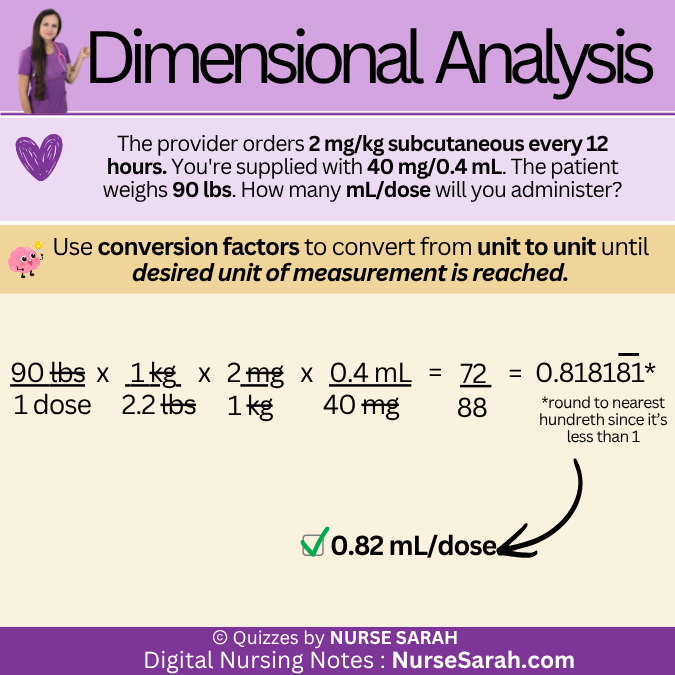
The healthcare provider has ordered 2 mg/kg subcutaneous every 12 hours. The patient weighs 90 pounds. You are supplied with 40 mg per 0.4 mL. We need to determine milliliters per dose.
Step 1: Start with the patient’s weight
90 lb / 1 dose
Step 2: Convert pounds to kilograms
The medication order is based on kilograms.
From the metric table:
2.2 lb = 1 kg
Set up the conversion factor:
1 kg / 2.2 lb
The pounds cancel out.
Step 3: Apply the ordered dosage
The provider ordered:
2 mg / 1 kg
Set up the conversion factor so kilograms cancel.
Step 4: Use the supplied concentration
The vial contains:
40 mg / 0.4 mL
Set up the conversion factor:
0.4 mL / 40 mg
The milligrams cancel out.
Step 5: Verify the remaining units
After canceling units, the remaining units are:
mL / dose
This is exactly what we are solving for.
Step 6: Solve
Multiply across the top:
90 × 1 × 2 × 0.4 = 72
Multiply across the bottom:
1 × 2.2 × 1 × 40 = 88
Divide:
72 ÷ 88 = 0.818181…
Step 7: Round
Because the answer is less than 1 mL, round to the nearest hundredth.
0.818181… = 0.82
Final Answer: 0.82 mL per dose
Rounding Reminder
- If the answer is less than 1 mL, round to the nearest hundredth.
- If the answer is greater than 1 mL, round to the nearest tenth.
- Always follow your school’s specific rounding rules.
Key Points to Remember
When using dimensional analysis for injectable medication dosage calculations:
- Start with the ordered dose.
- Bring all units through the problem.
- Convert units when measurements do not match.
- Use the metric table for conversions.
- Cancel units until only the desired unit remains.
- Multiply all values across the top.
- Multiply all values across the bottom.
- Divide to obtain the final answer.
- Verify that the final units match what the question is asking for.
- Follow your program’s rounding rules when reporting answers.
Test your Knowledge: Injectable Medications Dosage Calculation Questions Quiz