In this review, we’ll walk through three liquid oral suspension dosage calculation problems using dimensional analysis. The goal of dimensional analysis is to set up one continuous equation where units cancel out until you are left with the unit you are trying to solve for.
Remember, the key is to start with what was ordered and continue multiplying by conversion factors until you reach the desired unit.
Practice Problem 1
A patient is prescribed 5,000 micrograms (mcg) of a medication to be taken by mouth twice a day (BID). The available suspension contains 3 milligrams (mg) per milliliter (mL). How many mL/dose will be administered?
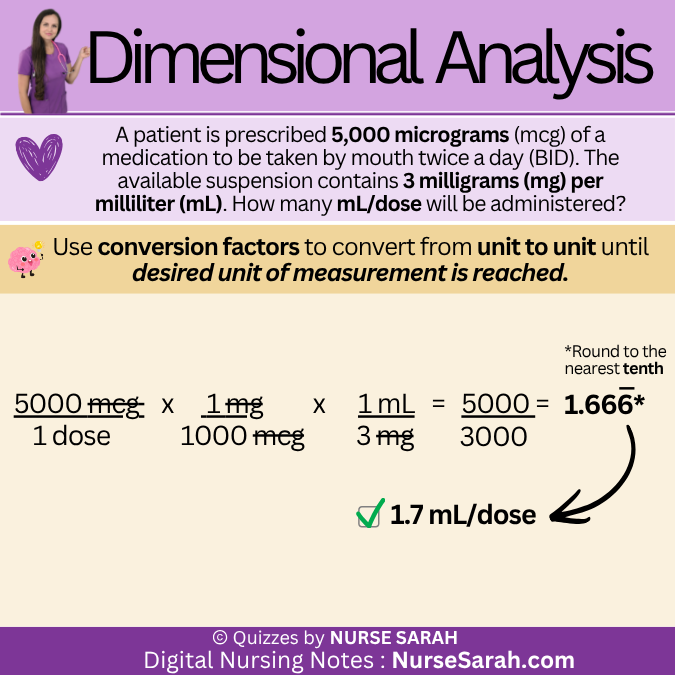
The order is for 5,000 micrograms by mouth twice a day. The medication supplied by the pharmacy contains 3 milligrams per milliliter. We need to determine how many milliliters should be given per dose.
Step 1: Start with the ordered dose
The healthcare provider ordered 5,000 micrograms for one dose.
Since the medication on hand is supplied in milligrams, we need to convert micrograms to milligrams before we can use the information on the bottle.
Step 2: Convert micrograms to milligrams
From the metric system, we know that:
1 milligram = 1,000 micrograms
Therefore, 5,000 micrograms can be converted using the appropriate conversion factor.
After the micrograms cancel out, we are left with milligrams, which matches the unit provided by the pharmacy.
Step 3: Use the medication supplied
The bottle contains:
3 milligrams per 1 milliliter
Now the milligram units cancel, leaving us with milliliters per dose, which is exactly what we need to solve for.
Step 4: Perform the calculation
Multiply the numbers on the top:
5,000
Multiply the numbers on the bottom:
3,000
Now divide:
5,000 ÷ 3,000 = 1.666 repeating
Step 5: Round the answer
When rounded to the nearest tenth:
1.666 becomes 1.7
Answer: 1.7 mL per dose
Dimensional Analysis Video Tutorial
Practice Problem 2
A patient is prescribed 1,000 mg of medication by mouth daily. The available suspension contains 2 grams (g) per 10 mL. How many tsp/dose will you administer?
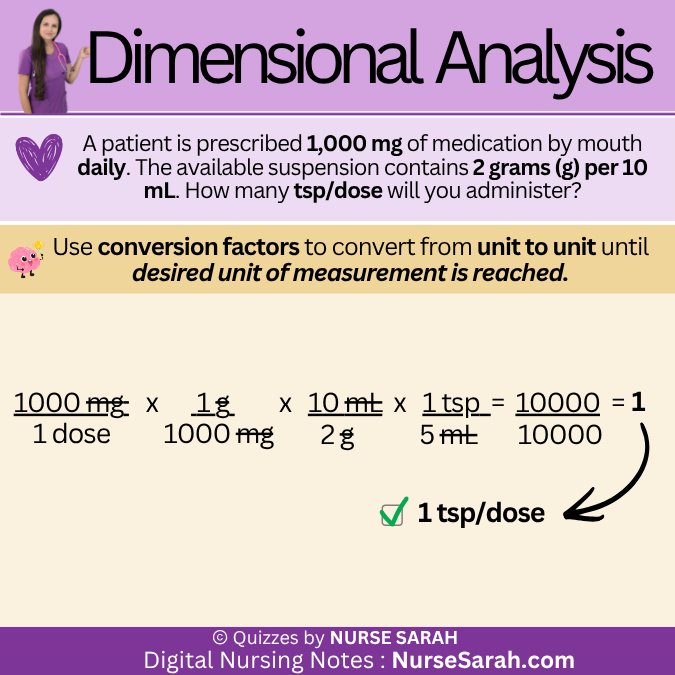
The order is for 1,000 milligrams by mouth daily. The medication supplied contains 2 grams per 10 milliliters. The question asks for teaspoons per dose.
Notice that the medication is supplied in grams and milliliters, but the answer must be in teaspoons. This means multiple conversions are needed.
Step 1: Start with the ordered dose
The healthcare provider ordered:
1,000 milligrams per dose
Step 2: Convert milligrams to grams
From the metric system:
1 gram = 1,000 milligrams
After converting, the milligram units cancel and we are left with grams.
Step 3: Use the medication supplied
The bottle contains:
2 grams per 10 milliliters
The gram units cancel, leaving milliliters.
At this point, we have milliliters per dose, but the problem asks for teaspoons.
Step 4: Convert milliliters to teaspoons
Using the standard conversion:
5 milliliters = 1 teaspoon
The milliliter units cancel, leaving teaspoons per dose.
Step 5: Perform the calculation
Multiply the numbers on the top:
10,000
Multiply the numbers on the bottom:
10,000
Now divide:
10,000 ÷ 10,000 = 1
Answer: 1 teaspoon per dose
Practice Problem 3
A patient is prescribed 500 mg of medication by mouth every 8 hours. The available suspension contains 150 mg per 5 mL. How any mL/day will be administered?
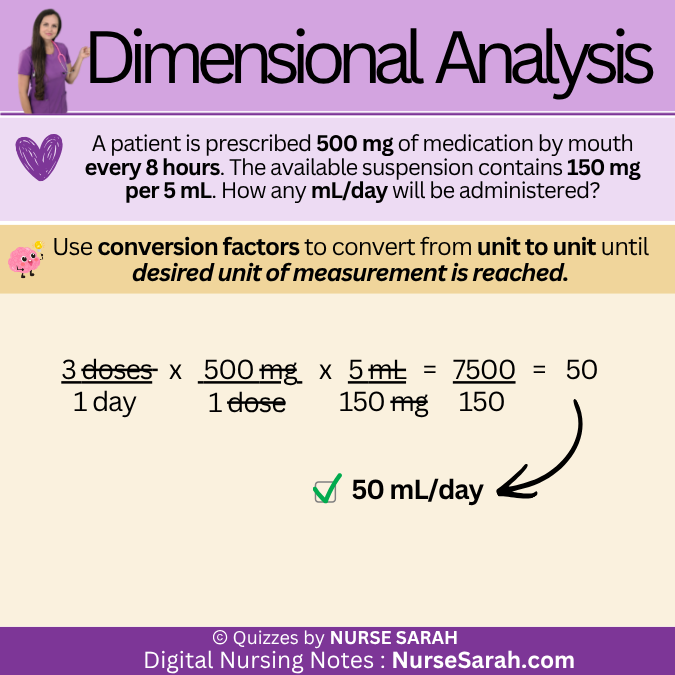
The order is for 500 milligrams by mouth every 8 hours. The medication supplied contains 150 milligrams per 5 milliliters. We need to determine how many milliliters the patient will receive per day.
This question is different because it does not ask for milliliters per dose. Instead, it asks for the total milliliters administered in an entire day.
Step 1: Determine the number of doses per day
The medication is given every 8 hours.
There are 24 hours in one day.
24 ÷ 8 = 3
Therefore, the patient receives:
3 doses per day
This information is important because our final answer must be expressed as milliliters per day.
Step 2: Start the dimensional analysis setup
Begin with:
3 doses per day
From the order, we know:
1 dose = 500 milligrams
The dose units cancel, leaving milligrams and day.
Step 3: Use the medication supplied
The bottle contains:
150 milligrams per 5 milliliters
The milligram units cancel, leaving milliliters per day.
Now we have reached the unit we were asked to find.
Step 4: Perform the calculation
Multiply the numbers on the top:
3 × 500 × 5 = 7,500
Multiply the numbers on the bottom:
150
Now divide:
7,500 ÷ 150 = 50
Answer: 50 mL per day
Key Points to Remember
When solving liquid oral suspension dosage calculations using dimensional analysis:
- Always start with what was ordered.
- Use conversion factors to cancel units until you reach the desired unit.
- Pay close attention to whether the problem asks for a dose amount or a daily amount.
- Memorize common metric conversions, as they are frequently needed during dosage calculations.
- Do not round until the final step unless instructed otherwise.
Test your knowledge: Liquid Oral Suspension Practice Quiz