In nursing, patient positioning plays a vital role in delivering patient care. As a nursing student, you want to be able to identify these different types of positions.
This review will guide you through the different patient positioning terms, what the position can be used for, and complications that can arise from the position.
Before reviewing, don’t forget about the quiz and patient positioning lecture.
Supine Position

The supine position is where the patient is placed flat on their back. The head and the spine will be lying on the support surface with the legs extended.
Mnemonic to remember the position: “Put the patient on their SPINE to be supine!”
This position is usually used for sleeping, and several medical procedures such as after a lumbar puncture (can sometimes help prevent a headache), cardiac procedures (heart cath via the femoral artery), abdominal surgeries including c-sections, and a head-to-toe assessment.
However, this position can cause pressure injuries at the back of the head, heel, sacral/coccyx area, elbow, and scapula. It can also cause foot drop.
The reason for this is because the bony prominences put pressure on the surrounding skin when they come into contact with the surrounding hard surface. Patients who are unable to shift their weight are more vulnerable to pressure injuries, particularly those in an unconscious state.
Prone Position
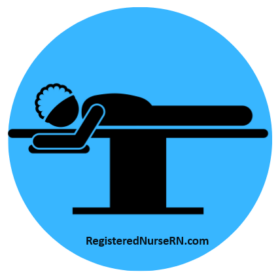
In the prone position, patients lie flat on their stomach. The head can be turned to either the left or right side and the legs are extended.
Mnemonic to remember the position: Look at the word PRONE. Take note of the word “on” and the letter “e” in the word. Remember that when the patient is PRONE, they are lying “ON” their “Entrails” or “Esophagus”.
This position has shown particular benefits for patients suffering from respiratory issues like ARDS and COVID-19. It enhances gas exchange, mobilizes secretions, and reduces the heart’s workload.
However, some potential complications may arise, including ear pressure injuries, tube dislodgment, or blockage, making airway maintenance challenging, ocular injury, and brachial plexus damage.
Dorsal Recumbent Position

Patients in the dorsal recumbent position lie on their backs with their knees bent. While it’s similar to the prone position, the key difference is that the knees are BENT, hence the name dorsal recumBENT. Think of the name of the position to remember it better – dorsal means “the back”, like the dorsal fin on a dolphin, and recumbent means “lying down”.
This position is typically utilized for procedures such as foley catheterization in females and peri-care. However, there are potential issues associated with it, such as pressure injuries to the heel, shoulder, elbow, coccyx/sacral area, and the back of the head.
Lithotomy Position

The lithotomy position entails placing the patient on their back with their legs bent at a 90-degree angle at the hip. In most cases, stirrups are used to aid in leg flexion.
It’s worth noting that the position derives its name from its application in removing stones from the urinary system. The term lithotomy breaks down into lith, meaning stones, and otomy, which denotes cutting or incision.
This position is often used for vaginal procedures, childbirth, vaginal exams, and genitourinary system surgeries. Potential problems are the same as with the dorsal recumbent position, with the added risk of nerve damage from stirrups.
Sims’ Position (Semi-prone)

Sims’ position, also known as semi-prone, involves the patient lying on their left side with the right knee and hip flexed and the left hip and knee slightly extended. It’s important to note the right side can also be utilized. Typically, this position is associated with the patient being on the left side because most providers are right-handed.
This position is used for procedures like foley catheter insertion on females who cannot tolerate the dorsal recumbent position and enema administration.
The potential problems include pressure injuries to the ear, greater trochanter, or side of the heel and ankle.
Lateral Recumbent Position

The lateral recumbent position involves the patient lying on either their right or left side. This position may also be referred to as right or left lateral recumbent.
To help you remember this position, remember that the term lateral means “to the side of”.
This position is beneficial for patients experiencing seizures, unconsciousness, or post-op from certain surgeries like throat procedures, as it can prevent aspiration and maintain an open airway.
Furthermore, this position can be used during hip or kidney surgery. However, potential problems that can arise from this position are pressure injuries and damage to the brachial plexus.
Fowler’s Positions
When studying Fowler’s positions, keep in mind that these positions deal with the angle of the head of the bed. The patient will be lying on their back (supine) and the legs can be extended or flexed.
Fun Fact: These positions get their name from a surgeon’s last name, “George Ryerson Fowler”.
There are 4 types of Fowler’s positions:
- Low Fowler’s*
- Semi-Fowler’s*
- Fowler’s
- High Fowler’s
Low and Semi-Fowler’s Position
*It’s important to note that some sources will group low and semi-Fowler’s together and simply call the position semi-Fowlers, with the head of the bed elevated up to a 45-degree angle.
In low Fowler’s position, the head of the bed is at a 15-30′ angle. While with semi-Fowler’s, the head of the bed is at a 30-45′ angle.

These positions can be used for sleeping, especially if the patient is experiencing breathing problems associated with heart failure. They are also beneficial after surgery to prevent swelling of the head and neck.
The use of a 30-degree angle is frequently used for patients experiencing elevated intracranial pressure. This position can help reduce cerebral pressure and maintain proper perfusion.
The 30-45 degree angle is used when a feeding tube is in place to prevent aspiration or during suctioning.
Furthermore, in critically ill patients, this position can help decrease aspiration and the risk of ventilator-associated pneumonia in those undergoing mechanical ventilation.
Problems with these positions include pressure injuries to the sacral/coccyx, shoulders, spine and heels.
Fowler’s Position

Fowler’s position involves the patient sitting up in bed at a 45-60 degree angle.
This position is often used for eating, drinking, and easing breathing problems for certain respiratory conditions.
The same pressure injuries as in the low or semi-Fowler’s can occur.
High-Fowler’s Position

This is the highest of all Fowler’s positions with the head of the bed at a 60-90 degree angle. It’s used for the same purposes as the other Fowler’s positions, and additional uses include nasogastric tube insertion and managing autonomic dysreflexia in patients with a T6 or higher spinal cord injury (remember place the patient at a 90′ angle to help decrease the blood pressure).
Trendelenburg Position
There are three types of Trendelenburg positions to remember. Similarly, like the Fowler’s position, these positions are named after Friedrich Trendelenburg, a renowned surgeon.
There are three types of Trendelenburg positions:
- Trendelenburg
- Reverse Trendelenburg
- Modified Trendelenburg
Trendelenburg

The Trendelenburg position involves the patient lying supine with the feet elevated and the head lowered. This position is used for central venous catheter line placement and removal of the internal jugular and subclavian because it may help decrease the risk of air embolism. In addition, it is a position used during pelvic surgeries.
At one point, it was considered a treatment method for hypotension. However, recent studies indicate that it does not aid in improving hypotension. Instead, it has been shown to negatively impact cardiac and lung function, as well as increasing intracranial pressure (Castiglione, 2015).
Reverse Trendelenburg Position

The reverse Trendelenburg position is the opposite of the Trendelenburg position, with the patient supine and the head elevated and the feet lowered.
This position is used for surgeries of the head and neck because it can help decrease blood flow and minimize blood loss.
In addition, it can be used when a patient has closed cervical traction.
Modified Trendelenburg Position

The modified Trendelenburg position involves the patient lying flat (supine) with their feet elevated and their head level with the upper body.
This position can be helpful with hemodynamic problems as it may increase venous return.
A case study in 2023 showed it improved the hemodynamic status of a patient with grade II hemorrhagic shock. (Chair, I.A., Fitria, N., 2023).
You may be interested in: Patient Positioning Quiz
References:
Armstrong M, Moore RA. Anatomy, Patient Positioning. [Updated 2022 Oct 31]. In: StatPearls [Internet]. Treasure Island (FL): StatPearls Publishing; 2023 Jan-. [Figure, Fowler and Semi-Fowler positions, Full…] Available from: https://www.ncbi.nlm.nih.gov/books/NBK513320/figure/article-26759.image.f2/
Castiglione SA & Landry T. What evidence exists that describes whether the Trendelenburg and/or modified Trendelenburg positions are effective for the management of hospitalized patients with hypertension? Rapid Review Evidence Summary. McGill University Health Centre; October 2015.
Hadaya J, Benharash P. Prone Positioning for Acute Respiratory Distress Syndrome (ARDS). JAMA. 2020;324(13):1361. doi:10.1001/jama.2020.1490
Head of Bed Elevation or Semirecumbent Positioning Literature Review. Content last reviewed January 2017. Agency for Healthcare Research and Quality, Rockville, MD. https://www.ahrq.gov/hai/tools/mvp/modules/technical/head-bed-elevation-lit-review.html
Nooraei N, Dabbagh A, Niazi F, Mohammadi S, Mohajerani SA, Radmand G, Hashemian SM. The Impact of Reverse Trendelenburg Versus Head-up Position on Intraoperative Bleeding of Elective Rhinoplasty. Int J Prev Med. 2013 Dec;4(12):1438-41. PMID: 24498500; PMCID: PMC3898450.
Ostrow CL. Use of the Trendelenburg position by critical care nurses: Trendelenburg survey. Am J Crit Care. 1997 May;6(3):172-6. PMID: 9131195.
Tse A, Schick MA. Central Line Placement. [Updated 2022 Dec 21]. In: StatPearls [Internet]. Treasure Island (FL): StatPearls Publishing; 2023 Jan-. Available from: https://www.ncbi.nlm.nih.gov/books/NBK470286/