Learn lung auscultation points and normal breath sounds vs abnormal breath sounds. This article will highlight everything you need to know about assessing a patient’s lung sounds. As a nursing student or nurse, it is important you know how to correctly assess a patient during a head-to-toe assessment. Listening to lung sounds are a vital part of this assessment.
In the previous review, I covered how to assess heart sounds. So, after you read this article be sure to watch the video and read the highlights on how to perform this assessment skill as well.
Don’t forget to take the lung sounds quiz which will test you on lung auscultation landmarks and audio sounds.
You will learn the following:
- The Basics about Lung Auscultation
- Anterior Lung Auscultation Points
- Posterior Lung Auscultation Points
- Normal Lung Sounds
- Abnormal Breath Sounds
Nurse Sarah’s Notes and Merch
Just released is “ABG Interpretation Notes, Mnemonics, and Workbook by Nurse Sarah“. These notes contain 64 pages of Nurse Sarah’s illustrated, fun notes with mnemonics, and worksheets that include over 90 ABG practice problems and 60 test review questions covering ABG concepts.
You can get an eBook version here or a physical copy of the book here.
How to Auscultate Lung Sounds
The Basics of Lung Auscultation:
- Listen to both the anterior and posterior sides of the chest
- Start at the top and work your way to the bottom of the chest while comparing sides (watch the video for the technique)
- When listening note the following:
- A full inspiration and expiration cycle
- The inspiration and expiration sound’s pitch, quality, duration, and if it is normal sounding
- Ask yourself is there anything “weird” heard along with the inspiration and expiration. For example, are you hearing crackles or wheezes?
- Have the patient sitting up with arms resting on lap. When listening to the posterior side of the chest the arms need to definitely be in the lap so the scapulae are separated.
- Use the diaphragm of the stethoscope to auscultate at various locations (see images below)
- Have patient breathe in and out through mouth slowly while listening. Allow the patient to set the pace to prevent hyperventilating , especially patients with breathing disorders like COPD.
Anterior Lung Auscultation Points

Start at: the apex of the lung which is right above the clavicle
Then move to the 2nd intercostal space to assess the right and left upper lobes.
At the 4th intercostal space you will be assessing the right middle lobe and the left upper lobe.
Then midaxillary at the 6th intercostal space you will be assessing the right and left lower lobes.
Note: within these landmarks move your stethoscope around to assess other areas as well.
Posterior Lung Auscultation Points
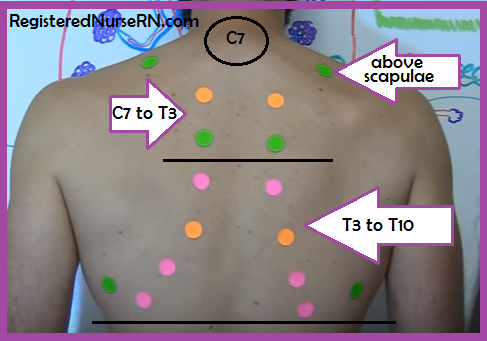
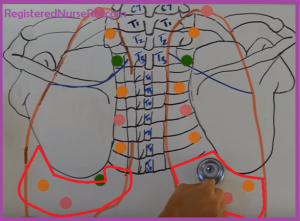
Start right above the scapulae to listen to the apex of the lungs.
Then find C7 (which is the vertebral prominence) and go to T3…in between the shoulder blades and spine. This will assess the right and left upper lobes.
Then from T3 to T10 you will be able to assess the right and left lower lobes.
Again, move your stethoscope around to assess various areas while comparing sides.
What are Normal Breath Sounds?
Audio of Normal Lung Sounds
 Bronchial:
Found where? auscultated over anterior chest and heard over tracheal area
Characteristics:
- sound will have a high pitch and be loud
- inspiration will be slightly SHORTER than expiration
Bronchovesicular:
Found where? auscultated anteriorly and posteriorly and heard over the bronchi
- anteriorly: 1st and 2nd intercostal space near the sternum
- posteriorly: between the scapulae


Characteristics:
- sound will have a medium pitch
- inspiration and expiration will be EQUAL
Vesicular:
Found where? auscultated anteriorly and posteriorly and heard over peripheral lung fields

Characteristics:
- sound will be soft with a low pitch
- inspiration will be slightly GREATER than expiration
What are Abnormal Lung Sounds?
Abnormal Lung Sounds Audio
Discontinuous Lung Sounds:
These are extra sounds heard LESS than 0.2 seconds during a full respiration cycle.
Coarse Crackles:
Crackles are also known as: rales
- Auscultated during inspiration and can extend into expiration as well
- Low-pitched, wet bubbling sound
- May be heard in patient with fluid overload, pneumonia etc.
Fine Crackles:
Crackles are also known as: rales
- Auscultated during inspiration (DON’T CLEAR with COUGHING)
- High-pitched, crackling sound that is similar to a fire crackling
- May be heard in patients with edema in the lungs or ARDS (acute respiratory distress syndrome).
Pleural Friction Rub:
- Auscultated during inspiration and expiration
- Low-pitched/harsh grating sound
- Patients may have pain when breathing in and out due to inflammation of pleural layers
- May be heard in patients with pleuritis
Continuous Lung Sounds:
These are extra sounds heard MORE than 0.2 second during a full respiration cycle
High Pitched, Polyphonic Wheeze
Also known as: Sibilant Wheeze
- Auscultated mainly in expiration but may be present during inspiration
- Sounds like a high-pitched musical instrument with MORE than one type of sound quality
- May be heard in patients with asthma
Low-pitched, Monophonic Wheeze
Also known as: Sonorous Wheeze or Rhonchi
- Auscultated mainly in expiration but may be present at anytime
- Sounds like a low-pitched whistling tune or whine with ONE type of sound quality
- May be heard in patients with COPD or pneumonia etc.
Stridor
- Auscultated during inspiration
- high-pitched whistling or gasping sound with harsh sound quality
- May be seen in children with conditions such as croup or epiglottitis or anyone with an airway obstruction etc.
More Nursing Head-to-Toe Assessment Tips