Anatomy of the heart quiz for students! These heart anatomy quiz contains multiple choice and diagram labeling questions to test your knowledge on the heart’s anatomy.
Don’t forget about other anatomy quizzes , free anatomy lectures, and to review the heart anatomy notes before taking this quiz.
ECG/EKG Study Guide and Workbook for Nursing Students
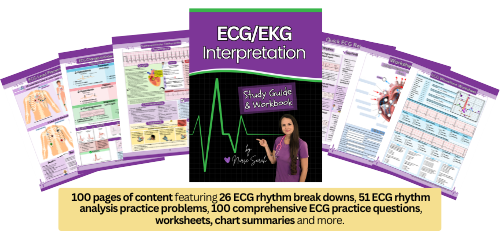
“ECG/EKG Interpretation Study Guide and Workbook by Nurse Sarah”. This book contain 100 pages of content featuring 26 ECG rhythm break downs, 51 ECG rhythm analysis practice problems, 100 comprehensive ECG practice questions, worksheets, chart summaries, and more.
You can get an eBook version here: “Nurse Sarah ECG Book” or a physical copy here: “ECG/EKG Interpretation Study Guide by Nurse Sarah“.
Heart Anatomy Quiz
Heart Anatomy Quiz
1. Which of the following statements is TRUE about the top chamber on the right side of the heart?
A. It receives oxygenated blood from the superior vena cava.
B. It connects to the right bottom chamber of the heart through the bicuspid (mitral) valve.
C. It contains the fossa ovalis, which was once the foramen ovale.
D. It primarily functions in pumping blood to the pulmonary veins.
The answer is C. It contains the fossa ovalis, which was once the foramen ovale. Option A is wrong because it receives deoxygenated (not oxygenated) blood from the superior vena cava. Option B is wrong because it connects the right bottom chamber of the heart through the tricuspid valve. Option D is wrong because it primarily functions in pumping blood to the right ventricle (not the pulmonary veins).

2. Which structure is labeled “A” on the illustration above?
A. chordae tendineae
B. papillary muscles
C. right atrium
D. trabeculae carneae
The answer is B: papillary muscles
3. Which of the following statements CORRECTLY differentiates between atrioventricular valves and semilunar valves?
A. Atrioventricular valves have two cusps and are supported by pressure changes, whereas semilunar valves have three cusps and are supported by chordae tendineae and papillary muscles.
B. Atrioventricular valves have three cusps and are supported by chordae tendineae and papillary muscles, whereas semilunar valves have two cusps and rely on pressure changes for support.
C. Atrioventricular valves are connected to the great vessels and rely on pressure changes, whereas semilunar valves connect the atria and ventricles and are supported by chordae tendineae and papillary muscles.
D. Atrioventricular valves connect the atria and ventricles and are supported by chordae tendineae and papillary muscles, whereas semilunar valves connect the ventricles to great vessels and rely on pressure changes.
The answer is D. Atrioventricular valves connect the atria and ventricles and are uniquely supported by chordae tendineae and papillary muscles, which prevent prolapse during ventricular contraction. In contrast, semilunar valves connect the ventricles to great vessels, such as the pulmonary artery and aorta, and their function is based on pressure changes within the heart, not by chordae tendineae and papillary muscles.
4. Which of the following vessels is responsible for carrying deoxygenated blood from the lower extremities to the right atrium?
A. superior vena cava
B. pulmonary artery
C. inferior vena cava
D. pulmonary veins
The answer is C: Inferior vena cava

5. Which structure is labeled “B” on the illustration above?
A. chordae tendineae
B. bicupsid (mitral) valve
C. pulmonic valve
D. trabeculae carneae
The answer is A: chordae tendineae

6. Which structures are labeled “C, D, E, and F” on the illustration above?
A. C: Tricuspid valve, D: Bicuspid valve, E: Pulmonic valve, F: Aortic valve
B. C: Aortic valve, D: Pulmonic valve, E: Bicuspid valve, F: Tricuspid valve
C. C: Tricuspid valve, D: Pulmonic valve, E: Bicuspid valve, F: Aortic valve
D. C: Pulmonic valve, D: Tricuspid valve, E: Bicuspid valve, F: Aortic valve
The answer is C: Tricuspid valve, D: Pulmonic valve, E: Bicuspid valve, F: Aortic valve
7. Which of the following best describes the function of the superior vena cava?
A. It carries deoxygenated blood from the lower extremities, abdomen, and pelvic area to the right atrium.
B. It carries oxygenated blood from the lungs to the left atrium.
C. It carries deoxygenated blood from the head, neck, upper part of the chest, and upper extremities to the right atrium.
D. It distributes oxygenated blood from the left ventricle throughout the body via a network of arteries.
The answer is C: It carries deoxygenated blood from the head, neck, upper part of the chest, and upper extremities to the right atrium.

8. Which structures are labeled “G, H, and I” on the illustration above?
A. G: aorta, H: pulmonary artery, I: pulmonary veins
B. G: pulmonary artery, H: aorta, I: pulmonary veins
C. G: pulmonary veins, H: aorta, I: pulmonary artery
D. G: pulmonary veins, H: pulmonary artery, I: aorta
The answer is: G: aorta, H: pulmonary artery, I: pulmonary veins

9. Which chamber of the heart is highlighted in yellow and labeled “J”?
A. left atrium
B. right ventricle
C. right atrium
D. left ventricle
The answer is D: left ventricle
10. Which heart chamber is described by the following characteristics: located on the left side of the heart, the bottom chamber, responsible for pumping oxygenated blood throughout the body, and helps form the apex of the heart?
A. right atrium
B. right ventricle
C. left atrium
D. left ventricle
The answer is D: Left Ventricle
Don’t forget to tell your friends about this quiz by sharing it your Facebook, Twitter, and other social media. You can also take more fun nursing quizzes.
*Disclaimer: While we do our best to provide students with accurate and in-depth study quizzes, this quiz/test is for educational and entertainment purposes only. Please refer to the latest NCLEX review books for the latest updates in nursing. This quiz is copyright RegisteredNurseRn.com. Please do not copy this quiz directly; however, please feel free to share a link to this page with students, friends, and others.