If you’re preparing for your maternity exams, understanding the different female pelvic types is essential. Not only does this knowledge help you answer test questions, but it also gives you insight into labor and delivery.
After you’re done reviewing this material, don’t forget you can access our free quiz at the end to test your understanding of this material.
Check out our free maternity nursing reviews.
Quick Review: Basic Pelvic Anatomy
Before diving into pelvic types, it’s important to review some female pelvic anatomy. The pelvis is composed of bones, ligaments, and soft tissues, all working together to allow a baby to pass through the birth canal during a vaginal delivery.
Here’s a quick breakdown of key pelvic bones:
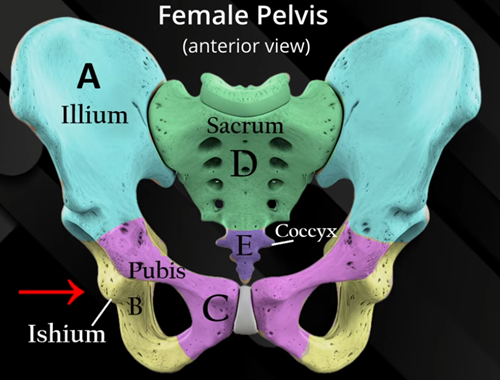
- Ilium: Upper portion of the pelvis
- Ischium: Lower portion of the pelvis
- Pubis: Front portion where the pubic bones meet at the pubic symphysis
- Sacrum: Triangular bone formed by five fused vertebrae
- Coccyx: Commonly called the tailbone, located at the bottom of the sacrum
True Pelvis vs. False Pelvis
The pelvis can be divided into true and false sections:

- True Pelvis: Found below the pelvic brim, this is the actual passageway for the baby during delivery. It includes:
- Pelvic Inlet: Top opening where the baby enters; usually wider than the outlet.
- Midpelvis: Narrowest part of the birth canal where the baby’s head flexes and rotates.
- Pelvic Outlet: Bottom opening that expands during labor; crowning occurs here at station +5.
- False Pelvis: Located above the pelvic brim, it doesn’t participate in labor but supports the growing uterus. Includes the ilium, parts of lumbar vertebrae, and ligaments.
Important Pelvic Measurements
Two diameter measurements are critical for understanding labor potential:

Transverse Diameter: Horizontal measurement of the pelvic inlet, typically around 13 cm. This determines if the baby’s head can engage and descend.
Anterior-Posterior (AP) Diameter: Front-to-back measurement from the pubic symphysis to the sacrum, usually 11–12 cm. This shows how much space the baby has to pass through.
The Four Female Pelvic Types
Now let’s go over the four main female pelvic types you need to know for maternity exams:
- Gynecoid Pelvis

- Shape: Round
- Characteristics: Wide pelvic inlet, ample midpelvis and outlet space
- Delivery Implications: Best pelvic type for vaginal delivery; less likely to have obstructed labor
- Prevalence: ~50% of women
- Android Pelvis

- Shape: Heart-shaped (similar to male pelvis)
- Characteristics: Narrow pelvic inlet, limited midpelvis space
- Delivery Implications: Can cause difficult labor; may require forceps or C-section. Risk of shoulder dystocia is higher.
- Prevalence: 20–25% of women
- Anthropoid Pelvis

- Shape: Long oval
- Characteristics: Narrow transverse diameter but deep AP diameter
- Delivery Implications: Vaginal delivery is possible, but labor may be longer if the baby is in a posterior position.
- Prevalence: 35–40% of women
- Platypelloid Pelvis

- Shape: Flat
- Characteristics: Wide transverse diameter but short AP diameter; shallow pelvis
- Delivery Implications: Difficult labor likely; may require forceps or C-section.
- Prevalence: <3% of women
Maternity Nursing Study Guide

Save Time Studying and Actually Learn
Nurse Sarah’s Maternity Nursing Study Notes are designed to help you study faster, remember more, and stress less. With 151 pages of simplified summaries, illustrations, mnemonics, and visual breakdowns, you’ll breeze through even the trickiest OB topics.
Laser-Focused on What You’ll See on Exams
Whether you’re prepping for nursing school exams or the NCLEX®, these notes focus on the exact maternity/OB concepts you’re most likely to be tested on with no filler, no wasted time.
Memory Hacks, Visuals & Rationales That Make It Stick
Colorful illustrations and proven mnemonics help you actually retain the material, while 220 practice questions with in-depth rationales teach you the “why” behind the right answers so that you’re not just memorizing, you’re understanding.
Available at: NurseSarah.com and Amazon.com* (This is an affiliate link. We may earn a small commission if you make a purchase through this link at no extra cost to you).
You may be interested in: Maternal Pelvic Types Quiz