Atrial flutter (a-flutter) quiz review for nursing students!
This quiz will test your knowledge on how to identify atrial flutter (a-flutter), the causes of this heart rhythm, and the treatment.
Don’t forget to check out the lecture on a-flutter and the access the atrial flutter notes.
Atrial Flutter (A-Flutter) ECG/EKG Quiz Questions
ECG/EKG Study Guide and Workbook for Nursing Students
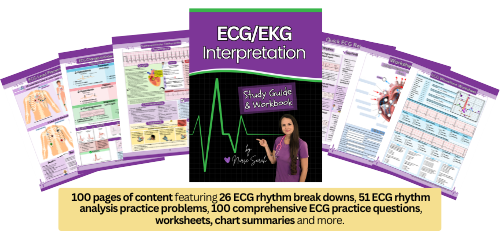
“ECG/EKG Interpretation Study Guide and Workbook by Nurse Sarah”. This book contain 100 pages of content featuring 26 ECG rhythm break downs, 51 ECG rhythm analysis practice problems, 100 comprehensive ECG practice questions, worksheets, chart summaries, and more.
You can get an eBook version here: “Nurse Sarah ECG Book” or a physical copy here: “ECG/EKG Interpretation Study Guide by Nurse Sarah“.
Atrial Flutter (Atrial Flutter) ECG Quiz Questions

1. Select the options below that describe the rhythm above:
A. P-waves present
B. Fibrillary waves present
C. Flutter waves present
D. Atrial rate <100 bpm
E. QRS complex less than 0.12 seconds
F. PR interval <0.20 seconds
G. Atrial fibrillation
H. Atrial flutter
I. Normal sinus rhythm
The answers are C, E, and H. The rhythm above is atrial flutter. There are no p-waves present but abnormal p-waves called flutter waves (creating a saw-tooth appearance). The atrial rate is very fast >300 bpm and its presentation is regular. The QRS complex is less than 0.12 seconds. Due to the presentation of the rhythm, you can’t measure the PR interval or QT interval or assess the t-waves.
2. Which statement is correct about atrial flutter?
A. The ventricular rate will always be irregular.
B. P-waves will be present.
C. This rhythm has a saw-tooth appearance.
D. The PR interval will be >0.20 seconds.
The answer is C. A defining characteristic of atrial flutter is its saw-tooth appearance. This is formed by the abnormal p-waves called flutter waves. This is a key point with discerning a-fib from a-flutter. The ventricular rate can be regular or irregular with this rhythm.
3. True or False: Atropine is the first-line treatment to help control the rate in a patient with atrial flutter.
The answer is FALSE. Atropine increases the heart rate, which is the opposite of what needs to happen in atrial flutter (the rate is too fast and irregular and needs to be slowed down). Calcium-channel blockers and beta-blockers are used to help control the rate in atrial flutter. These medications will help slow down the rate, which may help convert the patient back to normal sinus rhythm.
4. Your patient’s ECG shows atrial flutter. What complication can arise from this type of rhythm?
A. Pericarditis
B. Stroke
C. Hypoglycemia
D. Endocarditis
The answer is B. Atrial flutter can increase the patient’s risk of developing a blood clot which can lead to a stroke. This is because the atria are not fully contracting but quivering. The quivering leads blood to pool in the atria which can coagulate and form a clot. The clot can leave the heart and travel to the brain or lungs and cause a stroke or pulmonary embolism.
5. True or False: Treatment for unstable atrial flutter is synchronized cardioversion.
The answer is TRUE.

6. Fill-in-the-blank: Rhythm 1 is _________________ , and Rhythm 2 is _____________.
A. atrial fibrillation; atrial flutter
B. first-degree heart block; atrial flutter
C. atrial flutter; atrial fibrillation
D. atrial flutter; sinus bradycardia
The answer is A. Rhythm 1 is atrial fibrillation, and Rhythm 2 is atrial flutter.
Don’t forget to tell your friends about this quiz by sharing it your Facebook, Twitter, and other social media. You can also take more fun nursing quizzes.
*Disclaimer: While we do our best to provide students with accurate and in-depth study quizzes, this quiz/test is for educational and entertainment purposes only. Please refer to the latest NCLEX review books for the latest updates in nursing. This quiz is copyright RegisteredNurseRn.com. Please do not copy this quiz directly; however, please feel free to share a link to this page with students, friends, and others.