As a nurse you want to be familiar with different types of heart rhythms, especially ones that most commonly affect patients like atrial flutter.
Before reviewing these lecture notes, don’t forget to watch the lecture on atrial flutter.
A-flutter is a rhythm that is similar to atrial fibrillation in that the atria are not firing correctly. Unfortunately, the atria are firing at a rapid rate which affects how they empty blood. Instead of contracting properly, they cause blood to pool in the atria, and this could lead to the formation of a blood clot.
As a result of this, there is a risk of the patient developing a blood clot which could cause a stroke. This risk can also happen in atrial fibrillation.
Characteristics and Criteria of Atrial flutter

- No p-waves but flutter waves that look like a saw tooth
- The atria are firing very rapidly with an atrial rate of around 300 bpm. The atrial rate is regular.
- P-waves are NOT present, but abnormal p-waves that are termed flutter waves. These waves have a saw-tooth appearance to them. This is one of the key points with discerning a-fib from a-flutter.
- QRS complex measures less than 0.12 seconds.
- Ventricular rate will vary (it can regular or irregular)
- However, a too fast or slow ventricular rate will affect how well the heart can pump out blood. Therefore, it’s important the rate is managed, hence under control.
- Can’t measure PR interval or QT interval or assess the t-waves.
Causes of Atrial Flutter
Heart valve problems like with the tricuspid or mitral valves, overactive thyroid, can present after heart surgery or a heart attack
ECG/EKG Study Guide and Workbook for Nursing Students
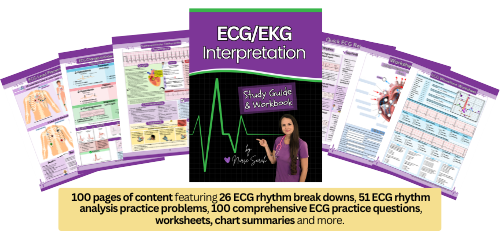
“ECG/EKG Interpretation Study Guide and Workbook by Nurse Sarah”. This book contain 100 pages of content featuring 26 ECG rhythm break downs, 51 ECG rhythm analysis practice problems, 100 comprehensive ECG practice questions, worksheets, chart summaries, and more.
You can get an eBook version here: “Nurse Sarah ECG Book” or a physical copy here: “ECG/EKG Interpretation Study Guide by Nurse Sarah“.
Treatment for Atrial Flutter
The treatment is similar as a-fib in that you want to control the rate. To do this, medications can be used such as, calcium channel blockers (Diltiazem), beta blockers (propranolol) or Digoxin (if patient has heart failure) along with antiarrhythmics (Amiodarone).
In addition, it’s important to prevent blood clot formation. Therefore, the patient may need some type of anticoagulant like “Warfarin” etc.
If the patient becomes unstable where the blood pressure is dropping, mental status changes are occurring, chest pain, shortness of breath (signs indicating decreased cardiac output), a synchronized cardioversion may be necessary.
In some cases, if the rhythm is persistent an ablation may need to be performed. This is a procedure that ablates (destroys or erodes) some of the tissue in the heart to prevent it from firing irregularly.
Now test your knowledge on this material by taking the atrial flutter ECG quiz.
References:
American Heart Association | Algorithms. (n.d.). Retrieved September 2, 2022, from https://cpr.heart.org/en/resuscitation-science/cpr-and-ecc-guidelines/algorithms#adult
Rodriguez Ziccardi M, Goyal A, Maani CV. Atrial Flutter. [Updated 2022 Aug 8]. In: StatPearls [Internet]. Treasure Island (FL): StatPearls Publishing; 2022 Jan-. Available from: https://www.ncbi.nlm.nih.gov/books/NBK540985/