Angina is a fancy term for chest pain. This is a type of chest pain that occurs when blood flow to the heart muscle (hence the myocardium) is restricted by the coronary arteries.
Chest pain is a warning sign from the body that the heart is not receiving enough blood, and if it doesn’t get this blood some sections of the heart are going to die.
Don’t forget to watch the angina lecture below and to take the free review angina quiz afterwards.
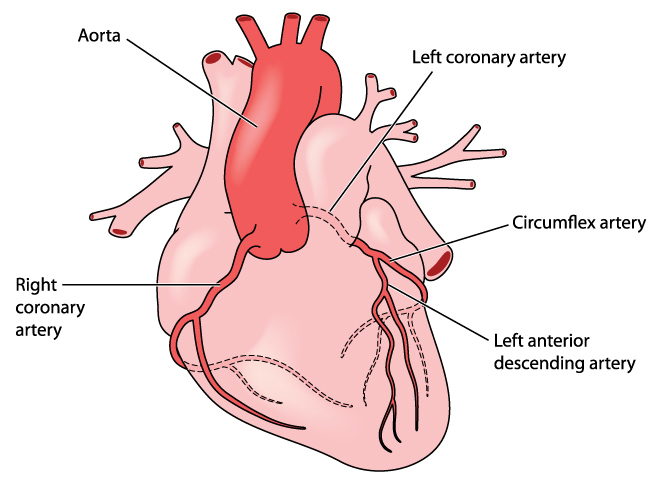
How does the heart muscle receive blood?
- From a network of arteries known as the coronary arteries
- The coronary arteries originate from the aorta.
There are two main coronary arteries called:
- left coronary artery
- right coronary artery
- These arteries feed the left and right side of the heart.
Right side feeds:
- Left atrium: top chamber
- Left ventricle: bottom chamber
- Interventricular septum: this is the wall that separates the right and left ventricle
Left side feeds:
- Right atrium: top chamber
- Right ventricle: bottom chamber
- Bottom of left ventricle
- Electrical structures: SA & AV node
ECG/EKG Study Guide and Workbook for Nursing Students
“ECG/EKG Interpretation Study Guide and Workbook by Nurse Sarah”. This book contain 100 pages of content featuring 26 ECG rhythm break downs, 51 ECG rhythm analysis practice problems, 100 comprehensive ECG practice questions, worksheets, chart summaries, and more.
You can get an eBook version here: “Nurse Sarah ECG Book” or a physical copy here: “ECG/EKG Interpretation Study Guide by Nurse Sarah“.
Types of Angina
Stable Angina
- also called “exertional angina”
- happens when there is exertional stress
- this increases the oxygen demand by the heart
- the blood flow within the arteries can’t keep up to allow blood to get to the heart muscle
- many cases are due to a fatty plaque within the coronary artery that causes stiffening and narrowing of the artery
- this leads to chest pain
Treatment includes:
- low fat and sodium diet
- smoking cessation
- managing glucose, if diabetic
- lowering cholesterol with statins
- lowering blood pressure and increasing blood flow to the heart
- beta blockers, nitrates, calcium channel blockers, ACEs, and ARBs
- antiplatelets like aspirin
- depending on the patient’s case heart catheterization may or may not be an option
Mnemonic to remember: 4 S‘s for STABLE
- Seeing it coming (predicable)
- Short (lasts less than 5 minutes)
- Stops (relieved with nitroglycerin or rest)
- Stiff or stenosed artery
With stable angina, there is no damage to the heart muscle, troponin levels are normal, ECG is normal at rest or may have slight ST depression and inverted T waves with exertion.
Unstable Angina
- also called “pre-infarction angina”
- happens before a myocardial infarction
- occurring due to decreased blood supply to heart muscle because a fatty plaque has ruptured
- VERY serious and must be treated because it can progress to an MI
- A chain of events is set off with the aggregation of platelets and thrombus creation, which acts as a roadblock and partially or completely blocks blood flow through the artery. As the thrombus grows, it can cause muscle cells to die leading to an MI.
Mnemonic to remember: 4 UN‘s for UNSTABLE
- UNexpected (occurs with rest or little activity)
- UNaltered by rest or nitroglycerin
- UNrelenting (last more than 15 minutes, multiple episodes, and increases)
- UNsurvivable for muscle cells without treatment
NSTEMI
- partial blockage of coronary artery
- no elevation of the ST segment
- ECG may show depressed ST segment or inverted T waves
- Troponin levels will usually be elevated
- Treatment:
- heart cath to open up narrowed artery, nitro to vasodilate, heparin to prevent thrombus, antiplatelet therapy (Clopidogrel)

STEMI
- complete blockage of coronary artery
- ST segment elevated on the ECG, which tells us a huge area of the heart muscle is not getting blood flow
- Troponins will be elevated
- Need to open up blood flow STAT to the heart muscle:
- heart cath: percutaneous transluminal coronary angioplasty (PTCA) with stents to open artery
- coronary artery bypass graft (CABG)
Variant Angina
- occurs due to a vasospasm of a coronary artery
- also called “prinzmetal angina”
- tends to happen during rest at night or in the morning
- short-lived ST segment elevation
- most common in patients who:
- use drugs that have a vasoconstriction effect on the arteries like smoking, cocaine, marijuana
- high alcohol consumption
- exposure to cold
- vascular disorders
- Treatment: nitroglycerin
- Prevention: calcium channel blockers
Test your knowledge on angina with this quiz.
References:
Daga LC, Kaul U, Mansoor A. Approach to STEMI and NSTEMI. J Assoc Physicians India. 2011 Dec;59 Suppl:19-25. PMID: 22624277.
Goyal A, Zeltser R, Gunn AA. Unstable Angina (Nursing) [Updated 2022 Sep 18]. In: StatPearls [Internet]. Treasure Island (FL): StatPearls Publishing; 2023 Jan-. Available from: https://www.ncbi.nlm.nih.gov/books/NBK568785/
Rousan, T. A., & Thadani, U. (2019). Stable Angina Medical Therapy Management Guidelines: A Critical Review of Guidelines from the European Society of Cardiology and National Institute for Health and Care Excellence. European cardiology, 14(1), 18–22. https://doi.org/10.15420/ecr.2018.26.1