Angina nursing NCLEX review questions for students!
Test your knowledge on the different types of angina (unstable, stable, and variant angina). These are also referred to as pre-infarction, exertional, and Prinzmetal’s angina.
As the nurse you want to be familiar with the characteristics of each type of angina, treatment, and causes. Don’t forget to check out the lecture review (coming soon) and the notes (coming soon) before taking the quiz.

Angina NCLEX (NGN) Nursing Questions
ECG/EKG Study Guide and Workbook for Nursing Students
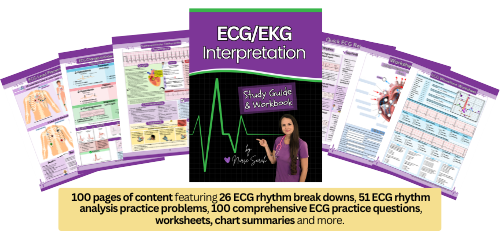
“ECG/EKG Interpretation Study Guide and Workbook by Nurse Sarah”. This book contain 100 pages of content featuring 26 ECG rhythm break downs, 51 ECG rhythm analysis practice problems, 100 comprehensive ECG practice questions, worksheets, chart summaries, and more.
You can get an eBook version here: “Nurse Sarah ECG Book” or a physical copy here: “ECG/EKG Interpretation Study Guide by Nurse Sarah“.
Angina NCLEX Questions
1. The myocardium receives its blood supply from what structure within the body?
A. pulmonary arteries
B. superior vena cava
C. coronary arteries
D. pulmonary veins
The answer is C. The coronary arteries supply the myocardium (heart muscle) with oxygen-rich blood. There are two main coronary arteries: right coronary and left coronary artery.
2. What vessel supplies parts of the electrical conduction system, SA and AV node, in the heart with blood?
A. left anterior descending artery
B. right coronary artery
C. left pulmonary artery
D. left coronary artery
The answer is B. The right coronary artery supplies the SA and AV node with blood.
3. Select all the structures in the heart the left coronary artery supplies:
A. left ventricle
B. interventricular septum
C. SA node
D. right atrium
E. left atrium
F. AV node
The answers are A, B, and E. The left coronary artery supplies the left side of the heart, such as the left ventricle, left atrium, and interventricular septum.
4. A patient presents to the emergency room reporting chest pain. They state their chest pain occurs with activity and that it subsided after taking nitroglycerin. In addition, the patient states the pain lasted for 8 minutes. Based on the patient’s signs and symptoms, what type of angina may the patient be experiencing?
A. unstable angina
B. variant angina
C. stable angina
D. microvascular angina
The answer is C. Stable angina happens with exertion, is short-lived, and is relieved with rest or nitroglycerin, which is what the patient is reporting. Therefore, this may be a case of stable angina.
5. The nurse educated the patient about nitroglycerin and how to take it. Which statements by the patient require re-education? Select all that apply:
A. “This medication can lower my blood pressure. So, I will monitor my blood pressure while I take it.”
B. “I will take this medication every 15 minutes as needed for chest pain.”
C. “I will seek medical treatment if my chest pain isn’t relieved after 3 doses.”
D. “I will either swallow or place a tablet under my tongue when I take this medication.”
The answers are B and D. The patient should take it every 5 minutes (NOT 15 minutes) under the tongue ONLY (not swallowed) for ONLY 3 doses. If the chest pain is not relieved, the patient needs to seek medical attention.
6. A patient reports having angina. What signs and symptoms reported by the patient indicates they may be experiencing variant (prinzmetal) angina? Select all that apply:
A. Chest pain occurs at night or early morning when at rest
B. The pain is not relieved by nitroglycerin.
C. The chest pain lasts for more than 15 minutes and has a crescendo pattern.
D. It occurs more frequently when the patient uses marijuana and drinks alcohol.
The answers are A and D. This is a type of angina that occurs due to a vasospasm. It is relieved by nitroglycerin and can happen at rest (typically during the night or early morning). Risk factors for this type of angina include using substances that cause vasoconstriction like cocaine, marijuana, or high alcohol ingestion.
7. A patient is experiencing crushing chest pain, nausea, vomiting, and diaphoresis. The ECG show ST segment depression. Troponin levels are positive. Based on these findings, what type of condition may be presenting?
A. NSTEMI
B. STEMI
C. Unstable angina
D. Variant angina
The answer is A. NSTEMI (Non-ST-segment Elevation) is a type of heart attack. It occurs when a partial blockage of a coronary artery presents. The ST segment is NOT elevated, but it can be depressed. In addition, troponin levels will be elevated.
8. What signs and symptoms are associated with unstable angina? Select all that apply:
A. Predictable chest pain
B. Not relieved with nitroglycerin or rest
C. Chest pain happens with little to no activity
D. Troponin levels are normal
E. ECG changes with ST-segment elevation
F. Unpredictable chest pain that lasts longer than 15 minutes
The answer are B, C, D, and F. Unstable angina is unexpected chest pain, unaltered with rest or nitroglycerin, unrelenting (lasts longer than 15 minutes).
9. True or False: Troponin levels are elevated during stable angina.
True
False
The answer is FALSE. Stable angina does NOT cause elevated levels. This happens in NSTEMI and STEMI.
10. What is the most common cause of stable angina?
A. rupture of a fatty plaque within a coronary artery
B. formation of a fatty plaque within the coronary artery that has caused the artery to stiffen
C. thrombus formation within a coronary artery
D. vasospasm of a coronary artery
The answer is B. Option A happens in many cases of unstable angina. Option C happens in most cases of a myocardial infarction, and option D happens in cases of variant angina.
Don’t forget to tell your friends about this quiz by sharing it your Facebook, Twitter, and other social media. You can also take more fun nursing quizzes.
*Disclaimer: While we do our best to provide students with accurate and in-depth study quizzes, this quiz/test is for educational and entertainment purposes only. Do NOT re-post this quiz onto any other site. Please refer to the latest NCLEX review books for the latest updates in nursing. This quiz is copyright RegisteredNurseRn.com. Please do not copy this quiz directly; however, please feel free to share a link to this page with students, friends, and others.