Premature ventricular contractions (PVCs) are early contractions that come from the ventricles. These premature contractions are usually benign but can be serious in some cases. The nurse should be able to identify these premature contractions and be familiar with causes, characteristics, types of PVCs, and treatments.
Don’t forget to watch the PVC lecture and read the premature ventricular contraction notes before taking the PVC quiz.

Premature Ventricular Contractions (PVCs) ECG/EKG Quiz Questions
ECG/EKG Study Guide and Workbook for Nursing Students
“ECG/EKG Interpretation Study Guide and Workbook by Nurse Sarah”. This book contain 100 pages of content featuring 26 ECG rhythm break downs, 51 ECG rhythm analysis practice problems, 100 comprehensive ECG practice questions, worksheets, chart summaries, and more.
You can get an eBook version here: “Nurse Sarah ECG Book” or a physical copy here: “ECG/EKG Interpretation Study Guide by Nurse Sarah“.
Premature Ventricular Contraction Quiz
- Which statement below is correct about premature ventricular contractions (PVCs)? Select all that apply:
A. PVCs are early contractions that originate in the ventricles.
B. PVCs are always serious and should be investigated further.
C. PVCs can occur due to hypothyroidism, hypercalcemia, and hypotension.
D. PVCs usually occur because of ventricular irritability.
The answers are A and D. These are true statements about PVCs. In many cases, PVCs are benign (not always serious). They should be further investigated if they are frequent and cause symptoms. PVCs can occur due to hyperthyroidism, hypokalemia/hypomagnesemia, and hypertension.
- The nurse is assessing a patient’s ECG/EKG and notes sinus rhythm with an isolated premature ventricular contraction (PVC). Which characteristics are NOT associated with a PVC? Select all that apply:
A. wide and bizarre QRS complex >0.12 seconds
B. PR interval >0.20 seconds
C. normal QT interval
D. compensatory pause after the PVC
The answers are B and C. Options A and D are characteristics found within a PVC. However, the PR interval cannot be measured on an actual PVC because the P wave is missing. In addition, it is difficult to accurately measure the QT interval because of the wide/bizarre QRS complex.
- A patient is having frequents premature ventricular contractions (PVCs) and reports feeling dizzy and chest palpitations. Which finding on the ECG/EKG requires immediate nursing action?
A. random PVCs without a pattern
B. PVCs are after the t wave
C. PVCs are occurring with the t wave
D. uniform-appearing PVCs
The answer is C. Premature ventricular contractions (PVCs) that occur with the T wave require immediate nursing action, as the nurse needs to notify the healthcare provider of this finding. This is known as the R-to-T phenomenon and can increase a patient’s risk of developing ventricular tachycardia (v-tach) or ventricular fibrillation (v-fib).
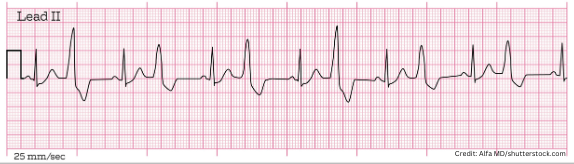
- The nurse notes that the patient is experiencing premature ventricular contractions (PVCs), which can be noted on the ECG/EKG strip above. What type of PVCs are these?
A. bigeminy
B. trigeminy
C. quadrigeminy
D. couplets
The answer is A: bigeminy This type of PVC occurs every 2nd beat.

- Assess the four rhythms above and select the rhythm that demonstrates trigeminy.
A
B
C
D
The answer is D. Trigeminy occurs when a PVC appears every third beat. Rhythm A is sinus rhythm with an isolated PVC. Rhythm B is bigeminy, and Rhythm C is sinus rhythm with premature atrial contractions (PACs).

- The nurse notes that the rhythm above is sinus rhythm with premature ventricular contractions (PVCs). The nurse should document which of the following characteristics about the PVCs?
A. the PVCs are uniform
B. bigeminy
C. the PVCs are multiform
D. the PVCs are couplets
The answer is C: the PVCs are multiform. The PVCs on the rhythm do not look the same; therefore, they are multiform. As a side note, they are also occurring every third beat (trigeminy).
- True or False: Three or more premature ventricular contractions (PVCs) in a row can be called a run of ventricular tachycardia.
True
False
The answer is TRUE.
- Which statements are TRUE about possible treatments for premature ventricular contractions (PVCs)? Select all that apply:
A. PVCs can be treated with a cardiac ablation.
B. Symptomatic PVCs can be managed with beta blockers, flecainide, or calcium channel blockers.
C. Random PVCs without symptoms are managed with antiarrhythmics.
D. PVCs can be treated with synchronized cardioversion.
The answers are A and B. These are true statements about PVC treatment. Option C and D are incorrect statements.
Don’t forget to tell your friends about this quiz by linking to it on your Facebook, Twitter, and other social media. You can also take more fun nursing quizzes.
*Disclaimer: While we do our best to provide students with accurate and in-depth study quizzes, this quiz/test is for educational and entertainment purposes only. Please refer to the latest NCLEX review books for the latest updates in nursing. This quiz is copyright RegisteredNurseRn.com. Please do not copy this quiz directly; however, please feel free to share a link to this page with students, friends, and others.