Premature junctional contractions (PJCs), also called premature junctional complexes, are early heartbeats that originate from the AV junction instead of the SA node. Understanding PJCs is essential for nursing students preparing for exams like the NCLEX and for clinical practice. This guide breaks down everything you need to know in an easy-to-follow format.
What Are Premature Junctional Contractions (PJCs)?
PJCs are early contractions that occur prematurely within the underlying heart rhythm. Unlike normal beats that start at the SA node, PJCs originate at the AV junction, which is why they appear early and sometimes cause abnormal P-wave patterns.
Key Points to Remember:
- Premature Beats – PJCs occur before the next expected normal beat.
- P-Wave Abnormalities – PJCs can have unusual P-wave presentations:
- Concealed P-wave: Hidden within the QRS complex.
- Before the QRS: Appears very close, with a PR interval <0.12 seconds.
- After the QRS: Rare, but possible.
- Inverted P-wave in leads aVF, II, and III when present.

PJCs vs. Junctional Escape Beats
It’s important to differentiate PJCs from junctional escape beats:
- PJCs: Premature, random beats with no pause beforehand.
- Junctional Escape Beats: Occur after a pause, compensating for a slow SA node to prevent cardiac standstill.
ECG Characteristics of PJCs
When analyzing PJCs, look for the following:
Rhythm
- Underlying Rhythm: Regular
- PJC: Irregular due to the premature beat
Rate
- Underlying Rhythm: Depends on the underlying rhythm
- PJC: Same as underlying, but occurs early
P-wave
- Underlying Rhythm: Normal
- PJC: Can be inverted, hidden, or appear before/after QRS
PR interval
- Underlying Rhythm: 0.12–0.20 seconds
- PJC: Often <0.12 seconds or unmeasurable
QRS complex
- Underlying Rhythm: <0.12 seconds
- PJC: Normal, occurs early
QT interval & T-wave
- Underlying Rhythm: Normal
- PJC: Normal
Example: Sinus rhythm with occasional PJCs:

Sinus beat → Sinus beat → PJC (inverted P-wave, PR <0.12 sec) → Sinus beats → PJC (P-wave hidden in QRS)
Causes of PJCs
PJCs result from increased automaticity of the AV junction which can be due to the following: Digoxin toxicity / drugs, excessive alcohol use, oxygen deprivation / hypoxia, electrolyte imbalance (K⁺, Ca²⁺, Mg²⁺), tobacco use, injury to AV node (surgery, infection, congenital defects), can occur naturally in some patients
Nursing Considerations and Treatment
PJCs are usually asymptomatic and harmless when infrequent. Problems arise when they occur frequently, potentially reducing cardiac output and causing:
- Chest pain
- Palpitations
- Fluttering sensations
- Hypotension (if severe)
Assess underlying causes:
- Review medications (e.g., digoxin)
- Check electrolytes and hydration
- Identify lifestyle factors (smoking, alcohol, caffeine)
Patient Education:
- Limit alcohol and caffeine
- Avoid tobacco
- Stay hydrated
- Monitor medications that affect electrolytes (like diuretics)
Notify healthcare provider if PJCs are frequent or symptomatic.
Check digoxin levels if applicable:
- Therapeutic: 0.5–2 ng/mL
- Toxicity: Levels above 2 ng/mL
- Antidote: Digifab/Digibind
Key Takeaways for Nursing Students
- PJCs are premature beats from the AV junction.
- P-wave abnormalities are a hallmark feature.
- They differ from junctional escape beats because they occur without a preceding pause.
- Common causes include digoxin toxicity, AV node injury, electrolyte imbalances, hypoxia, and lifestyle factors.
- Treatment focuses on addressing underlying causes and patient education.
You may be interested in: PJC Rhythm ECG Quiz
ECG/EKG Study Guide and Workbook for Nursing Students
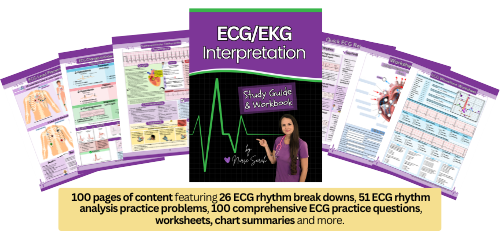
“ECG/EKG Interpretation Study Guide and Workbook by Nurse Sarah”. This book contain 100 pages of content featuring 26 ECG rhythm break downs, 51 ECG rhythm analysis practice problems, 100 comprehensive ECG practice questions, worksheets, chart summaries, and more.
You can get an eBook version here: “Nurse Sarah ECG Book” or a physical copy here: “ECG/EKG Interpretation Study Guide by Nurse Sarah“.
References:
Hafeez Y, Grossman SA. Junctional Rhythm. [Updated 2023 Feb 5]. In: StatPearls [Internet]. Treasure Island (FL): StatPearls Publishing; 2024 Jan-. Available from: https://www.ncbi.nlm.nih.gov/books/NBK507715/
How the Heart Works | NHLBI, NIH. Retrieved 15 February 2022, from https://www.nhlbi.nih.gov/health-topics/how-heart-works
Thaler, M. S. (2010). Arrhythmias of Sinus Origin. In The Only EKG Book You’ll Ever Need (6th ed., pp. 110–111). essay, Lippincott, Williams, Wilkins.