Premature junctional contractions (PJCs) are early contractions that come from an ectopic foci point in the AV junction. These premature contractions are usually benign but can be serious in some cases. The nurse should be able to identify these premature contractions and be familiar with causes, characteristics, types of PJCs, and treatments.
Don’t forget to watch the PJC lecture and read the premature junctional contraction notes before taking the PJC quiz.
PJCs (Premature Junctional Contractions) EKG ECG Rhythm Quiz
ECG/EKG Study Guide and Workbook for Nursing Students
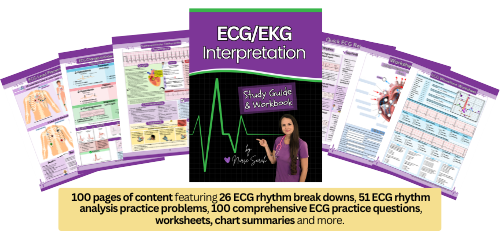
“ECG/EKG Interpretation Study Guide and Workbook by Nurse Sarah”. This book contain 100 pages of content featuring 26 ECG rhythm break downs, 51 ECG rhythm analysis practice problems, 100 comprehensive ECG practice questions, worksheets, chart summaries, and more.
You can get an eBook version here: “Nurse Sarah ECG Book” or a physical copy here: “ECG/EKG Interpretation Study Guide by Nurse Sarah“.
Premature Junctional Contractions (PJCs) Quiz
1.Where do Premature Junctional Contractions (PJCs) primarily originate from?
A. Purkinje fibers
B. AV junction
C. SA node
D. ventricles
The answer is B: AV junction. PJCs originate from a focal point around the atrioventricular (AV) junction, not from the SA node, purkinje fibers, or ventricles.
2. How can the P-wave typically appear in a PJC? Select all that apply:
A. concealed
B. after the QRS complex
C. normal
D. very close to the QRS complex
E. inverted in leads II, III, and aVF
The answers are A, B, D, and E. The P-wave in the PJC will NOT appear normal. It will occur early, and it can be any of the following: concealed (hidden in the QRS complex), after the QRS complex, very close to the QRS complex (leading to a short PR interval), and/or inverted in leads II, III, and aVF.

3. Which rhythm above contains Premature Junctional Contractions (PJCs)?
1
2
3
4
The rhythm that contains PJCs is rhythm 4. Rhythm 1 contains PACs (premature atrial contractions), Rhythm 2 is wandering atrial pacemaker (WAP), and Rhythm 3 contains Premature Ventricular Contractions (PVCs). The PJCs in rhythm 4 are found at beat 3 (note the inverted P-wave that is close to the QRS complex) and beat 8 (the P-wave is missing/concealed within the QRS complex). In addition, note that each PJC is an early (premature beat) without a pause before the PJC.
4. Which statement is TRUE regarding the P-wave in a PJC?
A. It may be inverted.
B. It is always concealed or missing.
C. It will never be before the QRS complex.
D. It will always be after the QRS complex.
The answer is A: It may be inverted. The P-wave can be inverted, missing/concealed in the QRS complex, right before the QRS complex, or after the QRS complex. It can vary.
5. What type of signs and symptoms can a patient report with a PJC? Select all that apply.
A. hyperglycemia
B. orthostatic hypertension
C. palpitations
D. asymptomatic
The answers are C and D. Typically, patients are without signs/symptoms (asymptomatic), especially if the PJCs are infrequent. However, if frequent, it can lead to palpitations or fluttering in the chest. This could progress to dizziness and syncope, which should be evaluated.
6. What are the characteristics of the PR interval during a PJC? Select all that apply.
A. It may not be measurable at times.
B. It may be >0.20 seconds.
C. It will be <0.12 seconds if measurable.
D. It should always be 0.12-0.20 seconds.
The answers are A and C.It may not be measurable at times, especially if the P-wave is hidden within the QRS complex or after the QRS complex. However, if it is present before the QRS, it will be close to the QRS complex, making the PR interval <0.12 seconds.
7. Your patient is experiencing frequent Premature Junctional Contractions (PJCs), which are leading to symptoms. Upon reviewing the patient’s medication history, which of the following medications is MOST likely contributing to the development of PJCs?
A. Lisinopril
B. Digoxin
C. Glucophage
D. Atenolol
The answer is B: Digoxin is the most common medication associated with the development of Premature Junctional Contractions (PJCs) because it increases vagal tone, which can slow conduction through the AV node and lead to ectopic beats originating in the AV junction. Elevated digoxin levels, especially in cases of toxicity or renal dysfunction, can exacerbate this effect and result in frequent PJCs. The other medications listed are not associated with the cause of frequent PJCs.
8. TRUE or FALSE: Premature junctional contractions (PJCs) will present with a brief pause before the PJC.
The answer is FALSE: Premature Junctional Contractions (PJCs) do not typically present with a brief pause before the PJC. Unlike junctional rhythms, which often involve a compensatory pause before the premature beat, PJCs occur prematurely within the underlying rhythm without a pause. The absence of a compensatory pause before the PJC is one of the defining characteristics between PJCs and junctional rhythms.

9. Is the rhythm above normal sinus rhythm with Premature Junctional Contractions (PJCs)?
Yes
No
No, the rhythm above is junctional escape rhythm. It is not normal sinus rhythm with PJCs. Note that before the junctional beat, there is a brief pause. This is a hallmark finding in junctional escape rhythm. PJCs do not have this brief pause before the PJC. PJCs do not have this brief pause before the PJC.
*Disclaimer: While we do our best to provide students with accurate and in-depth study quizzes, this quiz/test is for educational and entertainment purposes only. Please refer to the latest NCLEX review books for the latest updates in nursing. This quiz is copyright RegisteredNurseRn.com. Please do not copy this quiz and place it on third-party websites or document sharing websites.