In April of 2023, the NCSBN released the new version of the NCLEX exam, which is called the Next Generation NCLEX (or NGN, for short). One of the big changes with the Next Generation NCLEX was the introduction of case studies.
These new changes have caused some students and new graduates to become nervous, and some are wondering how they should be preparing for this new format.
Study Tips for Next Generation NCLEX Case Studies
What should your study plan be for the Next Generation NCLEX case studies?
First, let’s think about what’s different about a case study. A case study is going to give you a scenario of how a patient may present with a particular disease(s), and it’s going to walk you through a scenario of what may happen as the patient progresses.
These case studies are going to test your nursing knowledge on how to identify important symptoms, lab reports, what to watch for, how to deliver care, and provide patient education.
In other words, case studies are very similar to how things really work in the real world of nursing!
So the big question is how do you prepare for these case studies on the NGN?
Familiarize Yourself with NGN Case Studies
First, you’ll want to familiarize yourself with this new case study format so that you’ll understand how they work.
I developed a mock Next Generation NCLEX case study, and in that case study, I walk you through the sample questions step-by-step. I highly recommend you watch that video because it’s going to show you how to think critically as you answer these new NGN questions.

The Secret to Case Studies
As you prepare for case studies, you have to understand that merely memorizing a few facts about a disease will not work well to prepare you for these questions. Instead, you truly have to understand the material in a deeper way so that you are able to connect the dots and answer the different scenarios that might pop up.
To do this, I like to compare a disease to an onion. And just as onions have many different layers, there are many layers of what’s going on with a disease process, too. As you begin pulling back the layers of a disease, you can get to the core of what’s happening to your patient and see the domino effect that occurs.
But you have to go through those layers to get to that core. But if you skip those layers, you’re going to be missing things, and it is going to make these case studies much more difficult.
And the “layers” I’m referring to can be things like the pathophysiology, signs and symptoms, labs and diagnostics, treatment, medications, and your role as the nurse.
And you’ll want to be familiar with all of those different layers, because that will allow you to easily connect the dots and breeze through these case study questions.
Study Example for Case Study of Heart Failure
To illustrate my point, consider a case study over a heart failure patient. The first “layer” you’d want to peel back as you study is the PATHO!
Layer 1: Understand the Pathophysiology
I cannot emphasize enough that taking time to really dig into the pathophysiology of a disease will really help you understand what’s happening and why, which will be crucial in helping you understand how the different body systems are affected.
As you study, you want to ask yourself, “What’s occurring in the body? Which systems are affected? What causes this, and why?”
This step will take a lot of energy and time on your part, but in my opinion, it’s one of the best uses of your study time. Once you truly grasp this part, it will have a “domino effect” of helping you connect the dots.
Layer 2: Allow the Signs and Symptoms to Flow from the Patho
When you truly understand the patho of a disease, the signs and symptoms will easily fall into place. In many cases, you won’t even need to spend time memorizing a list of signs and symptoms for a disease! Understanding the patho will help you easily piece that together in your mind.
For example, in heart failure, you know we have a fluid volume overload. If the heart failure is on the right side, it’s going to cause a backup of fluid that can lead to things like JVD (jugular venous distention), ascites, edema, and enlarged liver.
If the heart failure is on the left side, it’s going to be affecting the lungs, leading to things like shortness of breath, crackles, orthopnea, difficulty breathing at night, and even pulmonary edema.
Layer 3: Determine Relevant Labs and Diagnostics
Next, I’d recommend focusing on the relevant labs and diagnostic reports. Even though we don’t order these as the nurse, they are very important to us because we need to know what we need to monitor for and what should be expected for that patient.
And the abnormal signs and symptoms you just learned about will go along with those labs and diagnostic reports. It’s all going to click and make sense.
Layer 4: The Patient’s Plan of Care
Those layers will then feed right into the patient’s plan of care. As you study, be asking yourself, “What do I expect the doctor to order? What are the common medications and procedures?”
One you peel back this layer, it will make your job as the nurse very easy to understand because what we do a nurses goes right along with the treatments ordered.
Layer 5: Focus on What We Do (and Don’t Do) for the Patient
In this final layer, you’ll want to be thinking about what you would and wouldn’t do for the patient. For example, think of questions such as, “What’s going to help this patient get better? What should I monitor? What should I report? What important patient education should I provide?”
With medications, for what side effects are you going to be monitoring? If a patient with heart failure is on loop diuretics, what side effects could occur? You’re going to look at urinary output, electrolytes (particularly the potassium level).
You’ll also want to consider information you’ll provide to the patient throughout their stay, along with discharge education points and care.
Conclusion of Study Tips for NGN Case Studies
In summary, the best way to prepare for the case studies on the Next Generation NCLEX is to actually understand the disease holistically, which means digging into the pathophysiology first, and then allowing that to flow to the signs and symptoms, medications, patient education, and so forth.
By taking the time to absorb the material, and digging deep in to the disease process, it’s going to pay off big when it comes time to answer these questions that evolve and require a deeper level of critical thinking.
That’s why I always try to take the time to cover these important concepts in my NCLEX review lectures on YouTube. I really try to help students connect the dots and understand these diseases in a way that will click and make it easier to remember, both on exams and in the real world of nursing.
Nurse Sarah’s Notes and Merch
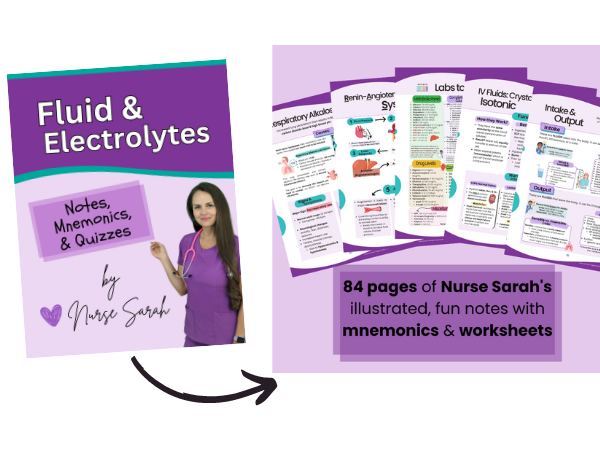
Just released is “Fluid and Electrolytes Notes, Mnemonics, and Quizzes by Nurse Sarah“. These notes contain 84 pages of Nurse Sarah’s illustrated, fun notes with mnemonics, worksheets, and 130 test questions with rationales.
You can get an eBook version here or a physical copy of the book here.