This review will cover left-sided heart failure vs. right-sided heart failure for nurses.
As a nurse it is important to be familiar with the differences between these two types of heart failure.
To help you understand left vs. right sided heart failure visualize the heart’s anatomy in your head and think about what each side is connected too.
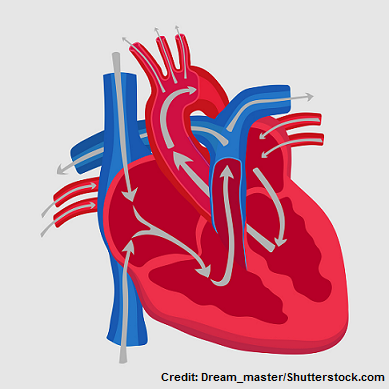
In heart failure, the heart is FAILING to pump blood forward. Therefore, blood backs up and volume overload occurs.
Let’s look at right-sided heart failure:
The right side of the heart receives deoxygenated blood from the systemic venous system.
When this side fails to pump blood properly it results in the congestion of blood in the right side of the heart which goes into systemic venous circulation.
This increases the pressure in the inferior vena cava (which normally brings “used” blood back to the heart for re-oxygenation). This built-up pressure causes the hepatic veins to become very congested with blood and leads to hepatomegaly and systemic venous congestion. This will lead to swelling in the legs, abdomen, and feet and weight gain.
- Right-sided heart failure is usually caused from left-sided heart failure because of the increased fluid pressure backing up from the left side to the right. This causes the right side of the heart to become overworked.
Right-sided heart failure presents with SWELLING and PERPHIERAL SIGNS AND SYMPTOMS.
Watch Lecture on Heart Failure
Right-Sided Heart Failure Signs and Symptoms
To help you remember the signs and symptoms of right-sided heart failure, try to remember the mnemonic SWELLING (fluid is backing up in the right side of the heart which causes fluid to back-up in the hepatic veins and peripheral veins).
Swelling of legs, hands, liver, abdomen (ascities)
Weight gain
Edema (pitting)
Large neck veins (jugular venous distention)
Lethargic (weak and very tired)
Irregular heart rate (atrial fibrillation)
Nausea (swelling of the abdomen and liver)
Girth of abdomen increased (from swelling of the liver and building up fluid in the abdomen)…can’t breathe well and this causes nausea and anorexia.
Left-Sided Heart Failure
The left side of the heart is responsible for pumping oxygenated blood it received from the lungs into arterial circulation. However, when the left side of the heart fails it cannot pump blood out of this side efficiently so blood starts to back up in the lungs, hence pulmonary circulation.
- Most common type of heart failure.
Left-sided heart failure can be classified as SYSTOLIC OR DIASTOLIC.

- Systolic heart failure (heart failure with reduced ejection fraction): also called “Left ventricular systolic dysfunction”
- Remember systole is the contraction or “squeezing” phase of the heart. In systolic dysfunction, there is an issue with the left ventricle being able to eject blood properly out of the ventricle and the organs can’t get all that rich-oxygenated blood it just received from the lungs. Patients will have a low ejection fraction.
- What is ejection fraction? Ejection fraction is a calculation used to determine the severity of heart failure on the left side.
- A normal EF is 50% or greater meaning that more than half of the blood that fills inside the ventricles is being pumped out. An EF can be measured with an echocardiogram, heart cath, nuclear stress test. An EF of 40% or less is a diagnosis for heart failure.
- Diastolic heart failure (heart failure with preserved ejection fraction): also called “left ventricular diastolic dysfunction”
- Remember diastole is the filling or resting phase of the heart. In diastolic dysfunction, the ventricle is too stiff to allow for normal filling of blood. Since there isn’t an issue with contraction but filling the ejection fraction is usually normal.
Left-sided heart failure will present with PULMONARY Signs and Symptoms.
Left-sided Heart Failure Signs and Symptoms:
To help you remember the signs and symptoms of left-sided heart failure, try to remember the mnemonic DROWNING (these patients are literally drowning in lung fluid from the heart’s failure to pump efficiently).
Difficulty breathing
Rales (crackles)
Orthopnea (cannot tolerate lying down…must sit-up to breath, especially while sleeping)
Weakness (extremely tired and fatigued due to shortness of breath and heart can’t compensate for increased activity)
Nocturnal Paroxysmal dyspnea (awaking during sleep with extreme dyspnea)
Increased heart rate (due to fluid overload and the heart is trying to get the blood to organs but it can’t because of muscle failure)
Nagging cough (can be frothy or blood-tinged sputum from fluid overload in the lungs…very bad sign)
Gaining weight from the body retaining fluid…2 to 3 lb in a day or 5 lbs in a week
More reviews on heart failure and heart failure quiz.
References:
“Heart Failure Fact Sheet|Data & Statistics| DHDSP |CDC”. Cdc.gov. N.p., 2016. Web. 12 Aug. 2016.
“How Is Heart Failure Diagnosed? – NHLBI, NIH”. Nhlbi.nih.gov. N.p., 2015. Web. 13 Aug. 2016.
“What Causes Heart Failure? – NHLBI, NIH”. Nhlbi.nih.gov. N.p., 2015. Web. 13 Aug. 2016.