ECG quiz on junctional tachycardia rhythm for nurses!
This quiz will test your knowledge on how to identify junctional tachycardia, characteristics of the rhythm, the nurse’s role, and treatments.
Don’t forget to check out our free series on ECG interpretation and other review quizzes.
Junctional Tachycardia ECG Rhythm Quiz
ECG/EKG Study Guide and Workbook for Nursing Students
“ECG/EKG Interpretation Study Guide and Workbook by Nurse Sarah”. This book contain 100 pages of content featuring 26 ECG rhythm break downs, 51 ECG rhythm analysis practice problems, 100 comprehensive ECG practice questions, worksheets, chart summaries, and more.
You can get an eBook version here: “Nurse Sarah ECG Book” or a physical copy here: “ECG/EKG Interpretation Study Guide by Nurse Sarah“.
Junctional Tachycardia Quiz
1. Which statement is true about junctional tachycardia?
A. This rhythm originates from the sinoatrial node.
B. Junctional tachycardia is a type of supraventricular tachycardia.
C. This rhythm occurs because the AV node has decreased automaticity.
D. Junctional tachycardia originates from the right and left bundle branches.
The answer is B: Junctional tachycardia is a type of supraventricular tachycardia. It originates from the AV junction (AV node or bundle of His).

2. Which rhythm above represents junctional tachycardia?
A
B
C
D
The answer is A. Image B is atrial fibrillation, C is accelerated junctional, and D is junctional escape.
3. The nurse is analyzing the patient’s ECG and notes that in order for the rhythm to be junctional tachycardia the rate must be?
A. <40 bpm
B. 40-60 bpm
C. 60-100 bpm
D. >100 bpm
The answer is D: >100 bpm.
4. How would the nurse expect the p waves to present in junctional tachycardia? Select all that apply:
A. hidden within the t waves
B. right before the QRS complex
C. after the QRS complex
D. concealed within the QRS complex
The answers are B, C, and D.
5. The PR interval can have what characteristics in junctional tachycardia? Select all that apply:
A. prolonged >0.20 seconds
B. short <0.12 seconds
C. unable to determine (missing)
The answers B and C. If the p wave is present, it will be very close to the QRS complex and the PR interval will be short.
6. In what leads on the ECG can the p wave appear upside down or inverted in junctional tachycardia? Select all that apply:
A. II
B. aVR
C. I
D. III
E. aVF
The answers are A, D, and E.
7. The QRS complex usually measures _____________ in junctional tachycardia.
A. >0.12 seconds
B. <0.12 seconds
C. >0.20 seconds
D. <0.04 seconds
The answer is B: <0.12 seconds. The QRS will be narrow.
8. Your patient is in junctional tachycardia with a heart rate of 140 bpm. The patient is presenting with a blood pressure of 102/68 but no other signs or symptoms except it feels like their heart is “racing”. Which medication classes can be used to slow down the rate? Select all that apply:
A. anticholinergics
B. beta adrenergic agonists
C. beta blockers
D. calcium channel blockers
The answers are C and D (beta blockers or calcium channel blockers).
9. Junctional tachycardia is noted on the ECG monitor. What signs and symptoms demonstrate that the patient is experiencing a drop in cardiac output? Select all that apply:
A. shortness of breath
B. blood pressure 70/48 mmHg
C. blood glucose 160 mg/dL
D. <2 second capillary refill time
E. chest pain
The answers are A, B, and E. These signs and symptoms demonstrate a drop in cardiac output.
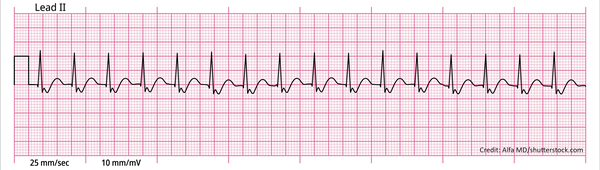
10. What is the rate of the rhythm above and the name of the rhythm?
A. 120 bpm, sinus tachycardia
B. 160 bpm, atrial tachycardia
C. 120 bpm, junctional tachycardia
D. 160 bpm, accelerated tachycardia
The answer is C: 120 bpm, junctional tachycardia.
Don’t forget to tell your friends about this quiz by sharing it your Facebook, Twitter, and other social media. You can also take more fun nursing quizzes.
*Disclaimer: While we do our best to provide students with accurate and in-depth study quizzes, this quiz/test is for educational and entertainment purposes only. Please refer to the latest NCLEX review books for the latest updates in nursing. This quiz is copyright RegisteredNurseRn.com. Please do not copy this quiz directly; however, please feel free to share a link to this page with students, friends, and others.