One of the most important things you can do before starting an IV or drawing blood (venipuncture) is to properly anchor the vein you are about to stick.
Anchoring the vein will help prevent it from moving (or rolling) as you attempt to penetrate it with the needle, and in the article and video, I’m going to show you some techniques for anchoring veins.
Why Do Veins Roll (Move)
Why do nurses, phlebotomists, and other healthcare professionals need to anchor veins before every stick? The biggest reason is that veins can be quite mobile (see video above), and as you go to penetrate the skin and vein, it could shift, causing you to miss the vein.
And trust me, missing a vein is very frustrating for both the patient and the healthcare professional.
You may have heard the expression “rolling veins.” Well, the vein doesn’t necessarily roll around on its axis—it’s just an expression that’s used in healthcare to describe a vein that moved during an attempted stick.
As you can see in the video above, veins can definitely twist, bend, and shift out of the way as you begin to penetrate the skin with the needle.
Reasons Veins Roll (or Move)
There are several reasons why veins tend to move or “roll.”
- First, patients can actual shift or move their body suddenly, especially if they are confused or afraid of needles. Any type of body movement can cause the vein to shift, so it’s always important to instruct the patient to remain still during the procedure and to hold the extremity in place.
- Some patient populations can experience mobile veins, particularly older adults. As a person ages, so do their veins and skin. Veins, skin, and surrounding tissue can lose elasticity, becoming more fragile and less supportive of the vein and surrounding tissue.
- Some veins are more prone to move due to their location. For example, veins on the hand tend to be more superficial and have less fat and other structures to help it stay in place, whereas veins in the cubital fossa region (front of the elbow) tend to be a bit more stable due to the surrounding muscle tissue.
How to Anchor Veins
Before anchoring veins, you always want to perform hand hygiene, properly prepare the site and supplies, and follow your facility’s protocols for anchoring veins. Some patients may require different techniques, and facility protocols may vary or change over time.
Next, apply a tourniquet (if necessary) and palpate for a vein to penetrate. Ideally, go for a straight vein that is easily visible, though many patients may not have visible veins. Perform hand hygiene, don gloves, and prepare/clean the site you plan to stick per your facility’s protocol.
There are two important steps to anchor any vein. The first step is to create as much tension on the vein as possible. You do this by having the patient either straighten or bend the extremity to naturally stretch the vein out.
To illustrate this, just imagine a piece of string. When the string is just sitting there, it can move in almost any direction. However, when tension is applied to the string, it loses much of its mobility.

How can you apply tension to the vein? Let’s say you are starting an IV or drawing blood from a vein near the cubital fossa area. You’ll might want to extend and support the patient’s elbow joint to apply this tension to the veins in that area.
If you are using the hand, you might want the patient to make a fist and gently bend the area to add tension. However, if blood is being drawn for labs, be sure the patient doesn’t pump the fist or squeeze too hard, as that can alter the potassium lab result.
The second important step in anchoring a vein is to position the thumb of your non-dominant hand around 1-2 inches below the insertion site, and then pull the skin down and hold the vein in place. This adds even more stability to prevent excess movement of the vein.

An important point here is that while you are holding the skin taut and applying light pressure over the vein, you are also using the rest of your fingers and hand to hold the extremity steady as you penetrate with the needle. This greatly increases your chances of a successful stick.
Once you have performed all necessary steps of anchoring the vein, you are ready to insert the needle into the patient’s vein with your dominant hand in one smooth motion, inserting with the bevel up at a 15-30 degree angle. The insertion point will be around 1-2 inches above the thumb.
C-Hold Technique for Anchoring Veins
Another technique that some people use to anchor veins is called the C-hold technique (or two-digit anchoring technique). With this method, you use the index finger and thumb to stretch the skin taut and hold the vein in place with your non-dominant hand as you stick.
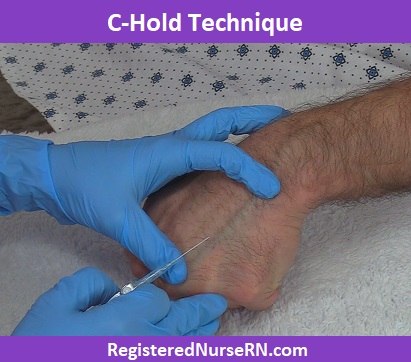
This technique also works well to anchor veins. However, most newer guidelines suggest avoiding this method altogether due to the increased risk of needle injury for the healthcare worker.
In addition, when you use the two digits in that position instead of the thumb only, It makes it a bit harder to hold the patient’s extremity steady with the rest of your hand. In the thumb anchoring technique, it is much easier to grasp the limb and hold it steady.
In our video on how to anchor veins, I demonstrate a quick comparison so that you can see how both methods can anchor the vein in place quite well. However, the thumb anchoring technique is generally considered safer since the thumb is under and not above the needle, unlike the C-hold technique that requires a digit to be placed above the needle.
Conclusion: Always Anchor the Vein
In conclusion, when you go to stick the patient, you want to take steps to ensure the vein isn’t going to move or roll out of the way. By taking time to properly anchor the vein, you will increase your chances of a successful stick.