Are you studying hyponatremia and need to know some mnemonics on how to remember the causes, signs & symptoms, nursing interventions? This article will give you some clever mnemonics on how to remember hyponatremia for nursing lecture exams and NCLEX.
In addition, you will learn how to differentiate hyponatremia from hypernatremia. Don’t forget to take the hypernatremia & hyponatremia quiz.
Nurse Sarah’s Notes and Merch
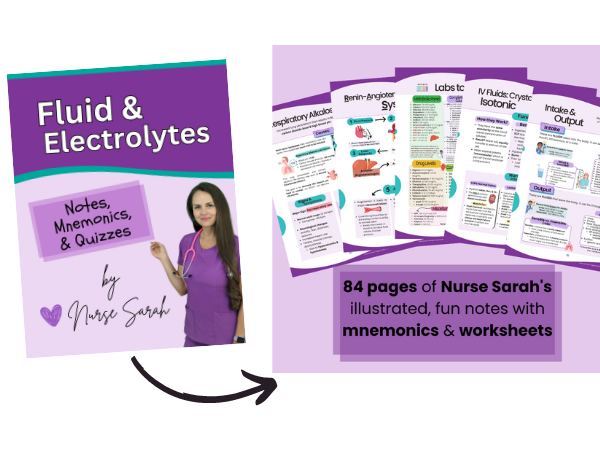
Just released is “Fluid and Electrolytes Notes, Mnemonics, and Quizzes by Nurse Sarah“. These notes contain 84 pages of Nurse Sarah’s illustrated, fun notes with mnemonics, worksheets, and 130 test questions with rationales.
You can get an eBook version here or a physical copy of the book here.
In this article you will learn:
- Normal Sodium Level
- 3 Types of Hyponatremias
- Causes of Hyponatremia
- Signs & Symptoms of Hyponatremia
- Nursing Interventions for Hyponatremia
Teaching Tutorial on Hyponatremia
Hyponatremia
Hypo: “under/beneath”
Natr: Prefix for Sodium
Emia: blood
Meaning of Hyponatremia: low sodium in the blood
Normal sodium levels: 135 to 145 mEq/L (<135 = hyponatremia)
Role of sodium in the body: An important electrolyte that helps regulate water inside and outside of the cell. Remember that water and sodium loves each other and where ever sodium goes so does water.
Learn about Hypertonic, Hypotonic, & Isotonic Solutions. For example, in hyponatremia sodium outside of the cell is very low and this causes water to move inside the cell. In turn, the cell will swell and you will start to see problems in the body, especially with brain cells (confusion).
Sodium also play a role in muscle, nerves, and organ function.
Types of Hyponatremia
Euvolemic Hyponatremia is where the water in the body increases but the sodium stays the same. The causes include: SIADH (Syndrome of inappropriate antidiuretic hormone secretion) which is due to the increased amount of secretion of antidiuretic hormone. This hormone retains water in the body which dilutes sodium. Other causes: diabetes insipidus, adrenal insufficiency, Addison’s disease etc.
Hypovolemic Hyponatremia is where the patient has lost a lot of fluid and sodium. Causes: vomiting, diarrhea, NG suction, diuretic therapy, burns, sweating
Hypervolemic Hyponatremia is where the body has increased in fluid and sodium. However, sodium decreases due to dilution and because total body water and sodium are regulated independently in the body. Causes: congestive heart failure, kidney failure, IV infusion of saline, liver failure etc.
Causes of Hyponatremia
Remember “NO Na+”
Na+ excretion increased with renal problems, NG suction (GI system rich in sodium), vomiting, diuretics, sweating, diarrhea, decreased secretion of aldosterone (wasting sodium)
Overload of fluid with congestive heart failure, hypotonic fluids infusions, renal failure (dilutes sodium)
Na+ intake low through low salt diets or nothing by mouth
Antidiuretic hormone over secreted **SIADH (syndrome of inappropriate antidiuretic hormone secretion…remembers retains water in the body and this dilutes sodium)
Signs & Symptoms of Hyponatremia
Remember “SALT LOSS”
Seizures & Stupor
Abdominal cramping, attitude changes (confusion)
Lethargic
Tendon reflexes diminished, trouble concentrating (confused)
Loss of urine & appetite
Orthostatic hypotension, overactive bowel sounds
Shallow respirations (happens late due to skeletal muscle weakness)
Spasms of muscles
Nursing Interventions for Hyponatremia
- Watch cardiac, respiratory, neuro, renal, and GI status
- Hypovolemic Hyponatremia: give IV sodium chloride infusion to restore sodium and fluids (3% Saline hypertonic solution….harsh on the veins…given in ICU usually through central line very slowly…must watch for fluid overload)
- Hypervolemic Hyponatremia: Restrict fluid intake and in some cases administer diuretics to excretion the extra water rather than sodium to help concentrate the sodium. If the patient has renal impairment they may need dialysis.
- Caused by SIADH or antidiuretic hormone problems: fluid restriction or treated with an antidiuretic hormone antagonists called Declomycin which is part of the tetracycline family (don’t give with food especially dairy or antacids…bind to cations and this affect absorption).
- If patient takes Lithium remember to monitor drug levels because lithium excretion will be diminished and this can cause lithium toxicity.
- Instruct to increase oral sodium intake and some physicians may prescribe sodium tablets. Food rich in sodium include: bacon, butter canned food, cheese, hot dogs, lunch meat, processed food, table salt