Cell membrane transport quiz to test your knowledge on how fluid and electrolytes transport in and out of the cell.
Cell transport is a vital process within the cell that helps moves water and molecules to and from the cell. There are several transport processes you want to be familiar with, like active and passive transport.
Nurse Sarah’s Notes and Merch
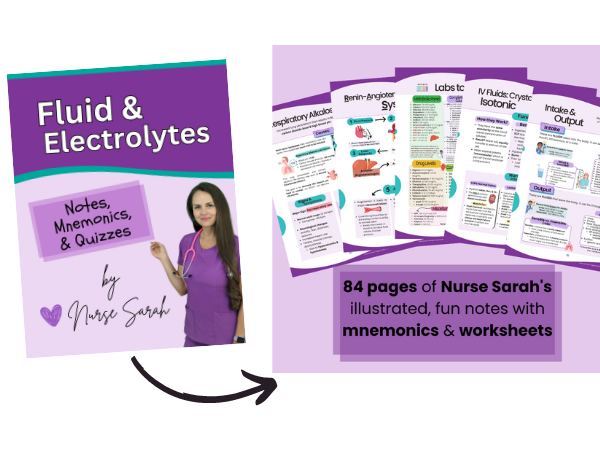
Just released is “Fluid and Electrolytes Notes, Mnemonics, and Quizzes by Nurse Sarah“. These notes contain 84 pages of Nurse Sarah’s illustrated, fun notes with mnemonics, worksheets, and 130 test questions with rationales.
You can get an eBook version here or a physical copy of the book here.
This quiz will test you on: passive transport (osmosis, simple diffusion, facilitated diffusion) and active transport. Before taking the quiz, you may want to review the cell membrane transport video or notes.

Cell Membrane Transport Quiz (Movement of Fluid & Electrolytes)
Cell Transport Quiz (Fluid and Electrolytes)
- What forms of fluid or electrolyte movement are considered to be passive transport processes? Select all that apply:
A. Osmosis
B. Active transport
C. Simple diffusion
D. Facilitated diffusion
E. Endocytosis
The answers are A, C, and D. These are all forms of passive transport that require no energy.
- What transport process moves molecules (solutes) from a high concentration to a low concentration without channel or carrier proteins or energy?
A. Active transport
B. Simple diffusion
C. Facilitated diffusion
The answer is B: simple diffusion. This transport process moves molecules (solutes) from a high concentration to a low concentration without channel or carrier proteins or energy.
- Select all the characteristics of active transport:
A. Requires ATP
B. Moves only tiny, noncharged molecules
C. Moves molecules from a high concentration to a low concentration of molecules
D. Moves molecules against the concentration gradient
E. Uses proteins to help assist in transporting molecules
The answers are A, D, and E. Active transport moves molecules against the concentration gradient (from low concentration to a high concentration. This movement takes effort and requires energy in the form of ATP. It can move large, polar and charged (ions) via carrier or channel proteins.
- Select all the correct statements about facilitated diffusion and active transport:
A. Facilitated diffusion requires no energy while active transport does.
B. Facilitated diffusion moves molecules down the concentration gradient (from high to low concentration), while active transport moves molecules against the concentration gradient (low to high concentration).
C. Both transport processes utilize carrier or channel proteins.
D. Both processes only transport tiny, noncharged molecules.
The answers are A, B, and C. Option D is incorrect. It should say that both processes transport big, charged, and polar molecules rather than tiny, noncharged (this is simple diffusion).
- What molecules (solutes) does the cell’s membrane (phospholipid bilayer) allow to diffusion through without channel or carrier proteins? Select all that apply:
A. Glucose
B. Oxygen
C. Ions
D. Carbon dioxide
The answers are B and D. The cells membrane only allows tiny, noncharged molecules like oxygen, carbon dioxide etc. through. If molecules are big, charged, and polar they must go through channel or carrier proteins.
- The sodium-potassium pump is an example of what transport process?
A. Osmosis
B. Active transport
C. Simple diffusion
D. Facilitated diffusion
The answer is B: active transport.
- What is the pressure needed to stop the movement of water due to osmosis called?
A. Hydrostatic pressure
B. Diffusion pressure
C. Osmotic pressure
The answer is C: osmotic pressure
- Which statement below best describes osmosis?
A. It occurs when water moves from a fluid with a low solute concentration to a fluid with a high solute concentration.
B. It occurs when solutes move from a fluid with a low solute concentration to a fluid with a high solute concentration.
C. It occurs when water moves from a fluid with a high solute concentration to a fluid with a low solute concentration.
D. It occurs when solutes move from a fluid with a high solute concentration to a fluid with a water solute concentration.
The answer is A: Osmosis occurs when water moves from a fluid with a low solute concentration to a fluid with a high solute concentration.
- During osmosis, the semipermeable membrane only allows what through?
A. Ions
B. Water
C. Glucose
D. Proteins
The answer is B: water.
- If the inside of a cell has a high osmolarity (high osmotic pressure), will water leave or enter the cell?
A. Enter
B. Leave
The answer is A: enter. If the inside of a cell has a high osmolarity or high osmotic pressure, it means the cell has a high solute concentration but low water. According to osmosis, water will move from the outside of the cell to the inside.
Don’t forget to tell your friends about this quiz by sharing it your Facebook, Twitter, and other social media. You can also take more fun nursing quizzes.
*Disclaimer: While we do our best to provide students with accurate and in-depth study quizzes, this quiz/test is for educational and entertainment purposes only. Please refer to the latest NCLEX review books for the latest updates in nursing. This quiz is copyright RegisteredNurseRn.com. Please do not copy this quiz directly; however, please feel free to share a link to this page with students, friends, and others.