ECG quiz on accelerated junctional rhythm for nurses!
This quiz will test your knowledge on how to identify accelerated junctional rhythm, characteristics of the rhythm, the nurse’s role, and treatments.
Don’t forget to check out our free series on ECG interpretation and other review quizzes.
Accelerated Junctional Rhythm ECG Quiz Questions
ECG/EKG Study Guide and Workbook for Nursing Students
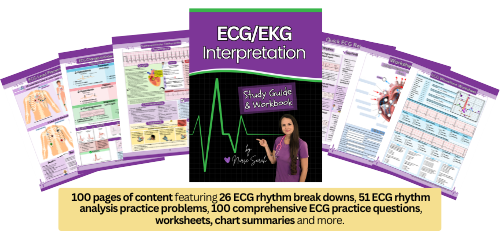
“ECG/EKG Interpretation Study Guide and Workbook by Nurse Sarah”. This book contain 100 pages of content featuring 26 ECG rhythm break downs, 51 ECG rhythm analysis practice problems, 100 comprehensive ECG practice questions, worksheets, chart summaries, and more.
You can get an eBook version here: “Nurse Sarah ECG Book” or a physical copy here: “ECG/EKG Interpretation Study Guide by Nurse Sarah“.
Accelerated Junctional Rhythm ECG/EKG Quiz
1. Which statement below is the most accurate about the origin of accelerated junctional rhythm?
A. This is an abnormal rhythm that arises from electrical structures in the AV junction due to a boost in their automaticity.
B. This is an abnormal rhythm that arises due to an increase in automaticity by the sinoatrial node.
C. This is an abnormal rhythm that arises from a decrease in automaticity by the electrical structures in the AV junction.
D. This is an abnormal rhythm that arises because both the sinoatrial and AV node experience a decrease in automaticity.
The answer is A. Accelerated junctional rhythm occurs because electrical structures in the AV junction (AV node or the bundle of His) have increased automaticity. In addition, many cases of accelerated junctional rhythm occur because there is a decrease in sinoatrial node automaticity, therefore, the AV junction electrical structures take over.

2. Which rhythm above demonstrates accelerated junctional rhythm?
A
B
C
The answer is C. Image A is a third-degree heart block, and image B is atrial fibrillation.
3. For a rhythm to be classified as an accelerated junctional rhythm the rate must be?
A. 40-60 bpm
B. 60-100 bpm
C. >100 bpm
D. <40 bpm
The answer is B. Accelerated junctional rhythm must have a rate between 60-100 bpm. Junctional escape has a rate between 40-60 bpm. Junctional tachycardia has a rate >100 bpm. Junctional bradycardia has a rate <40 bpm.
4. The nurse is assessing an ECG. What characteristics must be present for the rhythm to be classified as accelerated junctional rhythm? Select all that apply:
A. Rate >100 bpm
B. PR interval short (less than 0.12 seconds) or absent
C. P waves can be present before, after, or concealed within the QRS complex
D. P waves are always found either after or before the QRS complex
The answers are B and C. The rate should be 60-100 bpm. The PR interval (if the P wave is before the QRS complex) will be short (less than 0.12 seconds). However, the P wave can be found either in front of the QRS complex but very close to it, within the QRS complex (concealed/hidden), or after the QRS complex. In addition, on Leads II, III, and aVF the P wave will be upside down.
5. The patient’s rhythm is accelerated junctional rhythm with P waves present. In which leads would the nurse expect to find upside down P waves on the ECG? Select all that apply:
A. aVL
B. I
C. II
D. III
E. aVF
The answers are C, D, and E. In leads II, III, and aVF, the P wave can be upside down rather than upright.
6. How does the QRS complex measure in accelerated junctional rhythm?
A. narrow <0.12 seconds
B. wide >0.12 seconds
C. absent
The answer is A: narrow (less than 0.12 seconds)
7. The rate is ____________ in accelerated junctional rhythm?
A. irregular
B. regular
The answer is B: regular.
8. Select which parts on the ECG waveform that are ABNORMAL in accelerated junctional rhythm:
P wave
PR interval
QRS complex
QT interval
ST segment
T wave
The answers are P wave and PR interval. The P wave can be either concealed within the QRS complex, before, or after the QRS complex. The PR interval will be short (<0.12 seconds), if the P wave is found before the QRS complex. However, if the PR interval is not found before the QRS complex it will be absent. The other parts of the ECG waveform are within normal limits.
9. A patient is presenting with accelerated junctional rhythm. The nurse assesses for potential causes. Which finding below can cause this rhythm?
A. Potassium 4.5 mEq/L
B. Dilantin level 15 mcg/mL
C. Digoxin level 3 ng/mL
D. Magnesium 2 mg/dL
The answer is C. Digoxin toxicity is a main cause of accelerated junctional rhythm. A normal digoxin level should be 0.5-2 ng/mL. The other labs/levels presenting are within normal range.
10. What are some signs and symptoms that indicate a patient is not tolerating accelerated junctional rhythm? Select all that apply:
A. capillary refill <2 seconds
B. difficulty breathing
C. fatigue
D. blood pressure 70/40 mmHg
E. chest pain
The answers are B, C, D, and E. Option A is a normal response. However, a capillary refill that is increased >2-3 seconds is abnormal and demonstrates a decrease in cardiac output.
Don’t forget to tell your friends about this quiz by sharing it your Facebook, Twitter, and other social media. You can also take more fun nursing quizzes.
*Disclaimer: While we do our best to provide students with accurate and in-depth study quizzes, this quiz/test is for educational and entertainment purposes only. Please refer to the latest NCLEX review books for the latest updates in nursing. This quiz is copyright RegisteredNurseRn.com. Please do not copy this quiz directly; however, please feel free to share a link to this page with students, friends, and others.