Hypovolemia quiz for nursing students that will test your knowledge on fluid volume deficit (dehydration).
As a nurse you want to be familiar with the types of dehydration (hypertonic dehydration, hypotonic dehydration, and isotonic dehydration). In addition, to the signs and symptoms and nursing interventions.
Don’t forget to watch the lecture on fluid volume deficit and to access the fluid volume deficit notes.
Nurse Sarah’s Notes and Merch
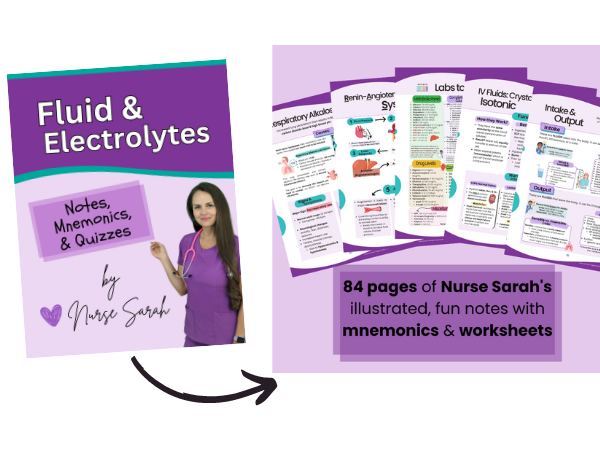
Just released is “Fluid and Electrolytes Notes, Mnemonics, and Quizzes by Nurse Sarah“. These notes contain 84 pages of Nurse Sarah’s illustrated, fun notes with mnemonics, worksheets, and 130 test questions with rationales.
You can get an eBook version here or a physical copy of the book here.
Hypovolemia (Fluid Volume Deficit) Nursing Quiz
Hypovolemia (Fluid Volume Deficit) Dehydration Nursing Quiz
- What type of dehydration presents with mainly a loss of water rather than electrolytes (solutes)?
A. Hypertonic dehydration
B. Hypotonic dehydration
C. Isotonic dehydration
The answer is A: hypertonic dehydration. This presents with mainly a loss of water rather than electrolytes (solutes). This is also known as hypernatremia. - A patient with diabetes insipidus is most likely to experience what type of fluid volume deficit (dehydration)?
A. Hypertonic dehydration
B. Hypotonic dehydration
C. Isotonic dehydration
The answer is A: hypertonic dehydration. Diabetes insipidus (DI) causes the patient to void a high volume of urine. This is due to a low level of ADH being produced in the body. DI will cause the extracellular compartment to lose mainly water rather than electrolytes. This change in osmolarity will further cause fluid to move from intracellular to extracellular compartment and shrink the cell. - What type of dehydration presents mainly with a loss of electrolytes (solutes) rather than water?
A. Hypertonic dehydration
B. Hypotonic dehydration
C. Isotonic dehydration
The answer is B: hypotonic dehydration. Hypotonic dehydration presents mainly with a loss of electrolytes (solutes) rather than water. This is also known as hyponatremia. - Your patient is experiencing a severe gastrointestinal bleed. What type of fluid volume deficit will this patient experience?
A. Hypertonic dehydration
B. Hypotonic dehydration
C. Isotonic dehydration
The answer is C: isotonic dehydration. This type of fluid volume deficit occurs when there is an EQUAL loss of water and electrolytes. This is the most common type of fluid volume deficit seen, and the problem from this type of dehydration arises from the intravascular loss (which can lead to hypovolemic shock). - What signs and symptoms of fluid volume deficit are not likely to present in older adults (geriatric patient populations)? Select all that apply:
A. Sluggish capillary refill
B. Confusion
C. Thirst
D. Weight loss
E. Decreased skin turgor
The answers are C and E. As people age the thirst response decreases along with skin elasticity. Therefore, thirst and decreased skin turgor are not reliable signs and symptoms of fluid volume deficit in the geriatric population. - What signs and symptoms in a young infant would alert the nurse that the patient is likely experiencing fluid volume deficit? Select all that apply:
A. Weight gain
B. Bulging fontanelles
C. Sunken fontanelles
D. No tears when crying
The answers are C and D. Sunken fontanelles (the spaces in between the skull bones that present as soft spots on the head during the first part of life) and no tears when crying would alert the nurse the infant is dehydrated. In addition, the infant may be fussy, restless, and experience weight loss. - A patient is admitted with fluid volume deficit (isotonic dehydration). What lab results would the nurse expect to see in this patient? Select all that apply:
A. Decreased hemoglobin
B. Increased serum osmolality
C. Increased urine specific gravity
D. Decreased urine osmolality
E. Increased BUN
The answers are B, C, and E. Lab results are going to depend on the type of dehydration, but in most cases there will be a low amount of fluid in the blood and urine. Therefore, the blood and urine are going to be concentrated. As a result, the tests that check for blood and urine concentrations will be INCREASED: serum osmolality, hemoglobin, hematocrit, BUN, sodium level, urine specific gravity and osmolality. - A patient is receiving treatment for fluid volume deficit (hypertonic dehydration). What will the nurse implement in the patient’s plan of care? Select all that apply:
A. Daily weights
B. Administer hypotonic IV solutions per physician’s order
C. Increase sodium intake
D. Monitor sodium level
E. Encourage the patient to limit fluids to 1-2 liters per day
F. Strict intake and output measurements
The answers are A, B, D, and F. The nurse would want to weigh the patient daily (this is a great early indicator of the patient’s fluid status). Administer hypotonic IV solutions per physician’s order to help rehydrate the cell and fluid compartments. Monitor sodium level because it can become too high in this type of dehydration. However, when the nurse administers hypotonic IV solutions the sodium level should be monitored to ensure it doesn’t get too low (hyponatremia) because the hypotonic solution could dilute fluid quickly, if not monitored closely. Limiting fluids should be avoided (1-2 L/day is a low amount of fluid per day and would be initiated in fluid volume OVERLOAD). Finally, the nurse would strictly monitor intake and output to ensure the patient is receiving enough fluid and urinary output is within normal range (30 mL/hr or 0.5 mL/kg/hr). - What signs and symptoms could present with fluid volume deficit in an adult patient? Select all that apply:
A. Weight loss
B. Pitting edema
C. Confusion
D. Rales
E. Thirst
F. Orthostatic hypotension
G. Weak pulse
H. Increase skin turgor
The answers are A, C, E, F, and G. Weight loss, confusion, thirst, orthostatic hypotension, and weak pulse all can present in an adults with fluid volume deficit.
Don’t forget to tell your friends about this quiz by sharing it your Facebook, Twitter, and other social media. You can also take more fun nursing quizzes.
*Disclaimer: While we do our best to provide students with accurate and in-depth study quizzes, this quiz/test is for educational and entertainment purposes only. Please refer to the latest NCLEX review books for the latest updates in nursing. This quiz is copyright RegisteredNurseRn.com. Please do not copy this quiz directly; however, please feel free to share a link to this page with students, friends, and others.