Taking an ovulation test can help you determine your most fertile days when you are trying to get pregnant, and these tests work by detecting when a process known as “ovulation” is about to occur.
What is Ovulation?
Ovulation happens when an ovary releases an egg, which must then be fertilized by a sperm for pregnancy to occur. Ovulation tests work by detecting whether the luteinizing hormone (LH) surge is occurring during your menstrual cycle.
The timing of the LH surges can vary from cycle to cycle, so it can be helpful to test and track your ovulation each month you are trying to get pregnant (see also: how to take a pregnancy test).
Best Time to Have Sex to Become Pregnant
This LH hormone surges occurs about 24-36 hours before an egg is released from an ovary, and if you want to increase your chances of getting pregnant, you’re going to want to have sexual intercourse within the next 48 hours of a positive ovulation test result.
Once released, an egg (also called an ovum) can live up to 12-24 hours, and sperm can survive around 3-5 days on average.
Signs of Ovulation
There are other indicators that you are ovulating or about to ovulate, such as clear, stretchy cervical mucus, which is similar to the consistency of an egg white. Also, your libido will likely be highest during this time, so you might find that you are more interested in physical intimacy.
In addition, you might notice ovary pain, body aches, irritability, brain fog, fatigue, and a slight increase in body temperature around the time of ovulation.
How to Take an Ovulation Test Using Clearblue
For this ovulation test tutorial, I used Clearblue’s digital ovulation test kit, which I purchased from Amazon.com: Clearblue test (affiliate ad link).. Here’s how to test for ovulation.
(Note: always follow the instructions that came with your ovulation test kit, as they may vary or change over time.)
Determine Your Menstrual Cycle Length
First, you need to determine your menstrual cycle length, as this will help you know when to start testing. To do this, you’ll want to determine the dates of when your last periods started. The period start date is cycle day one for each cycle. Count until the day before your next period begins.

It’s best to use at least three months of cycles and average them out. You can then determine your average cycle length. If you need more information on calculating your menstrual cycle, I have an article and video tutorial on that.
Refer to the Ovulation Test Kit’s Chart
Once you know your period cycle length, your ovulation test kit will likely have a chart to tell you on which cycle day you need to start testing. For example, if your cycle was 29 days long, you’d want to start testing on cycle day 12, according to Clearblue’s chart.
If you don’t know your cycle length or would prefer not to calculate it out, Clearblue recommends starting to test on cycle day 10.
Best Time of Day to Test for Ovulation
Different ovulation test kits may have different instructions for testing. The Clearblue ovulation test kit that I used suggests waiting at least four hours after last urinating, but you can take it any time of day as long as you are consistent each day you test.
When you are ready to collect your urine sample on the day of your test, I found that it’s easiest to collect the urine in a cup. However, you can also place the test in your urine stream if you don’t mind a possible mess.
How to Use the Clearblue Ovulation Test Strips
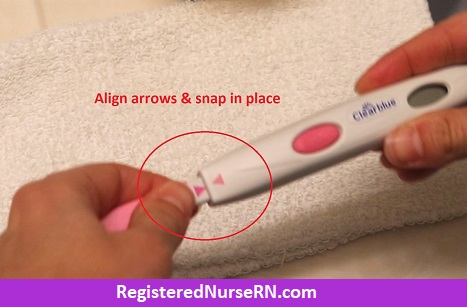
Open the test strip package and prepare the test by removing the pink cap. Find the pink arrow on the test strip and align it with test holder’s pink arrow. Insert until you hear it click. You’ll know it’s ready when the test-ready symbol appears on the screen. Now you’re ready to dip it into your urine sample immediately.
If you are using a urine sample you collected in a cup, dip the absorbent tip into the urine for 15 seconds. Then remove the test from the urine, put the cap back on, and place it on a flat surface as you await your results.
Positive vs Negative Ovulation Test Results
The display will flash as it reads the results to let you know everything is working. After around 3 minutes, the ovulation test should be complete.

Negative result: If no LH surge is detected, you’ll get a blank circle. In this case, you should keep testing each day at the same time.
Positive result: If the smiley face appears, it means the LH surge was detected, and you should have sex within the next 48 hours to increase your odds of pregnancy. Once you get the smiley face, you can stop testing for the rest of that cycle.
After reading the result, eject the test strip by hitting the eject button, and discard it. Keep the digital test holder, as you’ll need it for any future tests you want to take.
Talk to your doctor if you have any concerns about conceiving or if you experience any menstrual cycle irregularities.