Foley catheters help patients drain urine, and as a nurse, this is a common skill you may perform.
However, Foley catheters are a pretty big deal. If you don’t keep things sterile and insert properly, you can cause infection or damage to the patients genitals or urinary tract area.
This video covers some common mistakes you want to avoid when inserting Foley catheter or removing it in a patient.
Here are some things that you never want to do whenever you’re inserting a Foley catheter.
Never break the Sterile Field:
The first thing is that you never want to break the sterile field. This is extremely important with infection prevention.
One way to ensure this, is that you never turn your back on the sterile field or leave it. In addition, once you have your sterile gloves on, you never touch things outside the sterile field.
A mistake some nurses make is that after they’ve gloved their non-dominant hand with a sterile glove and touched the genitals for the betadine cleaning procedure, they don’t keep their hand there but move it and contaminate the sterility of the procedure. It is key to remember that once the sterile glove of the non-dominant hand touches the genitals, it is no longer considered sterile, and it must stay there until the insertion of the catheter is complete.
Never Remove a Foley catheter with an Intact Balloon, even if it is Partially Inflated (ouch!):

It’s important that you never attempt to remove a Foley catheter whenever the balloon is still inflated, even partially inflated. This could cause tearing and damage to the urethra, which could lead to an infection or deformity.
Prior to removal, you want to make sure all the water is out of the balloon.
How do you know the amount of water that needs to be removed from the Foley catheter balloon?
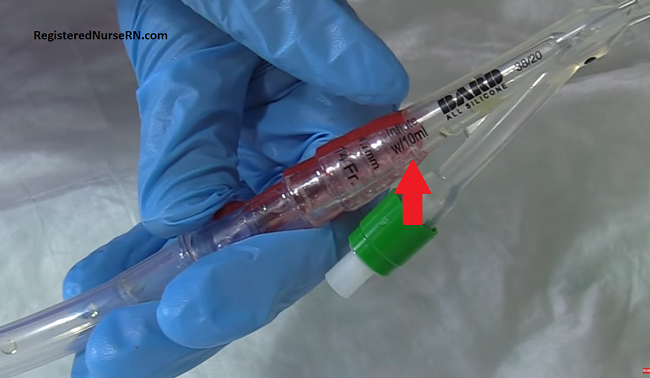
There are a variety of catheter sizes used in practice. Some catheters can hold 10 mL of water in the balloon, while others hold a lot more (20-30 mL).
To find the amount, look at the ports on the catheter (found near the catheter’s bifurcation). It will be written on the port how much water is to be instilled/removed from the catheter. Note the picture below:
Never surprise a patient with this procedure:
Before a Foley catheter insertion, you want to make sure you’ve discussed it in depth with the patient, and they know exactly what to expect and what it entails. Many patients have no idea what a Foley catheter is and how it is placed. This procedure is invasive, uncomfortable, and exposing.
Sometimes patients may be confused due to dementia or other factors, or the catheter will be placed when the patient is under anesthesia. However, you still want to discuss it with them or their family member beforehand and get verbal consent.
You may be interested in more nursing skills.