Registered Nurse RN

Registered Nurse, Free Care Plans, Free NCLEX Review, Nurse Salary, and much more. Join the nursing revolution.

  • RN
    • Nursing Clinical Skills
  • Nursing Videos
  • Blog
  • Nursing School
  • Nursing Care Plans
  • Nursing Quizzes
  • Nursing
  • Nursing Jobs
  • NCLEX Review
  • Store

Depolarization vs Repolarization of Heart Action Potential Explained

What is the difference between depolarization vs repolarization of the heart that creates cardiac action potential?

In order to understand how the PQRST waveform is created on the ECG, you have to understand these two terms. Depolarization and repolarization are words that can be used to describe how a heart cell is responding to the electrical conduction system of the heart.
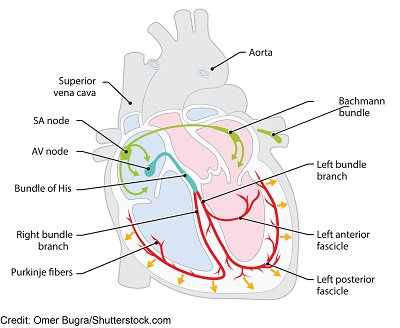
electrical conduction system of heart, ecg, ekg interpretation, nursing, sa node, av node, bundle of his

The heart cells I’m referring to are specialized heart cells that are part of the electrical conduction system of the heart. They make up the atria and ventricles and can receive electrical signals to cause the atria and ventricles to contract.

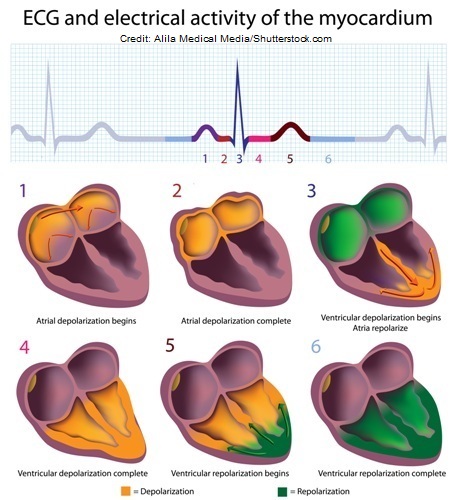
When these cells are resting they are negatively charged, or another way of saying this is that they’re polarized.  To get these cells to move (hence contract), they have to become depolarized (less negative) by an electrical stimulation.

How does this happen? The cells become depolarized (hence contract) when the ion concentration is shifted. When the cell is resting there are more sodium ions on the outside of the cell than the inside, and they can’t get inside of the cell because of the impermeable cell membrane.

But when the cell is stimulated (hence by electrical activity from let’s say the SA node) it causes the cell membrane to become receptive to sodium and sodium can now get inside. When sodium rushes inside the cell, it makes the cell positively charged, which changes its polarized state to a depolarized state, and this leads to the contraction of the heart cell.

ECG/EKG Study Guide and Workbook for Nursing Students
ekg ecg interpretation, ecg ekg study guide, nurse sarah, ecg workbook

“ECG/EKG Interpretation Study Guide and Workbook by Nurse Sarah”. This book contain 100 pages of content featuring 26 ECG rhythm break downs, 51 ECG rhythm analysis practice problems, 100 comprehensive ECG practice questions, worksheets, chart summaries, and more.

You can get an eBook version here: “Nurse Sarah ECG Book” or a physical copy here: “ECG/EKG Interpretation Study Guide by Nurse Sarah“.

Then right after the heart cell contracts it needs to relax. This is referred to as repolarization. Repolarization is where the cell goes back to its negatively charged state on the inside (hence it repolarizes). Therefore, this leads the heart muscle cell to relax.

**The take away from this is to remember that depolarization of the heart cells leads to contraction, and repolarization leads to relaxation (to keep them straight, remember that both repolarization and relaxation start with “re”.)

This process of depolarization and repolarization creates the ECG reading, which is caused by the electrical conduction system of the heart.
ecg, ekg interpretation, atrial depolarization, repolarization ventricular, pqrst

Click the link to learn more about how to interpret an ECG.

Please Share:

  • Print (Opens in new window) Print
  • Share on Facebook (Opens in new window) Facebook
  • Share on X (Opens in new window) X
  • Share on Pinterest (Opens in new window) Pinterest
  • More
  • Share on Reddit (Opens in new window) Reddit
  • Share on LinkedIn (Opens in new window) LinkedIn
  • Share on WhatsApp (Opens in new window) WhatsApp
  • Share on Telegram (Opens in new window) Telegram

Nursing Notes

Nursing School Bundles Notes by Nurse Sarah

RSS Latest YouTube Videos

  • IV Fluids Made Easy in 3 Minutes: Hypertonic, Hypotonic, Isotonic, Colloids
  • Top 5 Early Pregnancy Signs to Know (Eponymous): Chadwick, Ladin, Piskacek, Hegar, Goodell
  • NCLEX Review: Infection Control and Safety PPE Requirements #shorts
  • Lab Tube Colors and Tests (Order of Draw) Made Simple #phlebotomy #nursing #shorts

Recent Posts

  • Order of Draw Phlebotomy Quiz Questions
  • Insulin Types Explained: Onset, Peak, Duration (Ultra-Rapid, Rapid, Short, Long-Acting)
  • NCLEX Practice Questions: Infection Control and Safety
  • Female Pelvic Types: Gynecoid, Android, Anthropoid, Platypelloid
  • Insulin Types Quiz for Nursing Students (Onset, Peak, Duration, Mixing & IV Use)

Disclosure and Privacy Policy

This website provides entertainment value only, not medical advice or nursing protocols. We strive for 100% accuracy, but nursing procedures and state laws are constantly changing. By accessing any content on this site or its related media channels, you agree never to hold us liable for damages, harm, loss, or misinformation. See our full disclosure and privacy policy.

Important Links

  • Advertise
  • Contact Us

Follow Us on Social Media

  • Facebook Nursing
  • Instagram Nursing
  • TikTok Nurse
  • Twitter Nursing
  • YouTube Nursing

Copyright Notice

All images, articles, text, videos, and other content found on this website are protected by copyright law and are the intellectual property of RegisteredNurseRN.com or their respective owners.

Copyright © 2026 RegisteredNurseRN.com. All Rights Reserved.