BMI stands for body mass index, and this is one of the anthropometric measurements that nurses collect or calculate during health assessments, along with other measurements such as skinfold thickness, height, weight, and so on.
BMI scores are often used to screen for potential health problems, so it can be useful to know how to calculate BMI manually via the BMI math formula.
How to Calculate BMI (Body Mass Index)
To calculate BMI, you must first determine a person’s height and weight. The measurements can be in either the metric system (kilograms and meters) or the imperial system (pounds and inches), but the formula is slightly different for each one.
BMI Formula

Note: The formulas used to calculate BMI are the same for both male and female, adults and children.
For our first problem, let’s assume a patient weighs 167 pounds and is 6 feet tall. Because these measurements are in imperial units (pounds and inches), we’ll use the formula below:
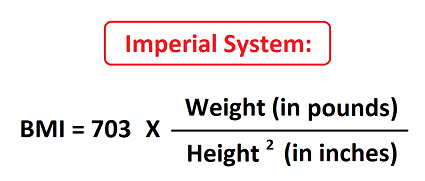
First, let’s plug in our numbers to our BMI formula. Our patient’s weight is 167 pounds. The height was 6 feet, but the formula calls for the units to be in inches. Therefore, we must first convert feet to inches.
There are 12 inches in one foot. Therefore we multiply 6 (feet) X 12 to get a total of 72 inches.
We can now plug these numbers into our formula and solve:
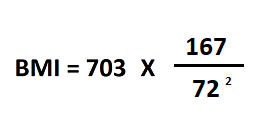
First, let’s solve the 72 squared. To square a number means to multiply it by itself. Therefore, we multiply 72 X 72, which gives us 5,184.
Next, we divide 167 by 5,184 = 0.0322145061728395. Finally, we’ll multiply 0.0322145061728395 by 703, which gives us a BMI of 22.6 (when rounded to the nearest tenth).
Here’s what the formula looks like as I solved it:

Quick TIP: What if our patient’s height had been 5 feet 5 inches tall instead of 6 feet even? We’d first multiply 5 feet X 12 to get 60 inches, but we’d also have to add the other 5 inches (because they are 5’5″), which would have given us a total of 65 inches for the patient’s height. Don’t forget to add all of the inches when converting feet to inches for a person’s height!
BMI Formula for Metric Units
For our next problem, our patient’s height is 1.65 meters (m), and their weight is 64.5 kilograms (kg). Because these measurements are given in metric units, we’ll use the metric BMI formula, which is slightly different because we don’t have to multiply by 703 like we did above:

First, let’s go ahead and plug in our numbers. Because these numbers are given in their required measurements, there is no need to convert anything. We can plug those numbers right into our formula.
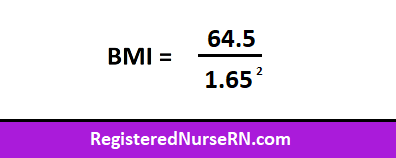
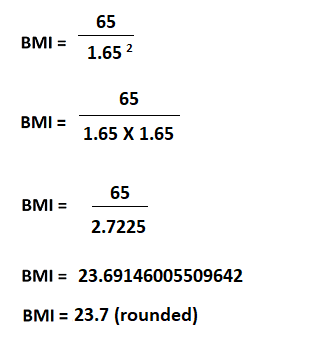
Let’s begin solving this by first squaring 1.65, which means to multiply it by itself. Therefore, 1.65 X 1.65 = 2.7225.
Next, we can divide 64.5 (our weight) by 2.7225 (our height squared): 64.5 / 2.7225 = 23.69146005509642.
We’ll round to the nearest tenth, so that gives us a final BMI of 23.7.
Here’s a visual of how I solved the formula:
Rounding tip: Remember, when rounding to the nearest tenth, you look at the number’s value in the 100ths place (in this case, it was the number 9). If the number in the 100ths place is 5 or greater, you round the 10ths place number up one digit. So instead of rounding to 23.6, it became 23.7.
Take the free BMI quiz to test your knowledge on BMI!
What are the BMI ranges for an adult (male and female)?
Once you calculate your BMI number, you can see which BMI category you fit in, per the CDC’s guidelines. The categories are the same for both adult males and adult females.
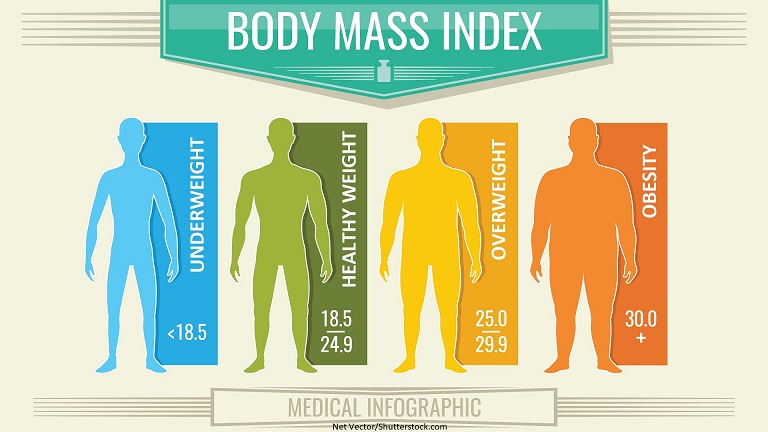
In our first example, the patient’s BMI was 22.6, which falls in the healthy weight category.
| BMI | Weight Status |
| Below 18.5 | Underweight |
| 18.5 – 24.9 | Healthy Weight |
| 25.0 – 29.9 | Overweight |
| 30.0 and Above | Obesity |
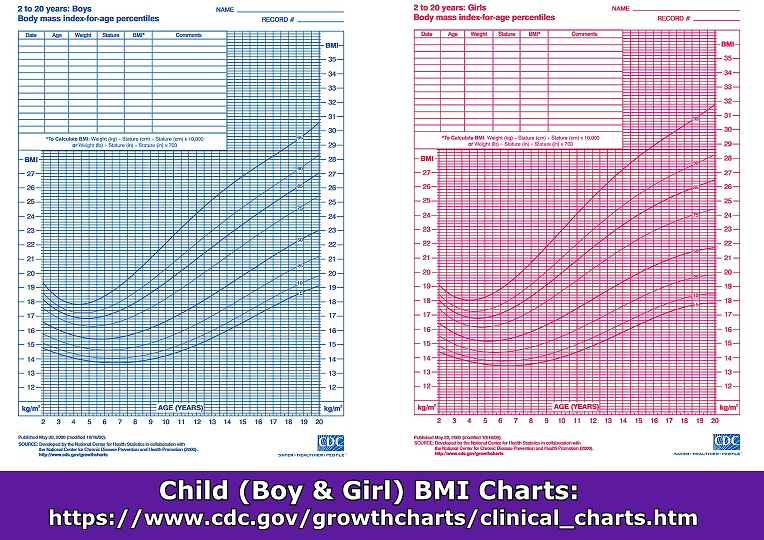
What are the BMI ranges for children (boys and girls)?
For children and teens, the CDC publishes individual charts for both boys and girls.
CDC References:
- https://www.cdc.gov/healthyweight/assessing/bmi/adult_bmi/index.html
- https://www.cdc.gov/healthyweight/assessing/bmi/childrens_bmi/about_childrens_bmi.html
- https://www.cdc.gov/growthcharts/clinical_charts.htm