Many people talk about body fat percentage, but how you do actually measure body fat percentage? In this article and video, I’m going to demonstrate how to measure body fat percentage on an adult male by using skinfold calipers to measure the skinfold thickness at various sites of the body.
The skinfold thickness measurement is a part of the anthropometric measurements that nurses assess, such as the height, weight, BMI, head circumference, and so forth.
Nursing Supplies Required for Skinfold Thickness Measurement
To perform this nursing skill, you’ll need the following:
1. Skinfold caliper. We’re using an inexpensive caliper that we purchased from Amazon. We have it available in our Amazon Affiliate Store.
2. Material to record the measurements (pen and paper or an electronic device)
3. A calculator or reference chart to determine the body fat percentage based on your measurements. Many skinfold calipers will include a reference chart so that you can determine body fat percentage.
How to Use Skinfold Calipers
Below are some general tips for using skinfold calipers. However, skinfold caliper instructions can vary for different manufacturers, so it’s important to read the instructions that were provided with your skinfold caliper.
In addition, nursing protocols can vary on measurement techniques or certain patient populations, so always verify facility protocols for specific instructions.
1. How much skin and fat should you pinch when measuring with skinfold calipers? You want to have a space of around 2-3 inches between your index finger and thumb, and then grab the skin and fold it together.
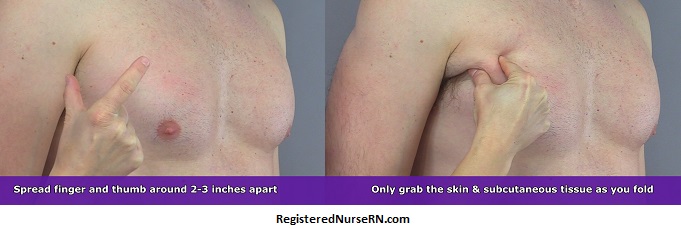
Be sure to only grab the skin and underlying subcutaneous tissue, and do not pinch and include the actual muscle tissue as you measure.
2. Try to take all measurements on the right side of the body if possible.
3. Position calipers around 1 cm below your fingers (or 1 cm to the side if measuring a horizontal fold of skin).

4. Measure with the caliper heads at the center of the skinfold as much as possible, and not at the base or tip (crest).

5. The skinfold caliper heads should be perpendicular to the skinfold.
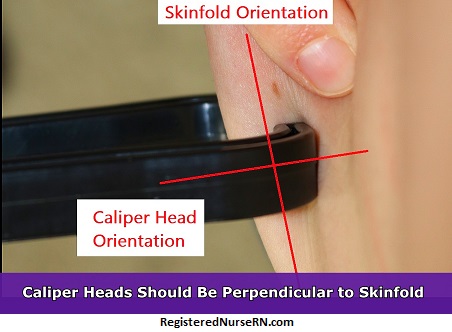
6. After releasing the trigger of the skinfold calipers, allow the caliper heads to adjust for around two seconds. Then you can read and record the measurement to the nearest millimeter (mm).
7. For accuracy, take three readings at each skinfold location and average them together to create a final average for that location.
8. Instruct the patient that there may be slight discomfort as the caliper heads pinch the skin.
9. Clean the calipers and perform hand hygiene before and after each use.
Skinfold Thickness Measurement Methods
To estimate body fat percentage, there are many different methods you can use to assess skinfold thickness, and different sites on the body you can measure. For this article and video, I’ll demonstrate it using the 1-site, 3-site, and 7-site methods.
Triceps Skinfold Thickness Measurement (1-Site Method)
First, I’ll demonstrate a common method used in nursing, which is the triceps skinfold thickness measurement.
Make sure the patient’s arm is relaxed and at the side. Go halfway down the back of the arm, and using your non-dominant hand, grasp around 3 inches of the skin with your finger and thumb.
Pinch the skin together into a vertical fold and gently pull it out.
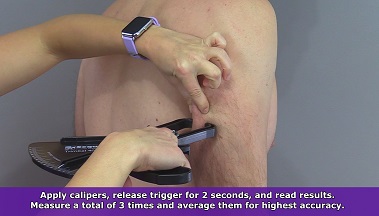
Next, holding the calipers in your dominant hand, press the trigger to open the caliper heads. Position the calipers heads about halfway down the pinched skin in a perpendicular orientation, just under or to the side of your fingers (1 cm), and release the trigger to allow the caliper heads to close.
After releasing the calipers for a couple of seconds, read and record the results to the nearest millimeter (mm). Repeat two more times and average the three numbers for a total score of this location.
Measuring Male Body Fat Percentage Using the 3 Caliper Method (Jackson-Pollock)
You can also use a 3-site Jackson/Pollock method to determine body fat percentage, which is taken at the chest, abdomen, and thigh in males. In females, it is measured at the triceps, suprailiac, and thigh locations.

- To measure the chest’s skinfold thickness, grasp a 3-inch portion of skin halfway between the nipple and the armpit, and gently pinch it into a diagonal fold. Measure the skinfold using a similar method as before, with the caliper heads placed in a perpendicular orientation to the skinfold. Release the calipers for a couple of seconds, and record the results. Again, you can take three measurements for each site and average them together with each site you measure.
- To measure the abdomen skinfold thickness, grasp a 3-inch portion of skin around 1 inch to the right of the belly button (umbilicus), and fold the skin into a vertical orientation. Use the same method discussed earlier to obtain the caliper reading to nearest millimeter.
- To measure the thigh skinfold thickness, grasp a 3-inch portion of skin about halfway down the thigh and pinch it into a vertical fold. Place the caliper heads halfway down the fold in a perpendicular orientation, and measure using the same methods previously described.
Measuring Male Body Fat Percentage Using the 7 Caliper Jackson/Pollock Method
If you want to use the 7-site method, you will measure the triceps, chest, abdomen, and thigh in the same way I demonstrated before, but you’ll also add the subscapular, suprailiac, and midaxillary locations.
Note: In females, you’ll use the following locations: chest, abdomen, thigh, triceps, subscapular, suprailiac, and midaxillary.

- Subscapular – To measure at the subscapular site, grasp a 3-inch portion of skin just under the shoulder blade, and gently pinch it together into a diagonal fold. Measure the skinfold with the calipers using the same technique as before, and record your results.
- Suprailiac – To measure at the suprailiac site, we’re going to palpate to feel that top portion of the hip bone, which is called the iliac crest. We’re going to go just above that and grasp a 3 inch portion of skin into a diagonal fold. Then, we’ll measure with our calipers and record.
- Midaxillary – Finally, to measure at the midaxillary site, we’re going to pinch a horizontal fold below the armpit area, and measure using the same measuring technique as before.
How to Determine Body Fat Percentage Based on Caliper Measurements
Once you have recorded and averaged all of your measurements, you can now calculate your body fat percentage. The method you use to find your body fat percentage will depend on the method you used to measure (1-site method, 3-site method, or 7-site method), as each will require a specific calculator or reference chart.
If you are in a clinical setting, your computer software should provide you with an instant body fat percentage figure once you enter all of your measurements into the required fields, or you will have a reference chart available to lookup the results. This is common with the triceps skinfold thickness measurement.
If you are measuring body fat percentage at home, a chart should be included with your skinfold calipers, which you can use to lookup your body fat percentage for the recommended method that came with your calipers.
You simply determine the average for each location, add all of the locations together for a total millimeter number, and then look at the row and column of the chart that corresponds to your age and total millimeters measured at all locations.
As an example, the calipers demonstrated in the video above recommended that you should use the 3-site method. Here were the measurements from my patient.
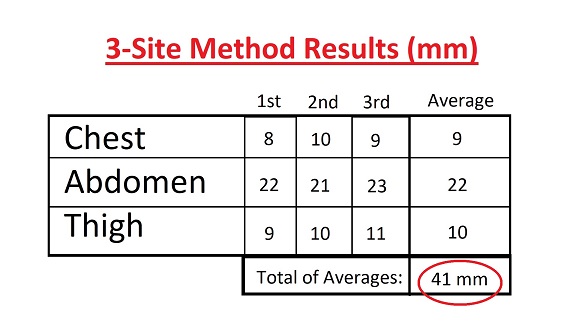
Once I had these figures, I simply referred to the chart and looked up my patient’s age (40) column and the the corresponding row for the measurement I collected (41 mm). I then found the estimated body fat percentage, which was 14% body fat (rounded).

Finally, if you do not have a chart, you use various free body fat percentage calculators online such as the one from linear-software.com. They have a calculator for various methods, and all you have to do is enter your weight, height, and measurements. The calculator will then tell you your estimated body fat percentage.
What Are the Body Fat Percentage Ranges?
Here are the body fat categorizations for men and women, according to the American Council on Exercise.
