This smooth muscle quiz will help you practice basic facts and concepts about this type of muscle tissue. Smooth muscle tissue is one of the three types of muscle tissue found in the human body. The other two types of muscle tissue are skeletal and cardiac muscle tissue.
Before taking the quiz below, you might want to review our smooth muscle tissue anatomy notes or watch our smooth muscle video on YouTube.
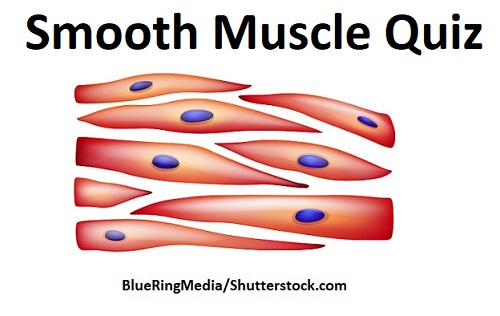
Smooth Muscle Quiz Anatomy
(NOTE: When you hit submit, it will refresh this same page. Scroll down to see your results.)
Smooth Muscle Quiz Anatomy
1. How many nuclei does a smooth muscle fiber contain?
a. One nucleus
b. Two nuclei
c. Three nuclei
d. Zero
The answer is a, one nucleus, which is located near the center of the smooth muscle cell.
2. Smooth muscle contains striations.
a. True
b. False
The answer is b, false. Unlike skeletal and cardiac muscle tissue, smooth muscle tissue does NOT contain striations (stripes), due to its lack of sarcomeres. This is why it’s called smooth muscle!
3. Which answer below describes the shape of smooth muscle cells?
a. Irregular and branched
b. Long and cylindrical
c. Fusiform (spindle or football shaped)
d. Both a and b
The answer is c, fusiform. These cells taper at each end, giving the appearance of a football or spindle shape. Skeletal muscle is long and cylindrical, and cardiac muscle features and irregular branched pattern.
4. How is smooth muscle controlled in the body?
a. Involuntarily
b. Voluntarily
The answer is a, involuntarily via the autonomic nervous system, as is cardiac muscle tissue. Skeletal muscle tissue is the only muscle tissue type that is under voluntary control.
5. Where is smooth muscle found in the body?
a. Skin
b. Hollow organs
c. Blood vessels and tracts of respiratory, reproductive, and urinary system
d. Eyes
e. All of the above
The answer is e, all of the above. Remember the mnemonic STOVE, which stands for skin, tracts, organs that are hollow, vessels, and eyes.
6. Smooth muscle contains actin and myosin filaments.
a. True
b. False
The answer is a, true. Although the actin and myosin filaments are not organized into bands and zones via sarcomeres, they are still present and enable contraction.
7. What are the two types of smooth muscle tissue?
a. Regular and irregular
b. Multi-unit and single-unit
c. Striated and non-striated
d. Involuntary and voluntary
The answer is b, multi-unit and single-unit types of smooth muscle tissue. Single-unit smooth muscle cells contain gap junctions, allowing simultaneous contraction of an entire bundle of cells. Multi-unit smooth muscle cells contain fewer gap junctions, and are innervated individually.
8. Smooth muscle contracts via sliding actin and myosin filaments.
a. True
b. False
The answer is a, true. Similar to cardiac and skeletal muscle, myosin heads attach to the actin filaments and pull the filament, which in turn pulls on the dense bodies and intermediate filaments, causing the smooth muscle cell to contract.
More Quizzes
Don’t forget to tell your friends about this quiz by sharing it your Facebook, Twitter, and other social media. You can also take more fun nursing quizzes.
*Disclaimer: While we do our best to provide students with accurate and in-depth study quizzes, this quiz/test is for educational and entertainment purposes only. Please refer to the latest NCLEX review books for the latest updates in nursing. This quiz is copyright RegisteredNurseRn.com. Please do not copy this quiz directly; however, please feel free to share a link to this page with students, friends, and others.