Registered Nurse RN

Registered Nurse, Free Care Plans, Free NCLEX Review, Nurse Salary, and much more. Join the nursing revolution.

  • RN
    • Nursing Clinical Skills
  • Nursing Videos
  • Blog
  • Nursing School
  • Nursing Care Plans
  • Nursing Quizzes
  • Nursing
  • Nursing Jobs
  • NCLEX Review
  • Store

Renin-Angiotensin-Aldosterone System (RAAS) NCLEX Review

Renin-angiotensin-aldosterone system (RAAS) review for nursing students!

Why do you need to know about the RAAS? This system is very important in managing our blood pressure, especially when the blood pressure falls too low. In addition, nurses should know how the renin-angiotensin-aldosterone system works so they can understand how certain cardiac medications (like ACE inhibitors) work to lower the blood pressure in the body.

Don’t forget to take the RAAS quiz and to watch the renin-angiotensin-aldosterone lecture after reviewing these notes.

Nurse Sarah’s Notes and Merch
fluid electrolytes nursing nclex, notes, mnemonics, quizzes, nurse sarah, registerednursern

Just released is “Fluid and Electrolytes Notes, Mnemonics, and Quizzes by Nurse Sarah“. These notes contain 84 pages of Nurse Sarah’s illustrated, fun notes with mnemonics, worksheets, and 130 test questions with rationales.

You can get an eBook version here or a physical copy of the book here.

RAAS Nursing Lecture

Renin-Angiotensin-Aldosterone System (RAAS) Nursing Review

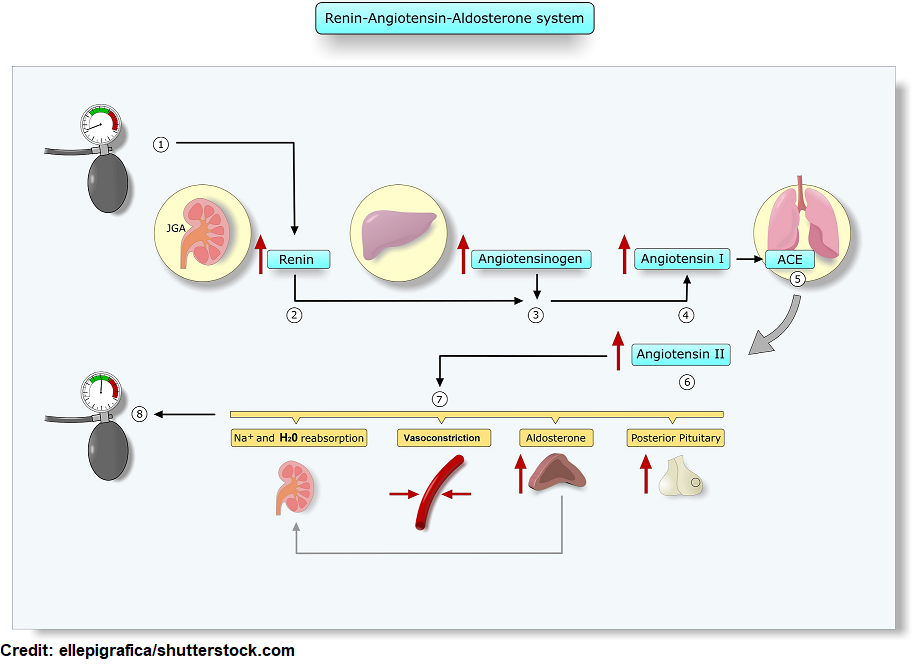
The role of the renin-angiotensin-aldosterone system (RAAS)? To increase the blood pressure when it becomes too low by activating Angiotensin II.

Angiotensin II will cause MAJOR vasoconstriction and help increase the blood volume by causing the kidneys to conserve sodium and water and triggers the release of aldosterone and ADH (antidiuretic hormone).

How the RAAS Works (step-by-step):
raas quiz, renin angiotensin, aldosterone, nclex, nursing

  1. Blood pressure drops too low ->
  2. Sympathetic Nervous System (fight or flight system) is stimulated and sends nerve impulses to Juxtaglomerular Cells in the kidneys to release RENIN ->
  3. With RENIN present in the circulation it will activate a substance in the liver called ANGIOTENSINOGEN. This causes angiotensinogen to turn into…
  4. ANGIOTENSIN I: With this substance present in the vessels it will cause ACE to become involved…
  5. ACE stands for Angiotensin-Converting Enzyme. ACE (just as it name says) will convert Angiotensin I into…
  6. ANGIOTENSIN II: Now the end result of the RAAS has occurred…it just activated Angiotensin II, which will cause:
    1. Vasoconstriction: both venous and arterial vessels will constrict. This will INCREASE systemic vascular resistance (SVR) and blood pressure.
    2. Increase Blood Volume: How???
      1. Kidneys will keep water and sodium
      2. Adrenal cortex gland will be triggered by angiotensin II to release aldosterone. Aldosterone will also cause the kidneys to keep sodium and water and excrete potassium.
      3. Pituitary gland will be triggered by angiotensin II to released ADH (antidiuretic hormone. ADH will cause the kidneys to keep water.
  1. End Result: increased blood pressure

Note: How would ACE Inhibitors work to decrease the blood pressure? It would inhibit ACE from converting angiotensin I to angiotensin II. Therefore, step 5, as demonstrated above would not happen.

References

Fountain JH, Lappin SL. Physiology, Renin Angiotensin System. [Updated 2019 May 5]. In: StatPearls [Internet]. Treasure Island (FL): StatPearls Publishing; 2019 Jan-. Available from: https://www.ncbi.nlm.nih.gov/books/NBK470410/

Please Share:

  • Print (Opens in new window) Print
  • Share on Facebook (Opens in new window) Facebook
  • Share on X (Opens in new window) X
  • Share on Pinterest (Opens in new window) Pinterest
  • More
  • Share on Reddit (Opens in new window) Reddit
  • Share on LinkedIn (Opens in new window) LinkedIn
  • Share on WhatsApp (Opens in new window) WhatsApp
  • Share on Telegram (Opens in new window) Telegram

Nursing Notes

Nursing School Bundles Notes by Nurse Sarah

RSS Latest YouTube Videos

  • Blood Draw (Phlebotomy Venipuncture Procedure) Butterfly Needle Made Simple #shorts
  • How to Draw Blood for Labs Nursing: Phlebotomy Venipuncture Blood Collection Butterfly Needle
  • Manual Blood Pressure Practice with Korotkoff Sounds #shorts
  • NCLEX Review Question: Infection and Safety Control (Fall Risk) #shorts

Recent Posts

  • Order of Draw Phlebotomy Quiz Questions
  • Insulin Types Explained: Onset, Peak, Duration (Ultra-Rapid, Rapid, Short, Long-Acting)
  • NCLEX Practice Questions: Infection Control and Safety
  • Female Pelvic Types: Gynecoid, Android, Anthropoid, Platypelloid
  • Insulin Types Quiz for Nursing Students (Onset, Peak, Duration, Mixing & IV Use)

Disclosure and Privacy Policy

This website provides entertainment value only, not medical advice or nursing protocols. We strive for 100% accuracy, but nursing procedures and state laws are constantly changing. By accessing any content on this site or its related media channels, you agree never to hold us liable for damages, harm, loss, or misinformation. See our full disclosure and privacy policy.

Important Links

  • Advertise
  • Contact Us

Follow Us on Social Media

  • Facebook Nursing
  • Instagram Nursing
  • TikTok Nurse
  • Twitter Nursing
  • YouTube Nursing

Copyright Notice

All images, articles, text, videos, and other content found on this website are protected by copyright law and are the intellectual property of RegisteredNurseRN.com or their respective owners.

Copyright © 2026 RegisteredNurseRN.com. All Rights Reserved.