Before removing a Foley catheter, it is crucial to explain to the patient the steps involved in the process and reassure them that it is a simple procedure compared to the Foley catheter insertion.
After confirming the doctor’s order for removal and ensuring the patient’s rights, gather all necessary supplies, including:
- Syringe to deflate the catheter balloon
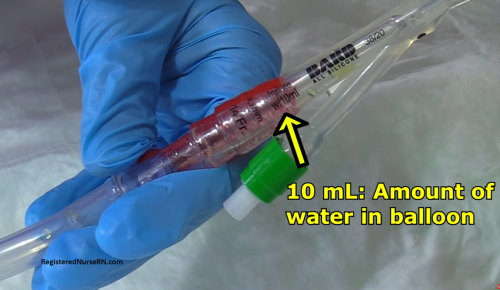
- Confirm how much water is in the catheter balloon. This is found on the catheter balloon installation port. Select the correct sized syringe based on the amount of fluid in the catheter balloon.
- Several pairs of clean gloves
- Soap and water
- Washcloths and towels
- Waterproof pad
- Graduated cylinder: used to measure urine output in the catheter drainage bag before removal
- Alcohol prep pads: to remove the stat-lock securement device
- Measuring “hat” for the toilet to measure future voids
Before Catheter Removal:
Perform hand hygiene and don a clean pair of gloves.
Empty the Foley bag
First, let gravity take any urine in the drainage tubing down into the catheter bag so this amount is included in the urine output.
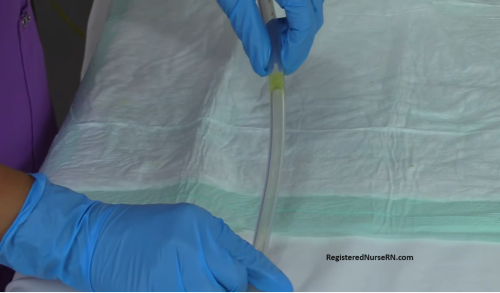
Then, open the catheter drainage bag and allow urine to drain down into a graduated cylinder.

Measure all the urine in a graduated cylinder and record it in the output section in the patient’s electronic health record.
Remove the gloves and perform hand hygiene. Don a new pair of gloves.
Provide peri-care and catheter care before removal:
- Remove the securement device using alcohol prep pads
- Clean labia and catheter with water and soap. Rinse and then dry.
Removal of Catheter
Connect the syringe to the balloon port and let the water remove itself from the balloon until it reaches the desired amount. This amount removed should match the amount of water the manufacturer recommends for the balloon. NOTE: This amount can vary. Some catheters can have as little as 5 cc of water in the balloon, while some may have 20 cc or more. During removal of the water, it is not recommended to pull back on the syringe to help the balloon deflate. This could change the shape of the balloon and cause damage to the urethra as the misshaped balloon is removed from the bladder.

Disconnect the syringe and remove the catheter in one continuous motion while the patient breathes in and out (remove on exhale).
Inspect the catheter for any break of integrity, including the balloon, and look for any weird growth or drainage.
If necessary, notify the doctor and send the catheter to the lab for a culture.
Wrap up the catheter in the waterproof pad and dispose of it per facility’s protocols.
Assist the patient with peri-care again and doff gloves and perform hand hygiene.
Document and note the time the catheter was removed.
Patient Education
As a nurse, it’s important to educate your patients on the proper procedure for voiding. Follow these steps to ensure the best possible outcome for your patients:
- First, instruct the patient to inform you before voiding so you can assist the patient.
- Inform the patient that they should void within the next six hours (check with your facility’s protocol for this time frame). If they are unable to do so, report it to the physician immediately.
- Encourage the patient to get up and try to void within an hour to three hours after the procedure.
- The void should be a complete stream, not just a dribble of urine.
- If the patient is unable to void within the allotted time, notify the physician and perform a bladder scan to check for any residual urine.
- For the first void, use a measuring hat to measure the output of urine. Record this information in your nursing notes and output section in the electronic health record, along with the color and any odor present.
- Explain to the patient that the bladder and urethra may be irritated, leading to some discomfort while urinating. However, this should decrease after a few voids.
- Inform the patient that they may experience frequent urges to urinate, as well as some incontinence and difficulty starting a stream initially. These symptoms should improve with time.
- Advise the patient to report any abnormal symptoms, such as a fever, an inability to void, excessive bleeding, or unusual urine color or odor, immediately.
- Encourage the patient to drink at least one cup of water every two hours while awake to help flush out the bladder, and avoid bladder irritants like caffeine.
References:
Bard Medical. (2016). SureStep Post Insertion Foley Catheter Care. Covington, Georgia; C.R. Bard Inc.
Lynn, P. (2014). Unit II Chapter 7 Promoting Healthy Physiologic Responses. In Skill checklists for Taylor’s clinical nursing skills : a nursing process approach (4th ed., pp. 358–359). essay, Wolters Kluwer.
Perry, A. G., Ostendorf , W., & Laplante , N. (2022). Chapter 18 Personal Hygiene and Bed Making . In P. A. Potter (Ed.), Clinical nursing skills & techniques (10th ed., pp. 528–529). essay, Elsevier.
Statlock Information Guide. Bardmedical.com. Accessed August 1, 2023. Information Guide. http://media.bardmedical.com/media/1680/statlock-information-guide.pdf