Premature atrial contractions (PACs) are early heartbeats that originate from a focal point in the atria, rather than the sinoatrial (SA) node. These early beats cause the atria to contract prematurely. PACs are sometimes referred to as “PACs,” and they can be seen in a variety of rhythm patterns.
After reviewing this material, don’t forget to take the premature atrial contractions quiz that will test you on this material and to watch the lecture on PACs.
Identifying PACs
In a rhythm strip, PACs often appear as early P waves that look different from the regular, underlying P waves. Initially, there may be a normal sinus beat, followed by a premature beat. After these PACs, a brief pause may be noted before the rhythm resumes. This early P wave is usually different in shape or size compared to the normal P waves in the underlying rhythm.
PACs can be classified as either conducted or non-conducted. In conducted PACs, the early P wave is followed by a QRS complex, indicating that the electrical signal reached the ventricles and depolarized them. In non-conducted PACs, the P wave is not followed by a QRS complex, suggesting that the electrical signal did not reach the ventricles, possibly due to a block.
Characteristics of PACs
When observing PACs, the following characteristics are important:

- Irregular rhythm: The rhythm becomes irregular due to the PACs, but the underlying rhythm typically remains regular.
- Early P waves: The P waves of the PAC will differ in shape and size from the regular P waves in the underlying rhythm.
- QRS complex: The QRS complex is usually normal (less than 0.12 seconds), but may be missing if the PAC is non-conducted.
- PR interval: The PR interval may vary due to the PAC, as the premature P wave alters the timing of the electrical signal.
- QT interval: The QT interval may vary but is often normal.
- T-wave variation: The T wave may vary due to changes in ventricular repolarization after the PAC.
Causes of PACs
PACs can be caused by a variety of factors, including:
- Atrial enlargement, particularly of the left atrium
- Tobacco use and regular stimulant use, such as caffeine
- Inflammation of the atrial tissue
- Electrolyte imbalances, especially low potassium and magnesium levels
- Stress can also contribute to the occurrence of PACs
ECG/EKG Study Guide and Workbook for Nursing Students
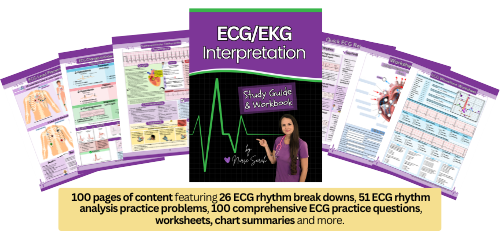
“ECG/EKG Interpretation Study Guide and Workbook by Nurse Sarah”. This book contain 100 pages of content featuring 26 ECG rhythm break downs, 51 ECG rhythm analysis practice problems, 100 comprehensive ECG practice questions, worksheets, chart summaries, and more.
You can get an eBook version here: “Nurse Sarah ECG Book” or a physical copy here: “ECG/EKG Interpretation Study Guide by Nurse Sarah“.
Symptoms and Treatment of PACs
PACs are often asymptomatic, and many patients may not be aware that they are having them, especially if they are infrequent. However, when PACs are frequent, patients may experience symptoms like palpitations or a fluttering sensation in the chest.
PACs can occur in patterns such as bigeminy (every other beat) or trigeminy (every third beat). The rhythm shown earlier was atrial bigeminy, where the rhythm alternates between normal sinus beats and PACs.
If PACs become frequent or if abnormal patterns are noted, further investigation may be necessary to rule out underlying heart conditions. Close monitoring of the rhythm is essential, and in some cases, medications such as beta-blockers and calcium channel blockers may be prescribed.
In addition to medication, it is important to address modifiable risk factors to prevent PACs. These include:
- Smoking cessation
- Limiting alcohol intake
- Staying hydrated
- Avoiding caffeine
- Managing stress
- Maintaining a healthy diet to help prevent electrolyte disturbances like low potassium and magnesium levels.
Conclusion
While PACs are often benign and asymptomatic, they can lead to discomfort in some patients. Identifying the cause and addressing any modifiable risk factors can help reduce their occurrence. In some cases, close monitoring and medication may be necessary, especially if PACs become frequent or irregular.
You may be interested in: Premature Atrial Contractions Quiz
References:
Amerman, E. C., & Irintcheva, V. (2016). Chapter 17 The Cardiovascular System I: The Heart. In Human Anatomy and Physiology (p. 636).
American Heart Association. (n.d.). Premature contractions (PACs and PVCs). Retrieved June 26, 2024, from https://www.heart.org/en/health-topics/arrhythmia/about-arrhythmia/premature-contractions-pacs-and-pvcs