Registered Nurse RN

Registered Nurse, Free Care Plans, Free NCLEX Review, Nurse Salary, and much more. Join the nursing revolution.

  • RN
    • Nursing Clinical Skills
  • Nursing Videos
  • Blog
  • Nursing School
  • Nursing Care Plans
  • Nursing Quizzes
  • Nursing
  • Nursing Jobs
  • NCLEX Review
  • Store

Osmosis and Osmolarity Explained

Understanding osmosis and osmolarity can help you understand how IV fluids can be useful in healthcare. Let’s take a look at some of the key concepts of osmosis and osmolarity.

Osmosis and Osmolarity

  • A passive type of water transport
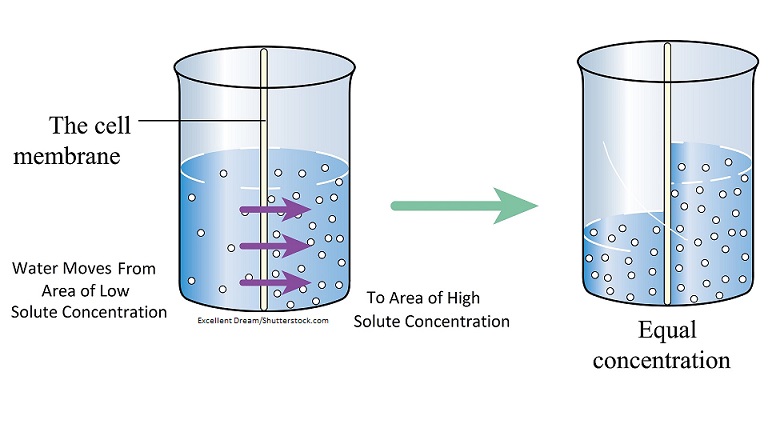
  • Water molecules move through a semi-permeable membrane that only allows water through.
osmosis, solutes, osmolarity, iv fluid types, hypertonic solutions, hypotonic, isotonic, nursing, iv fluid types nursing

Look at osmosis these two ways:

Water will move from a fluid of a higher water concentration to a fluid of lower water concentration.

OR

Water will move from a lower solute concentration fluid to a higher solute concentration fluid.

Simplified: Water is drawn to the fluid that has the MOST solutes.  

What is a solute?

A solute is a solid dissolved in a liquid.

Many substances can be a solute. For example, sodium and chloride are solutes in a bag of IV fluids. They are also considered electrolytes in this form.

The liquid or the solution that contains the solutes is known as the solvent.

Osmosis is influenced by how concentrated a fluid is of solutes, hence its osmolarity.

Osmolarity

Osmolarity is the total concentration of solutes in a solution (per liter).  

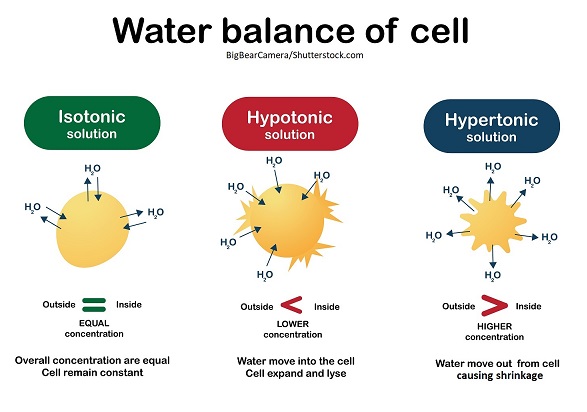
IV fluids can have an equal, high, or low osmolarity when compared to the blood plasma.
isotonic, hypotonic, hypertonic, iv fluids, iv fluid types, osmolarity, osmosis, water balance, iv solutions,

High osmolarity = high amount of solutes in a solution but low amount of water

Example: hypertonic solutions

Low osmolarity = low amount of solutes in a solution but high amount of water

Example: hypotonic solutions

Connecting the dots:

We can use the principles of osmosis and osmolarity to help treat patients who need fluids replaced based on what fluid compartment needs to be treated by shifting fluids around. This can be done by administering various types of IV fluids that have different osmolarities or solute concentrations, which will move water in or out of these fluid compartments.

Please Share:

  • Print (Opens in new window) Print
  • Share on Facebook (Opens in new window) Facebook
  • Share on X (Opens in new window) X
  • Share on Pinterest (Opens in new window) Pinterest
  • More
  • Share on Reddit (Opens in new window) Reddit
  • Share on LinkedIn (Opens in new window) LinkedIn
  • Share on WhatsApp (Opens in new window) WhatsApp
  • Share on Telegram (Opens in new window) Telegram

Nursing Notes

Nursing School Bundles Notes by Nurse Sarah

RSS Latest YouTube Videos

  • Nursing School Graduation Spring 2026: Congratulations!!
  • Top Blood Draw Mistakes Nurses & Phlebotomists Make
  • ECG EKG Interpretation Study Guide & Workbook for Nursing School Students
  • Blood Pressure Practice with Answers: Clinical Skills Checkoff #nursing

Recent Posts

  • Hegar’s Sign (Early Pregnancy) Nursing Maternity Review
  • Goodell’s Sign (Early Pregnancy) Nursing Maternity Review
  • Chadwick’s Sign (Early Pregnancy) Nursing Maternity Review
  • Herpes Simplex Virus (HSV) STI Nursing NCLEX Review
  • STI/STD NCLEX Review Questions – COMPREHENSIVE

Disclosure and Privacy Policy

This website provides entertainment value only, not medical advice or nursing protocols. We strive for 100% accuracy, but nursing procedures and state laws are constantly changing. By accessing any content on this site or its related media channels, you agree never to hold us liable for damages, harm, loss, or misinformation. See our full disclosure and privacy policy.

Important Links

  • Advertise
  • Contact Us

Follow Us on Social Media

  • Facebook Nursing
  • Instagram Nursing
  • TikTok Nurse
  • Twitter Nursing
  • YouTube Nursing

Copyright Notice

All images, articles, text, videos, and other content found on this website are protected by copyright law and are the intellectual property of RegisteredNurseRN.com or their respective owners.

Copyright © 2026 RegisteredNurseRN.com. All Rights Reserved.