Studying hyperkalemia and want to know how to remember hyperkalemia and how it is different from hypokalemia?
In this article, I want to give you some super easy ways on how to remember the causes of hyperkalemia, signs and symptoms, and the nursing interventions for this condition. I want to highlight the material you will be tested on in lecture class or the NCLEX exam.
After you read these notes, be sure to take the quiz on hypokalemia and hyperkalemia.
Nurse Sarah’s Notes and Merch
Just released is “Fluid and Electrolytes Notes, Mnemonics, and Quizzes by Nurse Sarah“. These notes contain 84 pages of Nurse Sarah’s illustrated, fun notes with mnemonics, worksheets, and 130 test questions with rationales.
You can get an eBook version here or a physical copy of the book here.
Video Teaching Tutorial on Hyperkalemia
Don’t forget to subscribe to my YouTube channel for more free teaching videos:
Hyperkalemia
You will learn the following:
- Causes (easy mnemonics to remember it)
Signs & Symptoms (tricks on how to easily remember)
Nursing Intervention…things that NCLEX and lecture exams look for
Hyper= excessive
Kal= root word for potassium
Emia=blood
Meaning of hyperkalemia: excessive potassium in the blood
Normal Potassium is 3.5 to 5.1. Anything higher 7.0 or higher is very dangerous!
Most of the body’s potassium is found in the intracellular part of the cell compared to the extracellular which is where sodium is mainly found. Blood tests that measure potassium levels are measuring the potassium outside of the cell in the extracellular fluid.
Remember that potassium is responsible for nerve impulse conduction and muscle contraction.
Causes of Hyperkalemia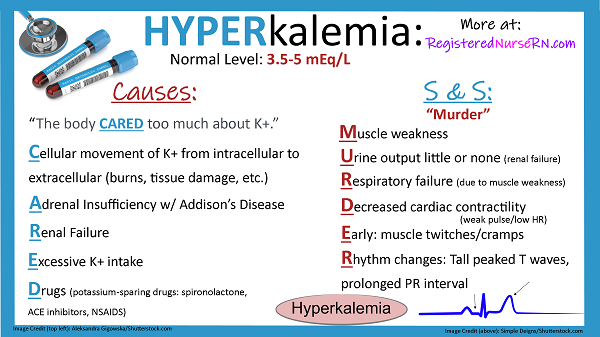
Remember the phrase “The Body CARED too much about Potassium”
Cellular Movement of Potassium from Intracellular to extracellular (burns, tissue damages, acidosis)
Adrenal Insufficiency with Addison’s Disease
Renal Failure
Excessive Potassium intake
Drugs (potassium-sparing drugs: spironolactone), Triamterene, ACE inhibitors, NSAIDS)
Signs & Symptoms of Hyperkalemia
Remember the word MURDER
Muscle weakness
Urine production little or none (renal failure)
Respiratory failure (due to the decreased ability to use breathing muscles or seizures develop)
Decreased cardiac contractility (weak pulse, low blood pressure)
Early signs of muscle twitches/cramps…late profound weakness, flaccid
Rhythm changes: Tall peaked T waves, flat p waves, Widened QRS and prolonged PR interval

Nursing Interventions for Hyperkalemia
- Monitor cardiac, respiratory, neuromuscular, renal, and GI status
- Stop IV potassium if running and hold any PO potassium supplements
- Initiate potassium restricted diet and remember foods that are high in potassium
- Remember the word POTASSIUM for food rich in potassium
Potatoes, pork
Oranges
Tomatoes
Avocados
Strawberries,
Spinach
fIsh
mUshrooms
Musk Melons: cantaloupe
Also included are carrots, cantaloupe, raisins, bananas.
-
- Prepare patient for ready for dialysis. Most patient are renal patients who get dialysis regularly and will have high potassium.
- Kayexalate is sometimes ordered and given PO or via enema. This drug promotes GI sodium absorption which causes potassium excretion.
- Doctor may order potassium wasting drugs like Lasix or Hydrochlorothiazide
- Administer a hypertonic solution of glucose and regular insulin to pull the potassium into the cell
Don’t forget to take the Hyperkalemia Quiz